
I. Introduction: Why Does RIF Deserve a Dedicated Prediction Article?
In the crypto market, RIF is an established infrastructure token that is easily overlooked. It doesn’t burst out of its niche based on community sentiment like meme assets such as SHIB, nor does it have an easily understood ecosystem narrative like public chain assets such as AVAX, and it isn't directly tied to a Web3 wallet gateway like TWT. The core logic of RIF is unique: it bets on Bitcoin ecosystem infrastructure.
RIF stands for Rootstock Infrastructure Framework, and it has a very tight relationship with Rootstock (formerly known as RSK). Rootstock is an EVM-compatible Bitcoin sidechain secured by the Bitcoin network, aimed at allowing developers to build smart contracts and DeFi applications on top of the Bitcoin ecosystem. Rootstock officially positions itself as a "Bitcoin sidechain backed by Bitcoin security," emphasizing its EVM compatibility and support for infrastructure like developer tools, oracles, and indexers.
RIF, on the other hand, acts as the infrastructure token within the Rootstock ecosystem. According to official introductions, RIF was created to make it easier for developers to build applications on Rootstock, focusing on infrastructure services such as bridges, domain name resolution, payments, data feeds, and Bitcoin DeFi wallets.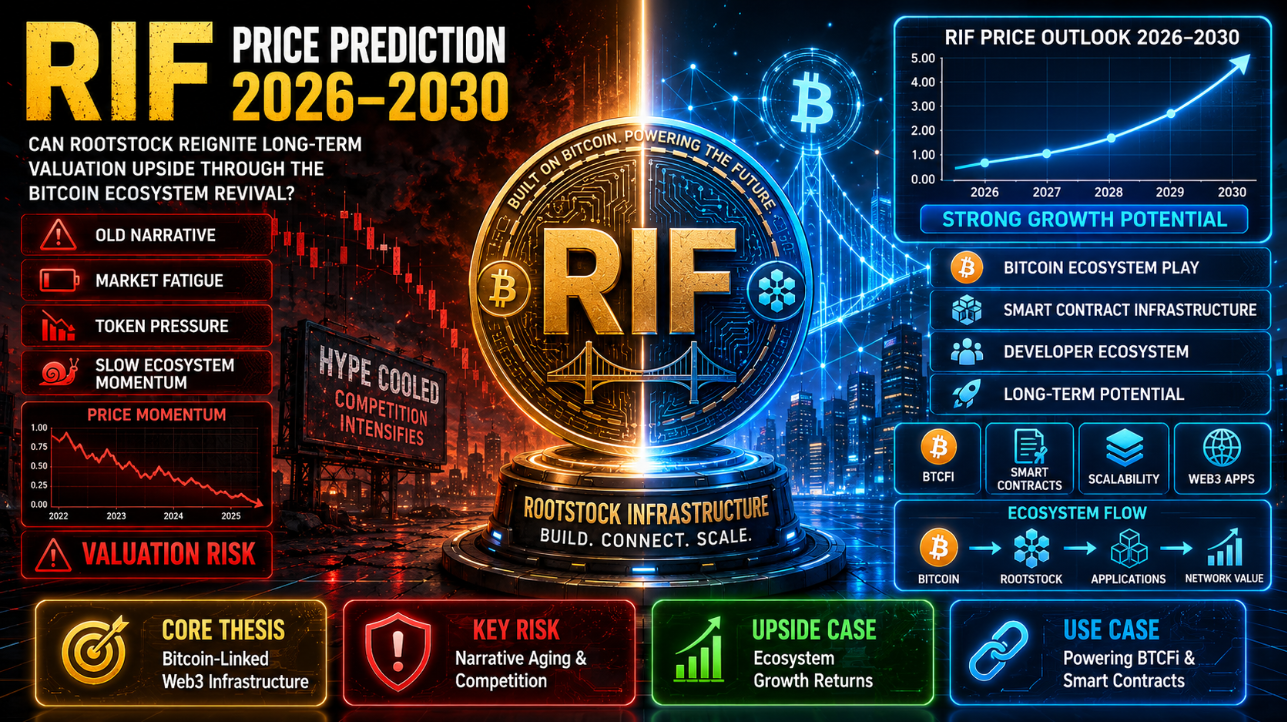
Therefore, evaluating RIF cannot rely solely on looking at candlestick charts. It fundamentally depends on three questions:
- Will the Bitcoin ecosystem continue to expand from a "store of value" into DeFi, payments, stablecoins, lending, and the application layer?
- Can Rootstock maintain its relevance among numerous Bitcoin Layer 2s, sidechains, and BTCFi solutions?
- Can the RIF token capture real demand from the growth of the Rootstock ecosystem, rather than just remaining stuck with the label of an "old infrastructure token"?
As of May 2026, CoinMarketCap shows the price of RIF floating around $0.06–$0.07, with a circulating supply and maximum supply both at 1 billion tokens, putting its market cap around the $60 million level. This indicates that while RIF is no longer a micro-cap in its absolute infancy, it is still far from entering the ranks of mainstream assets.
This article is not meant to simply pull a random number out of thin air—like "how many dollars it will hit in 2030." Instead, it uses fundamentals, Bitcoin ecosystem cycles, Rootstock on-chain data, the competitive landscape, and risk parameters to deduce several possible paths for RIF from 2026 to 2030.
II. What Exactly is RIF? Understanding the Project to Understand Its Price
2.1 What is the Relationship Between RIF and Rootstock?
To understand it in one sentence: Rootstock is the smart contract sidechain within the Bitcoin ecosystem, while RIF is the token built around Rootstock to provide infrastructure services and ecosystem incentives.
The value proposition of Rootstock is to combine the security of Bitcoin with EVM smart contract capabilities. Bitcoin itself functions more like a store of value and a settlement layer, but its native scripting capabilities are limited, making it difficult to host complex DeFi applications directly. Rootstock attempts to solve this problem by letting developers build applications for the Bitcoin ecosystem within an environment that mimics the Ethereum development experience.
RIF sits closer to the application infrastructure layer. The Rootstock ecosystem requires services like domains, payments, storage, data, wallets, bridging, and developer tools, and RIF is positioned to service these infrastructure modules.
This means that RIF's pricing logic is not "if Bitcoin goes up, RIF will definitely go up." More accurately, for RIF to benefit, the Bitcoin ecosystem needs to expand from simply holding BTC to embracing BTCFi, Bitcoin DeFi, Bitcoin payments, Bitcoin sidechain applications, and developer ecosystems.
2.2 What Services Does RIF Provide?
RIF's early service directions included payments, storage, domains, communication, and data infrastructure. Rootstock-related documentation has mentioned that the RIF token can be used to access payments, storage, and domain services.
From the perspective of an average user, these services can be understood as follows:
- Domain Services solve the issue of "hard-to-remember addresses." Average users cannot copy complex wallet addresses every day. If the Bitcoin ecosystem is to go mainstream, it needs a friendlier naming and identity system.
- Payment Services solve the on-chain transaction experience. The Bitcoin mainnet is better suited for high-value settlements rather than microtransactions. In theory, Rootstock and RIF-related payment infrastructure can empower Bitcoin ecosystem applications with richer payment capabilities.
- Data and Oracle Services solve the issue of applications reading external information. DeFi, lending, stablecoins, and derivatives all require price feeds and other external data sources.
- Wallet and Bridging Services solve asset onboarding and utilization. Users need to bring BTC or other assets into the Rootstock ecosystem to participate in DeFi or other applications.
These directions have genuine market demand, but the problem is that the current scale of the Rootstock ecosystem is not large enough. The value of infrastructure must ultimately be verified by real users, real TVL, real transaction volume, and real protocol revenue.
2.3 Is a "Bitcoin Sidechain" an Advantage or a Limitation?
This is one of the most critical questions facing RIF.
- The advantage lies in the fact that Bitcoin is the strongest asset and the strongest consensus in the entire crypto market. Any infrastructure that can turn BTC from a "static holding" into something "usable for financial applications" holds massive room for imagination. BTCFi, Bitcoin staking, Bitcoin lending, Bitcoin stablecoins, and Bitcoin Layer 2s are all directions that have continuously captured market attention from 2024 through 2026.
- Rootstock's edge is its long track record, EVM compatibility, deep roots in the Bitcoin ecosystem, and years of battle-tested operation. The official RootstockLabs website notes that Rootstock launched in 2018 with the goal of letting developers and partners build more flexible, real financial applications on top of Bitcoin's security.
- The limitation is that migrating users within the Bitcoin ecosystem is incredibly difficult. Many BTC holders are highly conservative; they prefer to hold BTC long-term rather than bridging their BTC to a sidechain to participate in DeFi. Meanwhile, alternative solutions like Stacks, Lightning Network, Liquid Network, newer Bitcoin Layer 2s, Babylon, Merlin, and BOB are all fighting for market attention.
Therefore, RIF’s long-term ceiling is determined not just by Bitcoin's market cap, but by how much real market share Rootstock can capture from the broader Bitcoin ecosystem.
2.4 RIF Tokenomics: Total and Circulating Supply
RIF has a maximum supply of 1 billion tokens, and CoinMarketCap currently shows its circulating supply at 1 billion tokens as well. CoinGecko similarly indicates that RIF's current circulating supply stands at 1 billion, with a market cap around the $60 million mark.
This presents one major advantage for investors: RIF does not face the massive future unlock pressures seen with newer tokens. It is close to a fully circulating asset, meaning price pressure comes primarily from market selling, insufficient ecosystem growth, and liquidity dynamics, rather than ongoing large-scale token unlocks.
However, full circulation does not guarantee a price increase. The issue for RIF isn't "how much supply is left to release," but rather "can the existing 1 billion RIF tokens be repriced by real demand?"
- If the Rootstock ecosystem expands and RIF plays a stronger role in governance, incentives, payments, and service usage, the price will have long-term structural support.
- If the Rootstock ecosystem grows slowly, RIF may languish long-term in a state of low market cap and low market attention.
III. Five Core Variables Determining RIF's Price
Variable 1: Overall Momentum of the Bitcoin Ecosystem
The most important external variable for RIF is the heat of the Bitcoin ecosystem. When the price of BTC rises, market capital typically flows into BTC first, before spilling over into BTCFi, Bitcoin Layer 2s, Bitcoin sidechains, Inscriptions, Runes, Bitcoin staking, and related infrastructure. As the ecosystem token of Rootstock, RIF stands a chance to benefit from this rotation.
However, this transmission is not automatic.
- If the market focuses exclusively on Bitcoin ETFs, institutional allocations, and spot BTC assets, RIF benefits very little.
- If the market focuses on the Bitcoin application layer, BTCFi, and Bitcoin DeFi, RIF can be repriced much more easily.
- Therefore, RIF rallies often don't trigger the moment BTC pumps; they require the Bitcoin ecosystem narrative to genuinely diffuse down into the infrastructure layer.
Variable 2: Actual Usage of the Rootstock Network
Rootstock's on-chain metrics are core to judging RIF. Current data from DefiLlama shows that the Rootstock ecosystem has roughly $59 million in bridged TVL, a 24-hour DEX trading volume of around $890,000, roughly 198 active addresses over 24 hours, and about 8,628 daily transactions. These numbers show that while Rootstock is not completely abandoned, there remains a massive gap between it and mainstream ecosystems like Ethereum, Solana, Arbitrum, Base, or BNB Chain.
This presents a dual signal for RIF:
- The upside: The current baseline is low. If the BTCFi narrative explodes, Rootstock has immense room to grow.
- The downside: The current ecosystem scale is limited and insufficient to sustain an aggressive valuation.
- To judge if RIF is truly gaining structural strength in the future, keep a close eye on Rootstock’s TVL, stablecoin volume, DEX volume, active addresses, number of DeFi protocols, bridged asset sizes, and developer activity.
Variable 3: The Competitive Landscape
The competition RIF faces is highly complex:
- The Lightning Network focuses more on Bitcoin payments.
- Liquid Network leans toward institutional use and asset issuance.
- Stacks leans closer to Bitcoin smart contracts and a native BTC narrative.
- Emerging projects like Merlin, BOB, and Babylon easily capture the spotlight in newer market cycles.
- Ethereum L2s and the Solana ecosystem continue to absorb a massive chunk of DeFi and application-layer capital.
Rootstock's advantage is its longevity, EVM compatibility, and clear Bitcoin alignment. Its disadvantage is that its market hype lags behind shiny new projects, and its ecosystem growth rate has been relatively modest. For RIF to reclaim a premium valuation between 2026 and 2030, it must prove that it isn't just an "old legacy BTCFi project," but one capable of defending real market share in the new era of Bitcoin ecosystem competition.
Variable 4: Team Execution and Ecosystem Advancement
RIF and Rootstock have long been pushed forward by entities like IOVlabs and RootstockLabs. RootstockLabs has publicly emphasized its goal to let Bitcoin back a more open, accessible financial system, positioning Rootstock as the "Bitcoin Finance Layer."
For investors, whether the team remains active and whether the ecosystem continues to hit milestones is vital. Rootstock is not a new project; it needs to prove long-term execution rather than relying on novelty to attract capital. Over the next few years, monitor:
- Whether new DeFi protocols migrate to Rootstock;
- Whether the Rootstock Collective successfully incentivizes developers;
- Whether RIF secures more practical utility use cases;
- Whether the ecosystem funds and DAOs deploy real capital;
- Whether Rootstock can successfully hitch a ride on new BTCFi narratives.
DefiLlama shows that RootstockCollective is a DAO designed to grow the Rootstock ecosystem, with the goal of rewarding Rootstock builders, users, and RIF holders. This indicates that RIF is pivoting toward ecosystem governance and incentives, though actual effectiveness remains to be proven by future data.
Variable 5: Regulatory Environment
The regulatory risk for Bitcoin sidechains is generally lower than that of privacy coins or high-leverage derivatives, but it is not non-existent. If Rootstock primarily services DeFi, stablecoins, lending, and bridging, it will still face regulatory scrutiny aimed at DeFi platforms, cross-chain bridges, stablecoins, and yield-bearing products. This is particularly true if institutional capital enters BTCFi down the road, raising compliance thresholds.
Conversely, the regulatory acceptance of the Bitcoin ecosystem is typically stronger than that of pure altcoin ecosystems. If Rootstock can successfully position itself as institutional-grade Bitcoin financial infrastructure rather than a hub for high-risk speculative applications, it could theoretically benefit from a more mature regulatory landscape over the long run.
IV. Review of RIF's Status in 2025–2026: Seeing the Starting Line Before Predicting
The current starting point for RIF is clear-cut: low unit price, small-to-mid market cap, fully circulating supply, and a real but limited ecosystem on Rootstock.
In terms of price and market cap, RIF sits around $0.06 with a market cap near $60 million. This size implies that if RIF gets repriced by the market, its upward elasticity could be significant; however, it also proves that the market currently does not view Rootstock as a core, leading flagship of BTCFi.
Looking at on-chain data, Rootstock's TVL, active addresses, and DEX volumes remain niche. This means RIF is presently trading on "potential logic" rather than "strong fundamental delivery."
Narrative-wise, the Bitcoin ecosystem is undoubtedly hotter than in previous years. BTCFi, Bitcoin Layer 2s, Bitcoin staking, and Bitcoin DeFi are all attracting capital. However, the hurdle RIF faces is that markets naturally favor new narratives and shiny new tickers. For an established project to command attention again, it requires stronger ecosystem metrics and a much clearer growth narrative.
Predicting RIF cannot simply rely on the idea that "the Bitcoin ecosystem will go up." What truly matters is whether Rootstock can slice off a big enough piece of the BTCFi pie.
V. 2026 RIF Price Prediction: Can the Post-Bitcoin Halving Effect Lift RIF?
The year 2026 represents the continuation phase following the 2024 Bitcoin halving. If the market remains within a risk-on expansionary cycle, capital could continue to spill over from BTC into Bitcoin ecosystem assets. For RIF, the critical question in 2026 is whether it can transition from a "depressed, legacy infrastructure token" into a "beneficiary of the BTCFi renaissance."
- Bearish Scenario: If BTC experiences a noticeable correction, interest in BTCFi cools off, and Rootstock TVL fails to grow, RIF may continue to chop along its lows in the $0.03–$0.07 range. In this case, it’s not that the project failed, but that the market found no new reason to revalue it.
- Neutral Scenario: If BTC remains strong but capital fails to enter Rootstock on a massive scale, RIF could trade within the $0.08–$0.18 range. This trajectory represents a valuation recovery driven primarily by overall market tides and Bitcoin ecosystem sentiment, rather than an explosion in Rootstock's own fundamentals.
- Bullish Scenario: If BTC breaks to new all-time highs, sparking a collective rotation into Bitcoin ecosystem assets, and Rootstock's TVL and transaction volumes surge significantly, RIF could have a shot at testing $0.25–$0.50. Stepping into this zone requires explicit catalysts, such as a major DeFi protocol launching on Rootstock, enhanced utility for the RIF token, or the BTCFi narrative broadening to embrace legacy sidechain projects.
Advice for 2026: For newcomers, 2026 is better suited for "observation + scaling in slowly" rather than chasing green candles. RIF’s liquidity and market attention are lower than mainstream coins; chasing short-term pumps makes it easy to get washed out by volatility.
VI. 2027 RIF Price Prediction: A Crucial Year of Ecosystem Expansion Verification
The year 2027 will serve as a report card year for RIF. If 2026 was merely about drifting upward alongside the broader market, 2027 will find the market asking tough questions: Has the Rootstock ecosystem actually grown? Has TVL scaled? Have active addresses multiplied? Is there real demand for RIF?
If Rootstock's TVL remains stuck in the tens of millions of dollars, it will signal that ecosystem expansion has underperformed expectations. For a project betting on being Bitcoin's financial layer, this will severely cap RIF’s valuation.
- Pessimistic Scenario: RIF could pull back to $0.04–$0.10. This typically occurs if the BTC bull run recedes, the BTCFi narrative weakens, and Rootstock fails to spawn a breakout application.
- Neutral Scenario: RIF could stabilize between $0.10–$0.25. Rootstock makes steady ecosystem progress but fails to achieve mainstream breakout. RIF's price will fluctuate with the wider market but struggle to form an independent, aggressive upward trend.
- Optimistic Scenario: RIF could reach $0.35–$0.80. The prerequisite here is clear growth in Rootstock TVL, an influx of stablecoins and DeFi protocols, and RIF capturing stronger organic demand within DAOs, governance, payments, or infrastructure services.
The biggest risk in 2027 is that the Bitcoin L2 sector might have its mindshare entirely captured by newer projects. If the market fixates solely on new Layer 2s, Bitcoin staking, and novel BTCFi protocols, Rootstock risks being marginalized as an older project. Therefore, the key to holding RIF in 2027 is not just watching whether it bounces, but checking whether those bounces are backed by hard Rootstock data.
VII. 2028 RIF Price Prediction: The Accumulation Phase Ahead of the Next Halving
The year 2028 is expected to approach the next Bitcoin halving cycle. Historically, periods leading up to and following a halving see renewed market focus on BTC and its closely aligned ecosystem assets. As a token tied to BTCFi infrastructure, RIF could see early positioning by savvy market participants.
However, 2028 is also prone to FOMO risks. Many investors buy into high-risk altcoins prematurely on the thesis that "the halving guarantees a pump," only to buy local tops.
- Pessimistic Scenario: If the macro environment is weak in 2028, BTC fails to spark a clear run, and the Rootstock ecosystem experiences sluggish growth, RIF may continue to oscillate between $0.05–$0.12.
- Neutral Scenario: If the market begins pricing in halving expectations early, but the Rootstock ecosystem delivers only modest growth, RIF could trade between $0.15–$0.35.
- Optimistic Scenario: If BTCFi re-emerges as a core market narrative, Rootstock's metrics show clear improvement, and RIF lands back on the market's watchlist, the price could push toward $0.50–$1.00.
The mistake to avoid most when investing in RIF in 2028 is blindly relying on the phrase "Bitcoin halving." A halving can improve market expectations, but it does not automatically send every BTC ecosystem token upward. What truly matters is whether Rootstock has accumulated a sufficient base of users and applications before the halving arrives.
VIII. 2029–2030 RIF Price Prediction: The Ultimate Vision for Long-Term Holders
By 2029–2030, RIF’s long-term ceiling will depend entirely on whether Rootstock can establish itself as a vital component of Bitcoin's financial layer. If the mainstream adoption of Bitcoin progresses, and institutions alongside retail users want to not only hold BTC but also use it to participate in lending, payments, stablecoins, yields, and on-chain finance, Rootstock stands to benefit. If RIF can cement itself as the critical token for Rootstock ecosystem governance, incentives, payments, and infrastructure services, its long-term valuation ceiling will open up drastically.
- Extremely Pessimistic Scenario: RIF could remain stuck between $0.03–$0.10 long-term. This scenario implies that competition in BTCFi intensifies, Rootstock's market share shrinks, RIF lacks sufficient use cases, and the market writes it off as a legacy, marginalized project.
- Neutral Scenario: RIF could sit between $0.20–$0.60 by 2030. This assumes Rootstock maintains a respectable ecosystem footprint and RIF sees baseline utility demand, though it stops short of becoming the flagship asset of the BTCFi sector.
- Optimistic Scenario: RIF could challenge $1.00–$2.00. The prerequisite here is Rootstock becoming a major infrastructure pillar for Bitcoin DeFi, witnessing significant growth in TVL and active users, and RIF achieving true value capture across ecosystem governance, incentives, and services.
- Extremely Optimistic Scenario: For RIF to discuss prices above $2.00, highly demanding conditions must be met: massive growth in Bitcoin financial applications, Rootstock emerging as one of the premier institutional-grade Bitcoin financial layers, widespread integration of RIF, and the broader crypto market sitting in a powerful structural bull cycle.
Long-term holders must remember: a 2030 target price is not a promise, but a scenario analysis. If Rootstock’s data shows zero growth over the long run, or if the BTCFi market is completely dominated by alternative projects, one should adjust their thesis early rather than blindly clinging to a target price.
IX. Practical Advice for Newcomers: What Should You Do After Reading the Predictions?
What Type of Investor is RIF Suited For?
It is best suited for investors who are willing to deeply research BTCFi, can tolerate high volatility, and are committed to tracking Rootstock's data long-term. It is poorly suited for beginners who want overnight riches, rely solely on price prediction numbers, and have no interest in studying ecosystem metrics.
- If you are a conservative investor, RIF can simply be kept on a watchlist or allocated a negligible percentage of your portfolio.
- If you are a balanced investor, you can treat RIF as a small, observational position within the BTCFi sector.
- If you are an aggressive investor, over-allocating is still discouraged because RIF is not the asset with the highest certainty in the BTC ecosystem.
Dollar-cost averaging (DCA) into RIF is worth considering, but mindless DCA is a trap. A more rational approach is to buy in tranches at low price points while conducting monthly checks on Rootstock’s TVL, active addresses, transaction volumes, ecosystem projects, and RIF-related governance updates.
Exit Strategy Logics
- Your stop-loss logic should not be based purely on price action. What matters more is whether the core fundamentals break down. If Rootstock fails to grow over a prolonged period, RIF’s use cases diminish, the BTCFi market is captured by other projects, or trading volumes continuously dry up, it’s time to re-evaluate the position.
- Your take-profit logic should also be mapped out in advance. If RIF experiences a sharp, short-term spike fueled purely by speculative BTCFi hype, but Rootstock's underlying on-chain metrics fail to show a corresponding improvement, taking profits in tranches is wise. Do not confuse a short-term, sentiment-driven rally with a long-term fundamental breakthrough.
If you want to compare the investment logic of different asset types, you can read these three related analyses:
- The 2030 AVAX Price Prediction is better suited for understanding how public chain infrastructure and multi-chain ecosystems are valued.
- The TWT Price Prediction helps clarify the long-term logic behind Web3 wallet gateway-style tokens.
- The 2030 SHIB Price Prediction offers a perfect point of comparison for meme assets, community consensus, and emotional market cycles.
Looking at RIF alongside these three asset classes reveals that RIF is not a typical public chain coin, nor is it a wallet gateway token, and it is certainly not a meme coin. It is a low-market-cap, high-risk asset tied intimately to Bitcoin ecosystem infrastructure.
X. Conclusion: The Boundaries of Prediction and the Essence of Investing
Every price prediction has a high probability of being wrong. This is especially true for small-to-mid-cap infrastructure tokens like RIF, which are simultaneously influenced by the BTC cycle, the Rootstock ecosystem, the broader BTCFi narrative, competitive dynamics, exchange liquidity, and general market sentiment. A shift in any single variable can invalidate a prediction.
The core thesis for investing in RIF shouldn't be a simple belief that "it will go up." It must be rooted in the belief that:
- The Bitcoin ecosystem will successfully expand into the application layer;
- Rootstock will secure and hold an important seat in the BTCFi race;
- RIF will capture real demand and value from Rootstock’s ecosystem growth.
If all three conditions hold true, RIF stands a genuine chance at a major valuation repricing between 2026 and 2030.
- If only the first condition holds, but Rootstock fails to capture market share, RIF won't necessarily benefit.
- If Rootstock secures decent usage, but the RIF token fails to adequately capture that value, the price could remain structurally weak.
- If the BTCFi narrative fades altogether, RIF will slide right back into obscurity.
My Ultimate Assessment:
- In 2026: RIF has an opportunity to experience a valuation recovery alongside the Bitcoin ecosystem.
- In 2027: The key will be verifying whether Rootstock's data confirms real growth.
- In 2028: Halving expectations could offer positioning opportunities, though the risk of chasing tops remains high.
- In 2029–2030: RIF's long-term ceiling hinges on whether Rootstock can become an indispensable core infrastructure piece of the Bitcoin financial layer.
For everyday investors, RIF is worth researching and observing with a small position, but it is not an asset to blindly load up on. The mature approach is to continuously track Rootstock’s TVL, active addresses, DEX volumes, RIF use cases, RootstockCollective incentive performance, and changes in the competitive BTCFi landscape.
Price is merely the symptom; ecosystem growth is the cause.
FAQ: Frequently Asked Questions Regarding RIF Price Prediction 2026–2030
What kind of coin is RIF? RIF stands for Rootstock Infrastructure Framework. It is a token focused heavily on providing infrastructure services within the Rootstock ecosystem. RIF's official documentation notes its goal is to make it easier for developers to build applications on Rootstock, touching on infrastructure like bridges, domain resolution, payments, data feeds, and Bitcoin DeFi wallets.
What is the relationship between RIF and Rootstock? Rootstock is a Bitcoin sidechain and an EVM-compatible smart contract platform, while RIF is the token utilized for infrastructure services and governance incentives built around the Rootstock ecosystem. Rootstock acts as the underlying layer, whereas RIF functions as the application infrastructure and ecosystem token.
What is the maximum supply of RIF? According to CoinMarketCap, RIF has a circulating supply of 1 billion tokens, and its maximum supply is capped at exactly 1 billion tokens as well.
Can RIF hit $1 by 2030? It has a chance, but this should not be treated as a default expectation. For RIF to clear the $1 mark, Rootstock needs to capture significant market share within the BTCFi sector, driving robust growth in TVL and active users, while RIF expands its utility use cases during a powerful market bull cycle. If Rootstock's ecosystem growth remains slow, reaching $1 will be exceptionally difficult.
What is the biggest risk for RIF? The single biggest risk for RIF is that the Rootstock ecosystem grows slower than expected. Currently, Rootstock’s on-chain data remains modest. DefiLlama data shows that its active addresses, DEX volumes, and TVL lag far behind mainstream ecosystems. If BTCFi capital chooses to flow toward alternative projects instead, RIF risks long-term marginalization.
Is RIF suitable for beginners? Beginners can use it as a learning case study or monitor it with a tiny position, but heavy positioning is highly discouraged. RIF is a small-to-mid-cap infrastructure token characterized by high volatility and relatively thin liquidity, and it relies heavily on the health of the Rootstock ecosystem. It is far better suited for individuals who can consistently track BTCFi and Rootstock metrics.
Kindly Reminder > The contents of this article are intended strictly for educational and research purposes and do not constitute any form of investment advice. Cryptocurrency prices are highly volatile; as a small-to-mid-cap infrastructure token, RIF is capable of pumping rapidly during bull markets, just as it is prone to prolonged stagnation if ecosystem metrics disappoint.
Do not assume that simply because RIF is tied to the Bitcoin ecosystem, it is guaranteed to move in lockstep with BTC. BTC is a foundational, core asset; RIF is a high-risk infrastructure token within the Bitcoin ecosystem. The risk profiles of the two are completely distinct.
Prior to investing, please manage your position sizing, avoid leverage, enter in tranches, and consistently track official Rootstock announcements, DefiLlama data, RootstockCollective updates, RIF ecosystem developments, and the competitive landscape of the BTCFi sector. What ultimately dictates RIF’s long-term value is not a set of predicted numbers, but whether Rootstock can successfully convert the financial demands of the Bitcoin ecosystem into real, on-chain usage.