
1. Introduction: Is AXS Still Worth Watching? From "Play-to-Earn Myth" to the Real Situation in 2026
If we were to list the most emblematic bubble symbols of the 2021 crypto market, AXS would definitely be on the list.
Axie Infinity was once the undisputed king of the entire GameFi sector. It wasn't just a blockchain game project; it was the representative case that pushed "Play-to-Earn" onto the global stage. In Southeast Asian markets like the Philippines, Vietnam, and Indonesia, Axie Infinity was once packaged as a new form of income generation: "play to earn." A massive number of users bought Axie NFTs, engaged in battles, earned SLP rewards, and AXS, as the governance and value-capture token, was wildly pursued by the market.
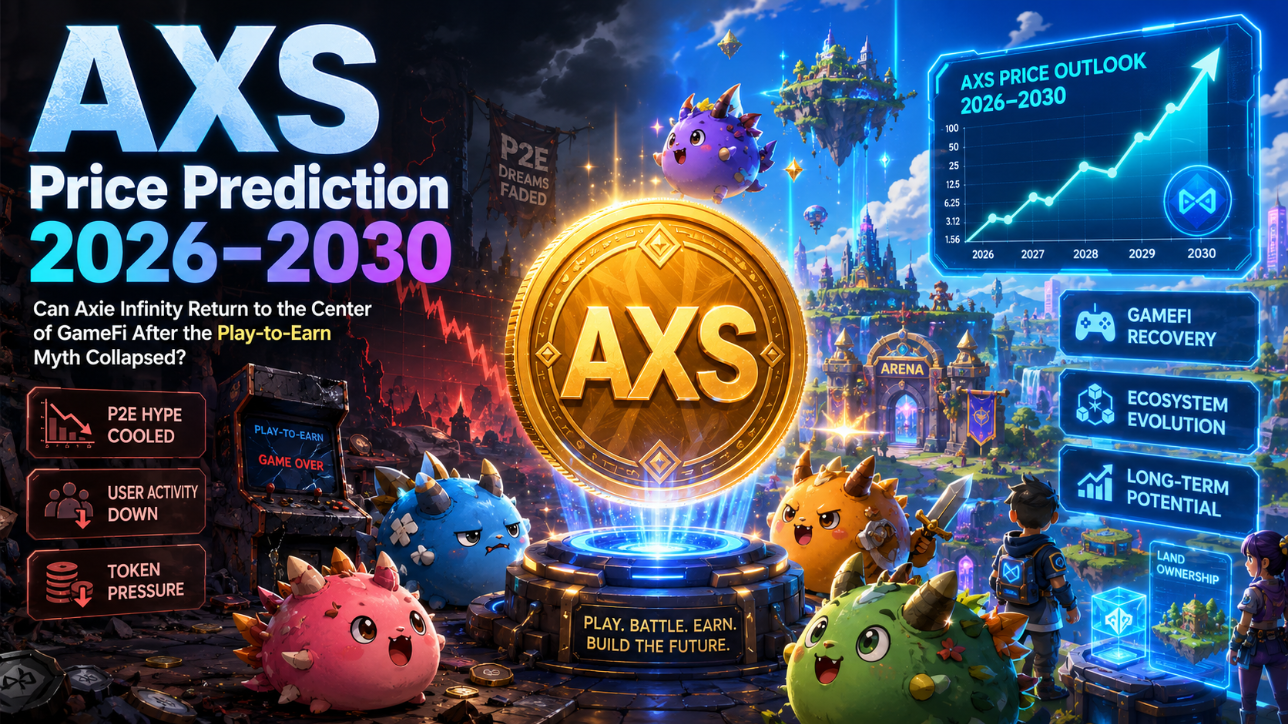
At the peak of the 2021 bull market, the AXS price once surged above $160. At that time, the market believed that gaming was not just entertainment; in the future, players could own assets, earn income, participate in governance, and blockchain games would become the next super gateway for the crypto market.
But everyone knows what happened next.
As new user growth slowed, SLP inflation spiraled out of control, and Axie's economic model became unbalanced, the Play-to-Earn model exposed serious flaws. After 2022, AXS fell from its pedestal, and its price remained low for a long time. The Ronin Bridge hack also dealt a huge blow to the project's credibility. In 2022, the Ronin network was hacked for approximately $625 million, one of the most severe hacks in crypto history; subsequently, Sky Mavis raised $150 million to compensate affected users.
So, looking at AXS again in 2026, the real question is not "It once rose to $160, so will it go back?", but rather:
Can Axie Infinity transform from a P2E bubble project into a truly sustainable Web3 gaming ecosystem?
This article will systematically analyze the possible trajectory of AXS over the next five years from several perspectives: AXS fundamentals, supply pressure, the Ronin ecosystem, GameFi 2.0, regulatory risks, competitive landscape, and price predictions for 2026–2030.
2. The Underlying Logic of AXS Price Drivers: Newcomers Must First Understand This Framework
2.1 Where Does Demand for AXS Come From?
AXS stands for Axie Infinity Shards, the core token of the Axie Infinity ecosystem. According to the official Axie whitepaper, AXS is primarily used for staking, governance, and future decisions related to the community treasury. The official documentation also clearly states that staking AXS is a way to reward long-term holders, and in the future, stakers can participate in community treasury governance.
Demand for AXS generally comes from four directions.
First, governance demand. AXS holders can theoretically participate in ecosystem governance, including how the community treasury is used, how ecological incentives are distributed, and how the game economy is adjusted. However, from an investment perspective, governance demand is rarely sufficient to directly support prices unless governance rights are tied to real cash flow or strong resource allocation power.
Second, staking demand. AXS can be staked to earn rewards. Staking reduces the short-term circulating supply, providing some price support. However, the problem is: if staking rewards primarily come from new token issuance rather than real ecosystem revenue, then this income essentially creates future selling pressure.
Third, in-game economic demand. In the Axie ecosystem, AXS was previously related to breeding, game assets, and ecological incentives. It's important to note that AXS is not an ordinary in-game currency; it's more like an ecosystem governance and value-capture token. The real high-frequency utility token for gameplay rewards used to be SLP. Therefore, the AXS price will not automatically rise simply because there are many players; it also depends on whether those players bring real consumption, fees, and asset trading.
Fourth, investment and narrative demand. This has historically been the strongest price driver for AXS. The surge in AXS in 2021 was not just because the Axie game was fun, but because the market believed P2E would transform the global gaming industry. After 2026, if GameFi 2.0, on-chain asset ownership, and Ronin ecosystem expansion become market hotspots again, AXS could still be repriced by capital.
But let's be clear: AXS is not a pure gaming token; it is a leading GameFi asset with historical baggage. Its advantages are high name recognition, deep ecosystem history, and a foundational Ronin network. Its disadvantages are the massive 2021 bubble, deep loss memories among old users, and a P2E model that has already been questioned by the market.
2.2 How Dangerous is AXS Supply?
The maximum supply of AXS is 270 million tokens, which is reflected in multiple data sources. Public information shows that the total supply cap of AXS is 270,000,000 tokens, with supply allocations including staking rewards, ecosystem fund, team, advisors, public sale, and private sale.
The supply issue is very important for AXS because it directly determines whether there is long-term selling pressure overhead.
The supply pressure on AXS comes mainly from three categories:
First, early team and investor unlocks. If early investors and team holdings are released gradually, they can create selling pressure when market sentiment is poor. Although a large part of the early large-scale unlock cycle for AXS has already passed, investors still need to pay attention to future token release schedules and changes in holding structures.
Second, staking reward issuance. Staking rewards can encourage holders to lock up tokens in the short term, but the rewards themselves are new supply. If the ecosystem does not have real revenue to support it, the higher the staking yield, the greater the potential future selling pressure.
Third, break-even selling by old players and investors. Many people bought AXS at high prices and have been underwater for years. Once the price rebounds to a key range, a large amount of selling pressure from those wanting "to get their money back and leave" will appear in the market. This is where AXS differs from new projects: it not only needs to attract new capital but also digest the chip pressure left over from the old cycle.
Therefore, AXS's future rise is not just about "whether anyone is buying," but also:
Whether buy-side demand is strong enough to absorb unlocks, staking rewards, old-user break-even selling, and short-term trader profit-taking.
2.3 What Are the Fundamental Flaws of the Play-to-Earn Model?
The core reason for AXS's collapse was not simply a bear market, but structural problems inherent in the Play-to-Earn model itself.
The logic of P2E looks beautiful: players play the game and earn token rewards; tokens can be traded, so players earn income; more players enter, the game ecosystem expands, and token value rises.
However, the problem is that this model is highly dependent on new users.
When new users keep entering, they buy Axie NFTs, consume tokens, push up asset prices, and existing players earn profits. The entire economic system looks very prosperous.
But once new user growth slows, a chain reaction occurs:
Fewer new users -> lower demand for Axie -> lower demand for SLP -> falling reward token prices -> lower player earnings -> players leave -> further falling asset prices -> more players leave.
This is the classic "death spiral."
Therefore, the key to AXS's future recovery is not to re-shout "Play-to-Earn," but to complete a model upgrade: from "playing to make money" to "the game itself is fun, and assets can be owned at the same time."
This is the real problem that GameFi 2.0 needs to solve.
2.4 What Is Sky Mavis Doing to Save Itself?
Sky Mavis has not given up on Axie Infinity. Over the past few years, it has done several things:
First, promoted Axie Origins, making the game experience closer to traditional card and strategy games, rather than pure yield farming.
Second, developed Axie Land gameplay, hoping to make land, resources, construction, and long-term management part of the ecosystem.
Third, expanded the Ronin ecosystem, making Ronin no longer just a chain dedicated to Axie, but a gaming chain serving more Web3 games and applications.
Fourth, revamped Ronin infrastructure. In 2026, the Ronin official documentation already positions Ronin as "an Ethereum L2 built for gamified experiences and real-world crypto adoption," emphasizing that it was launched by Sky Mavis and once supported a single game reaching millions of daily active users and billions of dollars in transaction volume.
This shows that Sky Mavis's strategy is clear: It cannot continue to tell stories relying only on Axie; it must turn Ronin into the infrastructure of the Web3 gaming ecosystem.
This is crucial for AXS. Because if Axie itself has limited recovery, but the Ronin ecosystem becomes strong, AXS could still be revalued as a core asset of the Sky Mavis ecosystem. However, investors should also note that Ronin ecosystem growth does not necessarily equal AXS appreciation, because Ronin also has its own token, RON.
This is one of the most complex aspects of AXS's future valuation.
3. Five Key Variables Determining AXS's Trajectory from 2026 to 2030
3.1 The Transmission Effect of the Bitcoin Halving Cycle
AXS is a high-beta altcoin. High beta means it can rise sharply in a bull market and also fall sharply in a bear market.
After the Bitcoin halving was completed in 2024, the market typically experiences a capital rotation from BTC to ETH, then to major altcoins, and then to narrative-driven altcoins. If the market is still in a risk-on expansion phase in 2026, AXS has a chance to be revisited by capital.
But it will not be the first asset to benefit. Capital is likely to flow first to BTC, ETH, Solana, AI, RWA, stablecoin infrastructure, mainstream DeFi, and exchange platform tokens. Only when the market enters a stronger speculative phase will GameFi, metaverse, and NFT-related assets be rotated into.
This means AXS is better understood as a "cyclical rebound asset" rather than being priced as a "long-term value asset" from the start.
If you want to understand the logic of how "old projects reposition themselves in a new cycle," you can also refer to the MOVR Price Prediction 2026–2030. Although MOVR and AXS are in different sectors, they share a common problem: after the halo of the previous cycle fades, the project must prove it still has a new growth story.
3.2 The Expansion Speed of the Ronin Chain Ecosystem
Ronin is one of the most important external variables for AXS's future.
In its early days, Ronin was almost equivalent to a chain dedicated to Axie. Later, Ronin began attracting more games and applications, trying to upgrade from a "single-game chain" to a "gaming ecosystem chain." In 2024, some industry analyses noted that Ronin's monthly active users, TVL, and transaction volume showed significant growth, partly due to the addition of non-Axie games like Pixels.
By 2026, Ronin's official narrative has further shifted toward Ethereum L2 and gamified application infrastructure.
This has two possible impacts on AXS.
Positive impact: The stronger the Ronin ecosystem, the greater the overall influence of Sky Mavis. As its flagship IP, Axie may also receive more traffic spillover, indirectly supporting AXS's valuation.
Negative impact: If the growth of the Ronin ecosystem is primarily captured in value by RON, while AXS remains confined within the Axie game, AXS could be marginalized. That is, a strong Ronin does not necessarily mean a strong AXS; there needs to be a clear value transmission mechanism between them.
Investors should focus on three indicators:
- The number of new games in the Ronin ecosystem;
- Daily active wallets and transaction volume on the Ronin chain;
- Whether Axie itself gains new users from the Ronin ecosystem.
If Ronin prospers but Axie does not grow, AXS's upside will be limited.
3.3 Can the GameFi 2.0 Narrative Succeed?
The keyword for GameFi 1.0 was "play-to-earn." The keyword for GameFi 2.0 should be "play-to-own."
These are very different.
P2E emphasizes income and tends to attract speculative users. Play-and-Own emphasizes asset ownership. Users are not necessarily trying to make money; they want to own characters, equipment, skins, land, identity, and community rights.
For AXS to regain market trust, it must shed the old label of a "money-making game." A truly promising model in the future should have:
- The game itself has sufficient replayability;
- Asset ownership enhances the experience, not the only selling point;
- Token rewards are controllable and do not cause runaway inflation;
- NFT assets have use cases, not just speculation;
- New users stay for the game itself, not to subsidize old users.
If Axie Infinity can complete this transformation, AXS will have a valuation repair opportunity. If not, it will likely remain a historical asset left over from the previous P2E myth.
3.4 Regulatory Risks: Will GameFi Tokens Face Stricter Scrutiny?
Regulatory risks for GameFi tokens are mainly concentrated in three areas.
First, whether they have securities attributes. If a token is promoted as an investment vehicle, regulators may scrutinize whether it meets the definition of a security.
Second, whether they involve gambling or gambling-like mechanisms. If certain blockchain games include gacha, random rewards, token earnings, and secondary market trading, they could be seen as products requiring special regulation in some countries.
Third, whether they involve minors and in-game financialization. The traditional gaming industry is already regulated by minor protection, payment compliance, and gacha mechanics. Adding tokens and NFTs to GameFi makes regulatory complexity even higher.
For AXS, the biggest risk is not a sudden global ban, but that major exchanges and app stores become more cautious toward GameFi tokens. If certain markets restrict P2E games or token trading, both AXS liquidity and user growth will be affected.
In contrast, projects like those mentioned in the UMA Price Prediction 2026–2030 — oracles and verification mechanisms — face regulatory scrutiny more at the level of DeFi infrastructure and financial contracts. AXS is more vulnerable to overlapping regulations on gaming, earnings, NFTs, and consumer protection.
3.5 Reshaping the Competitive Landscape: Is AXS Still a GameFi Leader?
In 2021, Axie Infinity was almost synonymous with GameFi. But by 2026, the competitive landscape has completely changed.
AXS's competitors include:
- The Immutable ecosystem: More focused on game publishing, NFT infrastructure, and Web3 game partnerships.
- Beam: Driven by Merit Circle, focusing on game infrastructure and ecosystem incentives.
- Gala Games: Emphasizes multi-game ecosystems and entertainment content.
- Other games within Ronin: May bring ecosystem traffic but could also divert attention away from Axie.
- Web2 gaming giants: If they truly enter the on-chain asset space, their user experience and content production capabilities will be far stronger than most blockchain game projects.
AXS's biggest advantage is its brand history and user memory. Its biggest disadvantage is also its brand history, because many people have negative memories of the P2E collapse.
Therefore, AXS's future is not without opportunity, but it must prove that: It is no longer just the P2E representative of 2021, but an old brand that can still evolve in the GameFi 2.0 era.
4. AXS Price Prediction for 2026: During the Post-Halving Bull Market Window, Can It Re-enter the Mainstream Spotlight?
2026 is a critical year for whether AXS can regain market attention.
From a price positioning perspective, AXS is far from its all-time high, and market expectations have significantly lowered. In this situation, as long as the GameFi narrative heats up again, AXS could easily see a strong rebound. But whether the rebound can sustain depends on whether the fundamentals cooperate.
4.1 Market Position Judgment at the Beginning of 2026
AXS faces three realities in 2026:
First, the all-time high is too far away, and the market will not easily believe it can return to $160. Second, GameFi is no longer the hottest market theme; capital preferences are more mature. Third, the Ronin ecosystem still has room to grow, but AXS's value capture mechanism needs to be re-proven.
Therefore, AXS in 2026 looks more like a "low-base, high-elasticity recovery asset" than a steady growth asset.
4.2 Is the Historical Beta Coefficient Still Applicable?
In 2020–2021, AXS significantly outperformed BTC, but the beta from that period cannot be simply applied to 2026.
The reason is simple:
In 2021, AXS was the leader of a new narrative, and the market was willing to give it an extremely high valuation. In 2026, AXS is an old-cycle project, and the market will demand proof of its recovery capability.
Therefore, AXS may still outperform BTC in the future, but the magnitude will likely be lower than the extreme performance in 2021. Unless a new major GameFi cycle emerges and Axie becomes the core gateway again.
4.3 Three-Tier Forecast Range for 2026

Strong BTC bull market, GameFi 2.0 returns as main theme, Axie user and transaction data significantly improve
The core view for 2026 is: AXS has a chance to rebound, but without real user growth, prices above $8 will be hard to sustain for long.
5. AXS Price Prediction for 2027: How to Identify Potential Top Signals?
If AXS has already seen a significant rebound in 2026, then 2027 requires a focus on top risks.
The place where altcoins most easily cause investors to lose money is not at the bottom when no one dares to buy, but after the rise when no one wants to sell. For an asset with extreme volatility like AXS, an exit strategy needs to be designed in advance.
5.1 Top Signals to Watch in 2027
First, a sudden drop in staking ratio. If a large amount of staked AXS starts to unlock, it may indicate that long-term holders are preparing to sell.
Second, an increase in large on-chain transfers. If whales frequently transfer AXS to exchanges, it usually signals rising potential selling pressure.
Third, overheated social media sentiment. If the market starts shouting "AXS back to $100" again without fundamental improvement, this is often a dangerous signal.
Fourth, stagnant Axie user growth while prices continue to rise. This suggests the rally is driven mainly by speculation, not ecosystem improvement.
Fifth, strong Ronin ecosystem but no value capture for AXS. If Ronin data is good but does not clearly reflect in Axie revenue, AXS demand, or community treasury value, AXS's upside logic weakens.
5.2 Three-Tier Forecast Range for 2027

Axie completes model upgrade, Ronin ecosystem explodes, AXS becomes representative GameFi asset again
If AXS enters the above-$12 range in 2027, investors should closely watch whether data supports the price. If it is only driven by market sentiment, consider taking profits incrementally rather than dreaming of a return to the all-time high.
6. AXS Price Prediction for 2028: When the Bear Market Arrives, Can GameFi Tokens Hold Up?
2028 could be one of the most difficult years for AXS.
If we extrapolate from crypto market cycles, around 2028 the market may enter a cooling phase. For GameFi assets, the damage during a bear market is typically greater than for mainstream assets.
6.1 Why Do GameFi Tokens Easily Collapse in Bear Markets?
GameFi tokens have three inherent weaknesses:
First, users are sensitive to earnings. Many users are not playing for the game itself but to make money. When earnings fall, users leave quickly.
Second, poor asset liquidity. NFT characters, equipment, land, and other assets are in high demand during bull markets but hard to sell in bear markets.
Third, high project operating costs. Game development, servers, communities, events, and content updates all require continuous spending. When revenue drops in a bear market, team pressure is significant.
Although AXS is one of the GameFi leaders, it cannot completely escape these problems.
6.2 Does AXS Have a "Floor Price"?
AXS's floor price may come from three sources:
- Staking yields;
- Real revenue from the Axie ecosystem;
- The Ronin ecosystem's support for the Sky Mavis brand.
But none of these supports are absolute.
If staking yields come from token issuance rather than real revenue, the floor is not solid. If Axie users continue to decline, game revenue cannot support the valuation. If Ronin develops well but AXS value capture is insufficient, AXS could be marginalized.
Therefore, AXS's floor in a bear market is determined not by "historical status" but by "real cash flow and real users."
6.3 Long-Tail Risk of the Ronin Hack
Although the Ronin hack happened years ago, its impact on the credibility of AXS and Sky Mavis will not completely disappear.
In a bull market, the market may temporarily overlook security history. In a bear market, if a new security incident or cross-chain bridge risk occurs, investors will remember old wounds.
This means Sky Mavis must continuously prove Ronin's security, infrastructure maturity, and risk management capabilities. Ronin's narrative shift to an Ethereum L2 is fundamentally a response to security, scalability, and ecosystem connectivity concerns. The official Ronin documentation in 2026 already positions it as an Ethereum L2, not just an early gaming sidechain.
6.4 Three-Tier Forecast Range for 2028

Ronin ecosystem remains active, Axie completes product transformation, GameFi sector resilient
The key in 2028 is not whether AXS can rise, but whether it can survive in good health. If during the bear market Axie still has stable users, Ronin still has new games, and AXS still has staking and governance value, then it will have a chance to wait for the next cycle.
7. AXS Price Prediction for 2029–2030: Where Is the Long-Term Value Cap?
By 2029–2030, AXS's long-term value depends on two big questions.
First, will the GameFi sector still exist? Second, can Axie Infinity still occupy a position among the new generation of blockchain games?
If game asset tokenization becomes a mainstream trend, and players truly get used to owning characters, equipment, skins, land, and identity assets, then AXS still has long-term upside potential.
But if blockchain games remain stuck in the "token incentives + low-quality gameplay" stage, GameFi may become a periodic speculative sector rather than a long-term growth track.
7.1 Is Benchmarking Against Roblox and Epic Games Reasonable?
Many people like to compare Axie to Roblox, Epic Games, Steam, or Nintendo.
This line of thinking can be used for valuation imagination, but cannot be mechanically applied.
The core value of Roblox and Epic Games comes from:
- Large-scale real users;
- Strong content ecosystems;
- Developer networks;
- Stable revenue;
- Platform-level distribution capability;
- Long-term brand mindshare.
Axie is currently far from reaching that level. If AXS is to obtain a similar platform valuation, it must prove that it is not just a single-game token, but a value gateway to the entire on-chain gaming ecosystem.
This is why the Ronin ecosystem is so critical. If Axie is just an old game, AXS's upside is limited. If Axie+Ronin form a Web3 gaming network, then AXS could reopen valuation space.
7.2 Biggest Long-Term Risks
AXS has several non-negligible long-term risks.
First, Sky Mavis may place more emphasis on RON than AXS. If future Ronin ecosystem value is primarily captured by RON, AXS could be weakened.
Second, Axie IP aging. The gaming industry changes quickly. If an old IP cannot continuously innovate, it can easily be replaced by new gameplay.
Third, AXS replaced by a new mechanism. If the future Axie economic model introduces new tokens, points, or bound assets, AXS's core position may decline.
Fourth, regulatory restrictions on the P2E model. If some countries restrict token-reward games, AXS growth will be affected.
Fifth, competition from new-generation blockchain games. If more fun blockchain games emerge, users may not necessarily return to Axie.
7.3 Three-Tier Forecast Range for 2029–2030

Emphasis here: The $20–50 range is not a conventional prediction, but an optimistic upper bound when a strong bull market, GameFi revival, and successful Axie transformation occur simultaneously.
A more realistic baseline judgment is: if AXS can survive the 2028 bear market and rebound with the new cycle in 2029–2030, the $6–18 range is a relatively more reasonable neutral zone.
As for whether it can return to above $160, the difficulty is very high. Unless Axie Infinity once again becomes a global-level Web3 gaming gateway, the all-time high should not be treated as a default target.
8. Practical Investment Strategies: How Different Types of Readers Can Use This Prediction
8.1 Three Major Cognitive Misconceptions About AXS Investment
Misconception 1: "It once rose to $160, so it will go back." The all-time high only shows it was once extremely sought after by the market; it does not guarantee a future return. For many altcoins, the all-time high was essentially a one-time bubble.
Misconception 2: "AXS is a GameFi leader, so it must be safe." Leaders can also decline. GameFi changes rapidly. If an old project fails to innovate continuously, it can easily be replaced by new projects.
Misconception 3: "Staking yields mean it's safe to hold for the long term." Staking yields depend on their source. If the yield mainly comes from new token issuance rather than ecosystem revenue, it cannot be simply regarded as risk-free income.
8.2 Where Can Newcomers Buy AXS?
Newcomers typically obtain AXS in three ways.
First, purchase on centralized exchanges. For example, mainstream trading platforms like Binance and Coinbase are generally more suitable for newcomers due to simple operations and good liquidity, but need to check whether the service is supported in their region.
Second, participate in the ecosystem via the Ronin wallet. This method is more suitable for those already familiar with on-chain operations, allowing direct entry into the Axie and Ronin ecosystem, but attention is needed for private key security, cross-chain bridge risks, and network fees.
Third, swap on decentralized exchanges. Suitable for those with DeFi experience, but need to verify contract addresses, slippage, and on-chain risks.
For newcomers, it is not recommended to pursue complex on-chain operations just for "slightly lower fees." AXS itself is a high-risk asset; the more complex the purchase path, the higher the operational risk.
8.3 Designing a Dollar-Cost Averaging (DCA) Strategy
If you are optimistic about AXS's recovery but cannot determine the bottom, you can use a small, staggered approach.
A relatively conservative framework:
- Keep total position within 3%–8% of your crypto portfolio;
- Gradually buy over 6–12 months;
- Fixed amount each time;
- Pause DCA during sharp rallies;
- Stop adding positions if fundamental logic breaks down;
- Do not use "price has fallen a lot" as the sole reason to buy.
AXS is suitable for small observation positions, not heavy all-in bets. It has high elasticity, but also high uncertainty.
8.4 Is a Staking Strategy Worthwhile?
AXS staking is suitable for two types of people:
First, those who have already decided to hold AXS for the long term. Second, those who can tolerate price fluctuations during the lock-up period.
But if you are a short-term trader, staking may not be suitable. Because during the lock-up period, if the market falls quickly or better opportunities appear, you may not be able to adjust your position in time.
To evaluate whether staking is worthwhile, consider three factors:
- Annual percentage yield (APY);
- AXS price volatility;
- Unlock and exit costs.
If AXS falls 50% in a year, even with a 10%–20% staking yield, the overall result may still be a loss. Therefore, staking cannot replace investment judgment.
8.5 Stop-Loss and Take-Profit Anchors
Based on the forecast ranges above, a clearer operational framework can be designed:
- Below $1: Only suitable for high-risk investors to observe with small amounts if the project fundamentals have not deteriorated.
- 1–3: Low-range oscillation zone, suitable for staggered observation, not heavy positioning.
- 4–8: Baseline rebound zone, need to observe whether user data and Ronin ecosystem cooperate.
- 8–15: Strong zone, suitable for considering incremental take-profits.
- Above $15: Unless Axie data significantly improves, priority should be given to protecting profits.
- Above $25: Belongs to the strong bull market optimistic zone, should be highly vigilant against overheated sentiment.
For an asset like AXS, what really matters is not buying at the absolute bottom, but not mistaking a short-term rebound for a long-term revival when sentiment is hottest.
9. Conclusion: 2026–2030, Will AXS Be Reborn or Slowly Fade Away?
AXS is not an ordinary altcoin. It is one of the most important tokens in GameFi history and a typical example of the post-P2E bubble burst.
Its opportunities come from three aspects:
First, Axie Infinity still has strong brand memory and a historical user base. Second, the Ronin ecosystem is still expanding and trying to upgrade from a gaming sidechain to an Ethereum L2 gaming infrastructure. Third, if GameFi 2.0 becomes a market theme again, AXS, as an old leader, may still attract capital attention.
But its risks are equally clear:
First, the old Play-to-Earn model has proven unsustainable. Second, the value capture relationship between AXS and RON is not completely clear. Third, break-even selling by old users, staking issuance, and historical credibility baggage will limit upside. Fourth, Axie must prove it is not only a past success story but also a game ecosystem with future growth capability.
Final judgment: AXS still has cyclical rebound opportunities from 2026 to 2030, but only after Sky Mavis completes the transformation from P2E to a sustainable gaming ecosystem does it have long-term holding value.
If you are optimistic about the GameFi revival, you can consider AXS as a small-position, high-elasticity, cyclical allocation. If you seek steady growth or cannot tolerate drawdowns above 80%, AXS is not suitable as a core position. If Axie user data continues to languish, Ronin ecosystem value cannot be transmitted to AXS, and staking/governance lack real revenue support, then AXS should be avoided.
One sentence summary:
AXS is not without opportunity, but it must prove itself again. From 2026 to 2030, what determines AXS's fate is not the $160 myth of the past, but whether Axie Infinity can truly evolve from a "money-making game" into a "sustainable on-chain gaming economy."
This article is only for research analysis and scenario simulation and does not constitute any investment advice. Crypto assets are extremely volatile. AXS is a high-risk asset. Please make independent judgments based on your own risk tolerance before investing.