
Introduction: Why Does GRT Deserve Its Own Complete Guide?
In the crypto market, many beginners tend to focus on coins with high price volatility, such as meme coins, public chain tokens, exchange tokens, AI coins, and RWA tokens. However, one asset class is often overlooked: Web3 infrastructure tokens.
GRT belongs exactly to this category.
The Graph, the project behind GRT, is not a typical public chain, nor is it an exchange or a single DeFi protocol. It solves a highly fundamental yet easily underrated problem in the blockchain world: how on-chain data is efficiently queried, organized, and retrieved.
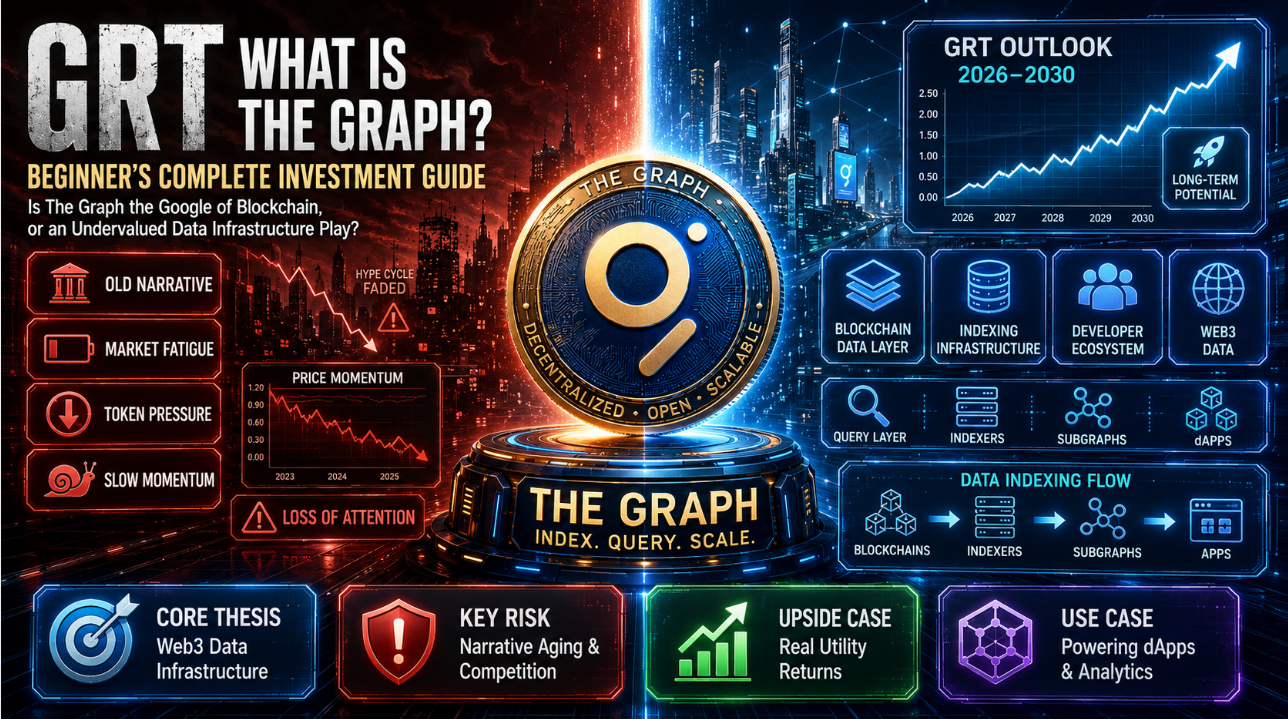
Although blockchain data is public, public does not mean easy to use. You can see all transactions, contracts, addresses, and events on Ethereum. However, if a DApp developer wants to quickly query a user's historical transactions on Uniswap, holder changes for a specific NFT contract, or voting data of a DAO, reading the raw on-chain data directly becomes incredibly cumbersome.
The Graph officially defines itself as an indexing protocol for organizing blockchain data and making it easily accessible with GraphQL. Simply put, it helps developers organize complex, scattered, and hard-to-query on-chain data into data interfaces that applications can quickly call.
This is why many people call The Graph the "Google of Blockchain." The analogy isn't perfectly accurate, but it is easy to understand. Google helps users index internet web pages, while The Graph helps developers index blockchain data.
As of May 2026, CoinMarketCap shows that the GRT price is hovering around $0.025, sitting well below its peak from the previous bull market. CoinMarketCap also indicates that GRT had a total supply of 10 billion tokens at mainnet launch, an initial circulating supply of approximately 1.245 billion tokens, and an annual issuance rate of about 3% starting via indexing rewards.
This article aims to answer three questions: What exactly is GRT? Is it worth investing in? If you decide to participate, how should you buy it, how much should you buy, and when should you sell?
First: The Essence of GRT—What Exactly Is It, and What Problem Does It Solve?
1.1 The Blockchain "Data Black Box" Problem
Many beginners assume that because blockchains are open and transparent, data must be easy to query. In reality, it is not.
On-chain data is indeed public, but raw data is highly complex. If a DApp wants to query user transaction histories, asset balances, liquidity pool data, NFT trades, or governance votes, it cannot simply rely on manual block explorer searches. Developers usually have to run their own nodes, parse blocks, listen to smart contract events, set up databases, and then build APIs for the frontend.
This process is incredibly heavy.
If every DApp built its own data indexing system, it would create a massive amount of redundant labor. Developers who want to build products would instead spend a lot of time handling low-level data. For small teams, this severely drags down development speed.
The Graph solves exactly this problem. It allows developers to create Subgraphs, which are data indexing rules tailored for specific smart contracts, protocols, or applications. Other applications can then quickly query this organized data using GraphQL.
To understand it simply:
Blockchain is the raw database.
Subgraph is the organized directory and index.
GraphQL is the query tool.
The Graph is the protocol that keeps this whole system running in a decentralized way.
1.2 The Graph’s Core Answer: The Indexing Protocol
An indexing protocol can be compared to a library.
Without an index, if you want to find a specific sentence in a massive library, you have to flip through books one by one.
With an index, you can quickly find the exact location based on keywords, authors, categories, or the table of contents.
The blockchain works the same way.
Without The Graph, developers need to extract information bit by bit from raw on-chain data.
With The Graph, developers can directly use pre-organized Subgraphs.
The official homepage also emphasizes that developers can quickly access blockchain data through Subgraphs and GraphQL queries, making application data load much faster.
Therefore, the value of The Graph does not lie in "generating more transactions," but rather in "making on-chain data easier for applications to use." This type of infrastructure will not attract retail sentiment every day like meme coins do, but it could become an invisible yet vital underlying component behind Web3 applications.
1.3 What Is a Subgraph?
A Subgraph is the core product form of The Graph.
A Subgraph can be understood as a data instruction manual for a specific protocol. Developers define: which smart contracts to listen to, which events to extract, which data fields to organize, and how others can ultimately query them.
For example, a Uniswap Subgraph can organize data like trading pairs, liquidity, trading volume, and price changes. An NFT project's Subgraph can organize minting, transfers, and holder changes. A DAO's Subgraph can organize votes, proposals, and participant behavior.
The difference between a Subgraph and a traditional database API is that it serves public on-chain data and can index and query it through a decentralized network. It is not a data service provided by a single company behind closed doors; rather, it attempts to build an open data market.
Of course, Subgraphs themselves are not a silver bullet. They require developer maintenance, need Indexers to provide services, and depend on query demand to sustain their economic model. If nobody uses them, having more Subgraphs means nothing.
1.4 What Role Does GRT Play in the Protocol?
GRT is the coordination token within The Graph network.
Without GRT, The Graph could still exist as a data tool, but it would be hard to form a decentralized economic network. The role of GRT is to establish incentive relationships among Indexers, Curators, Delegators, and data Consumers.
Indexers must stake GRT to provide indexing and querying services. Official documentation clearly states that Indexers are node operators in The Graph Network who must stake GRT to provide indexing and query processing services, earning query fees and indexing rewards in return.
Delegators can delegate their GRT to Indexers, helping Indexers provide more services and sharing a portion of the returns. Official documentation also notes that more GRT staked and delegated to Indexers means Indexers can serve more queries, leading to higher potential rewards.
Curators use GRT to signal high-quality Subgraphs, helping Indexers determine which Subgraphs are worth indexing.
Therefore, GRT is not a pure governance token; it is an economic coordination tool in The Graph's data market. Its long-term value depends entirely on whether this data market is actually heavily used.
1.5 The Graph vs. Centralized Data Solutions
The Graph’s competitors are not just other decentralized protocols; they also include centralized or semi-centralized data providers like Infura, Alchemy, QuickNode, and Moralis.
The advantages of centralized providers are obvious: fast speed, great user experience, stable services, robust customer support, and strong enterprise-grade backing. Many developers do not care whether the backend is decentralized; they care more about whether the API is easy to use, whether the price is right, and whether the data is accurate.
The Graph’s advantages lie in openness, transparency, censorship resistance, composability, and not being completely dependent on a single company. For DeFi, DAOs, public data, on-chain analytics, and decentralized applications, this open data network holds long-term value.
However, there is a trade-off: decentralized systems are usually more complex, the developer experience might not be as smooth as centralized SaaS, and query speeds, costs, and maintenance experiences require continuous optimization.
Ultimately, whether The Graph wins in the future won't rely on the slogan "decentralization is better," but rather on proving that it is both sufficiently open and sufficiently easy to use.
Second: The Technical Architecture of The Graph—Understandable Even Without Coding Knowledge
2.1 Four Types of Network Participants
There are four primary roles in The Graph network: Indexers, Curators, Delegators, and Consumers.
Indexers run nodes, index Subgraphs, and process query requests. They are the service providers in the network, and their income comes from query fees and indexing rewards.
Curators are responsible for finding and flagging high-quality Subgraphs. You can think of Curators as the "recommenders" in the data market. They signal using GRT to tell Indexers which Subgraphs are likely to see high query demand.
Delegators are everyday token holders. If they don't want to run a node themselves, they can delegate their GRT to Indexers, indirectly participating in the network and earning a portion of the rewards.
Consumers are the users, namely DApps, developers, protocols, or analytics tools that use The Graph to query data. They pay query fees to receive on-chain data services.
The goal of this design is to give every role an economic incentive to participate in the network: someone provides the service, someone discovers quality data, someone provides capital support, and someone pays for usage.
2.2 How Do Indexers Make Money?
Indexers' revenue primarily comes from two parts: query fees and indexing rewards.
Query fees come from real usage demand. DApps or developers pay fees when querying data, and Indexers earn revenue by providing that service. Indexing rewards come from protocol issuance, used to incentivize Indexers to provide baseline services to the network. Official documentation clearly states that Indexers earn query fees and indexing rewards through indexing and query processing services.
From an investment perspective, query fees are far more important than indexing rewards.
If Indexers mainly rely on new protocol issuance to sustain their returns, it means the network is still running on subsidies. If Indexers primarily make money from real query fees, it indicates that The Graph has entered a healthier, usage-driven phase. This is one of the most vital questions for long-term GRT investing: whether The Graph can transition from being "reward-driven" to "real-fee-driven."
2.3 The Game Logic of Curators
The role of a Curator is somewhat like a weather vane in the data market. They need to judge which Subgraphs will be heavily used and then signal those Subgraphs with GRT. Indexers then decide where to allocate their resources based on these signals.
If a Curator's judgment is correct and that Subgraph sees high query volume in the future, the Curator earns a return. If their judgment is wrong and the signal value drops, their returns will suffer.
This mechanism ensures that The Graph is not just a passive data query system, but a data network with a market selection mechanism. High-quality, genuinely used Subgraphs receive more resources, while low-quality ones are gradually marginalized.
Naturally, this mechanism is complex. Average investors might not be suited to act as Curators, as it requires a deep understanding of protocols, applications, data demands, and fee structures. For most people, delegation is much easier to grasp than curation.
2.4 Is Being a Delegator Suitable for Average Token Holders?
Delegator is the easiest role for average GRT holders to participate in. You don’t need to run a node or maintain a server; you simply choose an Indexer, delegate your GRT to them, and share a portion of the network rewards.
However, delegation is not a risk-free yield.
You need to choose a reliable Indexer. An Indexer's fee rates, performance, allocation parameters, and service stability will all affect your returns. The official Graph Explorer documentation notes that Indexers can earn query fees and indexing rewards, and Delegators can delegate via the Indexer's profile page.
Additionally, the price of GRT itself fluctuates. You are earning rewards denominated in GRT, not capital-protected USD returns. If the price of GRT drops, your delegation rewards may not offset the loss on your principal. Therefore, beginners should not treat GRT delegation like a bank savings account. It is more accurately viewed as a way to participate in the network economy.
2.5 Technical Shortcomings of The Graph
While The Graph is the flagship project in the data indexing sector, it is not without its flaws.
First, the developer experience still requires continuous optimization. Centralized API services are usually faster to get started with, whereas The Graph’s decentralized network mechanics are more intricate.
Second, query speeds and stability must meet production-grade application requirements. Developers will not tolerate a poor experience just because something is "decentralized."
Third, Subgraph coverage and maintenance quality vary significantly. Not all Subgraphs are active, and not all data updates in a timely manner.
Fourth, the AI era may shift data demands. In the future, developers might require more complex on-chain data analytics, semantic queries, real-time data streams, and AI-verifiable data interfaces, which means the traditional Subgraph model will need to evolve.
These shortcomings are not fatal, but they will determine whether The Graph can maintain its status as an industry standard.
Third: GRT Tokenomics—Where Does the Money Come From, and Where Does It Go?
3.1 Core Utilities of GRT
The core utilities of GRT include staking, delegation, curation signaling, query fee payments, and governance.
Staking forms the foundation for Indexers to provide services. Without enough staked GRT, an Indexer cannot handle sufficient service volume within the network. Delegation allows average holders to participate in network rewards. Curation signaling helps the market discover high-value Subgraphs. Query fees represent the most critical long-term revenue source for The Graph. Governance allows GRT holders to participate in steering the protocol's direction.
Among these utilities, the one with the most long-term value support is query fees because it represents real demand. Staking and delegation reduce circulating supply, and curation improves data market efficiency, but without query demand, the entire economic model lacks an ultimate payer. Therefore, to evaluate the long-term value of GRT, the most important metric to watch is real query volume and query fees, rather than just staking yields.
3.2 GRT Supply and Inflation
At the launch of The Graph's mainnet, the total supply was set at 10 billion GRT. Data from CoinMarketCap indicates that new token issuance started in the form of indexing rewards at roughly 3% annually, subject to future technical governance by The Graph Council.
The Graph’s official tokenomics documentation also states that the initial supply is 10 billion tokens, with a target of approximately 3% new issuance annually to reward Indexers for allocating stake to Subgraphs. This means GRT is not a fixed-supply asset; it experiences continuous issuance.
However, inflation is not inherently bad. The real question is what that new issuance buys. If newly issued GRT incentivizes more Indexers, better service quality, higher query volume, and stronger network security, then the inflation represents a growth cost for the network. If the new GRT merely maintains a low-utilization network, it becomes pure downward price pressure. Thus, whether GRT's inflation is healthy depends on whether real query fees continue to grow.
3.3 Query Fee Revenue Logic
The ideal economic state for The Graph is one where data consumers pay query fees, Indexers earn revenue by providing services, and Delegators and Curators also share in the network's earnings.
As Web3 applications multiply, the demand for on-chain data queries will grow. DeFi, NFTs, DAOs, RWAs, gaming, AI Agents, and on-chain analytics tools all require reliable data. Theoretically, a rise in query volume leads to more query fees, which boosts Indexer revenue, subsequently increasing the demand for GRT staking and delegation. This is the fundamental flywheel for GRT.
However, investors should note that query volume and the price of GRT do not share a linear relationship. Short-term prices are heavily driven by market sentiment and liquidity. In the long run, only when query fees become substantially large can GRT transition from a "conceptual infrastructure" token into a "cash-flow protocol token."
3.4 Can the Burn Mechanism Counter Inflation?
The Graph incorporates a specific burn mechanism. The official tokenomics documentation mentions that the protocol burns a portion of query fees, along with fee mechanisms related to delegation taxes and curation signaling, to help offset new issuance.
The catch, however, lies in whether the burning power is strong enough. If network utilization remains very low and burning is minimal, the roughly 3% new issuance will dominate supply dynamics. If query fees grow massively, and the share of burning and fee revenue scales up, the GRT economic model becomes much healthier. Therefore, average investors shouldn’t assume guaranteed deflation just because they hear a "burn mechanism exists." The key is the relationship between the scale of burning and the scale of new issuance.
Fourth: The Graph’s Ecosystem—What Can It Do Now, and Where Is It Going?
4.1 Current Ecosystem Maturity of The Graph
The Graph is no longer an empty project. It has long served DeFi, NFT, DAO, and on-chain analytics applications, and is used by a vast number of developers as data querying infrastructure. The official homepage heavily emphasizes that developers can use Subgraphs and GraphQL queries to query blockchain data, allowing apps to access data quickly.
From an investment perspective, however, simply seeing "many projects using it" is not enough. You must look at whether this usage has migrated to the decentralized network and is generating real fees. In the past, The Graph offered a hosted service, and many developers used this free or low-cost hosted service. While helpful for product adoption, it didn't necessarily translate directly into GRT value capture. The truly critical metric is whether these queries enter the decentralized network and generate query fees.
4.2 Which Chains Does The Graph Support?
The Graph started in the Ethereum ecosystem, but its long-term direction is multi-chain data indexing. Today, Web3 applications are no longer limited to Ethereum; ecosystems like Solana, Arbitrum, Base, Polygon, Avalanche, BNB Chain, Optimism, and Near all require data services.
If The Graph can establish itself as the multi-chain data indexing standard, its value potential will expand significantly. However, multi-chain also means fiercer competition. Every chain has its own ecosystem, node providers, data tools, and developer habits. The Graph must prove it can deliver stable, easy-to-use, and economical query services across different chains.
4.3 The Graph’s Status in DeFi
DeFi is one of the most critical application scenarios for The Graph. DeFi applications require a massive amount of on-chain data: prices, trades, liquidity, lending, liquidations, staking, yields, and fund flows. Without a stable data query layer, the frontend experience suffers, and analytics tools struggle to run.
Protocols like Uniswap, Aave, and Compound all rely heavily on high-quality on-chain data. Even if not all data must come from The Graph, The Graph still represents a highly essential method of data indexing. If DeFi continues to grow in the future—especially cross-chain DeFi, RWA DeFi, institutional DeFi, and AI-driven trading tools—the demand for data indexing will become even stronger.
4.4 Why Is Migrating from Hosted Services to the Decentralized Network So Important?
This is a pivotal milestone in The Graph's development. If developers use free or centralized hosted services, it proves that The Graph's tools are useful, but it does not necessarily bring value to GRT. Only when queries migrate to the decentralized network can they easily form GRT query fees, Indexer revenue, and a token economic cycle.
Therefore, the long-term value of The Graph isn't just about total usage volume; it's about whether that usage enters the protocol's economy. This is a must-watch detail when investing in GRT: a project being used does not automatically mean its token captures value. For The Graph to benefit GRT, it must successfully close the loop between network usage, fee payments, and staking mechanisms.
4.5 Key Directions for 2026–2028
Over the next few years, the most critical directions for The Graph likely include multi-chain support, decentralized network migration, query fee growth, the convergence of AI and on-chain data, developer experience upgrades, and Indexer ecosystem enhancements.
In particular, combining AI with blockchain data could emerge as a powerful new narrative. If AI Agents in the future need to read on-chain states, analyze wallet behaviors, monitor DeFi risks, or execute on-chain strategies, they will require a reliable data indexing and querying layer. The Graph has a shot at becoming part of the core on-chain data infrastructure for AI Agents. Yet, this still requires verification. The AI narrative cannot just live in the imagination; we must see actual integrations, query volumes, and revenue growth.
Fifth: The Graph’s Team and Backing Capital—Who Is Building This, and Are They Trustworthy?
5.1 The Graph Team and Project Background
The Graph is an established veteran project within the Web3 data infrastructure space. Its core team has long been built around on-chain data indexing, GraphQL, decentralized networks, and developer tool construction.
To judge whether a team is reliable, investors shouldn't just look at founder stories; they need to look at long-term delivery. The Graph has at least proven it is not a "vapourware" project. It features an actual product, active developer usage, a fully fleshed-out network role design, live tokenomics, official documentation, and continuous ecosystem updates. This makes it far more dependable than projects that raise funds based solely on a whitepaper and a concept.
5.2 What Institutional Investment Means
In its early days, GRT garnered attention from top-tier institutions like a16z, Coinbase Ventures, and Framework. This level of institutional backing boosts market trust and indicates that the project was recognized by professional capital early on.
However, institutional investment is not a risk-free guarantee. Institutional backing proves a project has potential, but it doesn't guarantee that buying on the secondary market will turn a profit. This is especially true for infrastructure projects, which often launch with very high early valuations and then undergo lengthy unlock periods and market repricings. Retail investors who chase highs can still suffer heavy losses. Therefore, institutional backing is a plus, but it shouldn't be the sole reason to buy.
5.3 The Graph Foundation and Governance
The governance structure of The Graph revolves around the Foundation, the Council, the community, and GRT holders. GRT holders can participate in shaping the protocol's direction through governance, though the actual depth of participation for average users is often limited.
As with most protocols, while governance rights are open in theory, practical influence tends to concentrate in the hands of the core team, the Foundation, long-term community contributors, node operators, and large whale holders. Consequently, governance is a sign of project maturity, but it cannot sustain the GRT price on its own. True price support still comes down to query demand, fee revenue, and network engagement.
5.4 How to Evaluate Project Transparency
The Graph's transparency can be evaluated across several vectors:
Whether official documentation is clear.
Whether Indexer, Delegator, and Curator mechanisms are public.
Whether tokenomics details are accessible.
Whether the Graph Explorer displays live network data.
Whether communities and developers are active.
Whether the roadmap is steadily progressing.
Whether the Subgraph and query ecosystem are growing.
Currently, The Graph does an excellent job of making its documentation and mechanisms public. The official documentation offers meticulous breakdowns of Indexers, Delegators, tokenomics, and more. Even so, investors must continuously monitor whether the project is actually growing, rather than just admiring the completeness of its documentation.
Sixth: The Graph’s Competitive Landscape—The War in the Data Indexing Sector
6.1 The Counterattack of Centralized Data Service Providers
The heaviest competitive pressure facing The Graph comes from centralized data service providers. Platforms like Infura, Alchemy, and QuickNode offer more straightforward, stable, and enterprise-tailored data services. Many developers don’t want to study complex protocol incentives or deal with the nuances of a decentralized network; they just want to plug into a fast API.
The core advantage of these providers is product experience. The Graph’s core advantage is its open protocol and decentralized network. The future won't necessarily be a winner-take-all scenario; many projects may choose to use centralized services alongside The Graph simultaneously. The key is whether The Graph can strike the right balance between open data, censorship resistance, composability, fee structures, and developer experience.
6.2 Emerging Decentralized Competitors
Beyond centralized providers, there are emerging decentralized data projects and on-chain analytics tools. For instance, projects like Subsquid are also building multi-chain data indexing, with some tools emphasizing faster synchronization, more flexible data processing, or better optimization for specific chain ecosystems.
These competitors will inevitably erode The Graph's monopoly. However, The Graph holds a first-mover network effect advantage. Subgraph standards, developer habits, existing integrations, the Indexer ecosystem, and brand recognition cannot be replicated overnight. If The Graph continues to upgrade, it stands a strong chance of maintaining its industry-standard status. If its upgrades are slow, the experience poor, or fees unreasonable, developers will gradually migrate away.
6.3 Risks of Public Chains Building Their Own Indexing Services
Major public chains may also choose to build their own data indexing services. Ecosystems like Solana, Aptos, Sui, Base, and Arbitrum all have incentives to provide official or ecosystem-level data tools to attract developers.
This poses a challenge to The Graph. If a specific chain comes with a built-in, highly effective data service, developers may not feel the need for an external indexing protocol. However, The Graph’s advantage lies in cross-chain unified standards. If a developer needs to query data across multiple chains, a unified indexing protocol remains immensely valuable. The future key for The Graph is not necessarily dominating every individual chain, but becoming one of the premier standards for multi-chain data access.
6.4 Is The Graph’s Moat Truly Deep?
The Graph’s moat is constructed primarily from four elements:
First, developer mindshare. A vast number of Web3 developers are already well-versed in Subgraphs and GraphQL querying.
Second, its protocol network. The Indexer, Curator, and Delegator mechanisms have been live and running for years.
Third, ecosystem integration. Countless protocols have used or are currently using The Graph’s data services.
Fourth, brand positioning. The Graph stands as one of the most recognizable names in the Web3 data indexing space.
However, no moat is permanent. The data service market is highly pragmatic; developers will ultimately choose the solution that is cheaper, faster, more stable, and easier to use. The Graph must continuously optimize its experience, or its first-mover advantage will run dry.
6.5 Where Will GRT Most Likely Stand in Five Years?
By 2030, GRT will likely face one of three outcomes:
The best-case scenario: The Graph cements itself as one of the definitive industry standards for Web3 and AI Agent on-chain data indexing, query fees grow exponentially, and GRT’s value capture tightens significantly.
The neutral scenario: The Graph remains an important piece of infrastructure, but centralized providers and alternative protocols capture a massive chunk of the market. The GRT price experiences cyclical fluctuations but struggles to maintain sustained market dominance.
The worst-case scenario: Developers migrate en masse to superior alternatives, The Graph is marginalized, and GRT enters a long-term slump.
As an average investor, your job isn't to guess the final outcome right now, but to consistently track query volumes, fees, Indexer activity, and developer adoption.
Seventh: How to Buy GRT on the HIBT Exchange—A Step-by-Step Tutorial from Scratch
7.1 Confirm HIBT Supports GRT Before Buying
Before buying GRT on HIBT, your very first step is to confirm whether the platform currently supports GRT/USDT spot or futures trading. Exchange trading pairs can change over time, so always rely on live search results within the HIBT App or official website before making any moves.
If you can find the GRT/USDT spot pair, it means you can buy GRT spot directly. If only futures trading is available, you are trading price contracts, which is not the same as holding actual GRT spot. Beginners are highly encouraged to prioritize spot trading and avoid leverage starting out.
7.2 Register an HIBT Account and Complete KYC
When registering an account, you can use your email or phone number. Right after registering, it is highly recommended to complete your security settings immediately, including setting a strong password, enabling two-factor authentication (2FA), and binding your email or phone.
If HIBT requires KYC (Know Your Customer), you will need to submit identification documents and undergo verification. Common reasons for KYC failure include blurry document photos, mismatched information, expired IDs, or unsupported regions. If you plan to buy GRT, don't wait for a market rally to get verified. Preparing your account ahead of time helps you avoid missing trading windows due to review delays.
7.3 Funding Methods: Fiat or USDT
Buying GRT usually requires preparing USDT first. If HIBT supports fiat funding, you can use a bank card, credit card, or third-party channels to purchase USDT. Fees and processing times vary by region, so check the actual platform display.
If you already hold USDT in another exchange or personal wallet, you can deposit it into HIBT. When depositing, double-check the network selection, such as ERC-20, TRC-20, or BEP-20. Choosing the wrong network could result in the permanent loss of your assets. Beginners should always test with a small amount first and transfer larger sums only after confirming successful receipt.
7.4 Locate the GRT/USDT Trading Pair
Once you enter the trading page, type "GRT" into the search box. When GRT/USDT appears, click to enter the trading interface. This interface typically includes candlestick charts, the order book, recent trades, buy/sell zones, and your account balances.
Beginners don't need to master every technical indicator right away, but you must at least understand Market Orders and Limit Orders. A Market Order executes immediately at the current market price, ideal for anyone looking to buy quickly, though it is subject to slippage. A Limit Order allows you to set your own specific buying price, executing only when the market hits that target, which is better for cost control. For a medium-to-small-cap asset like GRT, beginners should lean toward Limit Orders to avoid overpaying due to short-term volatility.
7.5 Place Your Order to Buy GRT
Before hitting buy, lock in three numbers: how much USDT you plan to commit, what buy price you are willing to accept, and the maximum loss you can tolerate.
If using a Limit Order, input your desired price and quantity, then wait for the order to fill. If using a Market Order, simply enter the total purchase amount, and the system will execute it against the available order book. Once the purchase succeeds, you can review your GRT holdings on your balance page. If you are day trading, keeping it on the exchange makes selling convenient. If you are holding for the long run, consider withdrawing it to a personal wallet.
7.6 Withdrawing GRT to a Personal Wallet
GRT is an ERC-20 token, meaning common withdrawal networks include the Ethereum network, though other network variants might be supported. Always defer to what is currently displayed on HIBT.
Before initiating a withdrawal, ensure that the wallet address is correct, the networks match perfectly, and the network fee is acceptable. Choosing the wrong network can result in missing assets. For long-term holders, moving assets to a personal wallet ensures your private keys stay under your own control, reducing exchange-related risks. The downside is that you become solely responsible for safeguarding your seed phrase. If your seed phrase is lost or leaked, your assets are gone forever.
7.7 HIBT Earn vs. Self-Delegating GRT
If HIBT offers flexible or fixed-term savings products for GRT, beginners can weigh whether to participate based on the APY, lockup periods, redemption rules, and platform risks.
The alternative is using The Graph network to delegate directly to an Indexer yourself. Official documentation notes that Delegators can delegate GRT to Indexers and share in potential rewards. For beginners, exchange financial products are operationally simple but carry platform risk. Direct network delegation is closer to native protocol participation, but the process is more complex, requiring you to understand Indexer selection, parameters, yields, and risks. If you are just starting with a small amount to learn, begin with the simpler option. Once your capital grows larger, you can dive deeper into on-chain delegation.
7.8 Must-Do Security Checklist
After purchasing GRT, account security becomes paramount.
Always turn on two-factor authentication (2FA).
Never click on random links from unknown customer service reps.
Never share your verification codes with anyone.
Do not reuse passwords across multiple sites.
Use withdrawal whitelists whenever dealing with large asset amounts.
When holding assets for the long term, consider hardware wallets or high-security wallet setups.
Many investors don't lose money to market downturns; they lose it to poor account security and messy private key management.
Eighth: Investment Risks of GRT—Five Capital-Loss Scenarios You Must Face Before Buying
8.1 Demand Risk
One of the most prominent risks for GRT is that actual query demand fails to meet expectations. If DApp developers shift en masse to centralized data services, or if The Graph's query fee growth moves at a snail's pace, GRT's value capture will take a major hit. A project being well-known does not mean it is being heavily paid for. Investors must keep their eyes on real usage data, not just brand popularity.
8.2 Inflation Risk
GRT features a target annual new issuance rate of roughly 3% to fund indexing rewards. If query fees and burn mechanisms don't scale up fast enough to match, this new issuance can create long-term selling pressure. This doesn't mean GRT is inherently flawed, but it warns long-term holders to closely monitor the supply-demand balance.
8.3 Technology Displacement Risk
The intersection of AI and blockchain data tools could fundamentally change how developers query data. In the future, developers might completely stop writing manual Subgraphs, opting instead for automated data agents, semantic queries, AI data interfaces, or entirely new indexing systems. If The Graph fails to adapt to this paradigm shift, the traditional Subgraph model could be partially phased out.
8.4 Liquidity Risk
GRT is currently not a mega-cap asset; its trading depth and overall market attention are weaker compared to assets like BTC, ETH, or SOL. Large capital entries or exits can noticeably move the price, particularly during bear markets or low-volume periods. While minor retail accounts won't feel much impact, anyone managing larger positions needs to stay alert to slippage and liquidity constraints.
8.5 Black Swan Risk
Black swans include smart contract exploits, protocol governance standoffs, regulatory crackdowns, core team departures, mass exits of Indexers, severe drops in data service quality, or exchange delistings. These types of risks are impossible to predict perfectly; they can only be mitigated through diversification, position sizing, staying away from leverage, and checking fundamentals regularly.
Ninth: Is GRT Worth Investing In?—A Comprehensive Fundamental Judgment
9.1 The Strengths of GRT
The biggest strength of GRT is that its sector is completely real. On-chain data querying is not a fake narrative. As long as Web3 applications exist, the demand for data indexing and querying will exist right alongside them.
The second strength is The Graph's first-mover advantage. It is comfortably the most famous project in the Web3 data indexing space, and its Subgraph model is universally recognized by developers.
The third strength is its fully integrated network architecture. The interplay between Indexers, Curators, Delegators, and Consumers creates a highly complete data market structure.
The fourth strength is that future AI + Web3 data integrations could unlock entirely new layers of demand.
9.2 The Weaknesses of GRT
The primary weakness of GRT is that its value capture is not immediately straightforward. Just because The Graph is highly useful does not automatically mean GRT’s price will moon. You must see query fees, staking demand, burn mechanisms, and real revenue form a closed loop.
The second weakness is intense competition. Centralized service providers deliver an outstanding user experience, new indexing protocols are constantly emerging, and major public chains are increasingly building native data tools.
The third weakness is inflationary pressure. The roughly 3% annual new token issuance needs to be continuously absorbed by real demand.
The fourth weakness is that the market narrative isn't overly "sexy." Compared to AI, memes, or RWAs, data indexing infrastructure has a much harder time capturing short-term speculative capital.
9.3 Who GRT Is Suitable For
GRT is best suited for investors who:
Are genuinely interested in studying Web3 infrastructure.
Are perfectly comfortable with long periods of low volatility and low market attention.
Deeply believe that on-chain data query demand will scale over time.
Are willing to actively track query volumes, Indexers, Subgraphs, and protocol fees.
Are not looking to get rich overnight, but are instead aiming for a medium-to-long-term infrastructure allocation.
9.4 Who GRT Is NOT Suitable For
GRT is a poor fit for investors who:
Are looking solely for short-term explosive gains.
Have zero understanding of how the data indexing sector operates.
Cannot stand watching an asset trade sideways for months on end.
Rely purely on price predictions while completely ignoring actual usage metrics.
Mistake delegation yields for principal-protected savings accounts.
9.5 Final Verdict: Buy, Watch, or Pass?
My comprehensive takeaway is that GRT is absolutely worth researching and is suitable for a small-to-medium observer position, but it shouldn't serve as a core, heavy anchor in your portfolio.
If you are highly bullish on Web3 data infrastructure and the on-chain data needs of AI Agents, you can look into accumulating a position in tranches. If you are looking to buy the dip purely because the price seems low and its historical all-time high was massive, I would caution against it. If you are a complete beginner, make it a point to study how The Graph's mechanisms function before risking small amounts of capital.
The opportunity for GRT lies in its real-world sector and first-mover status. Its risks lie in value capture, competition, and inflation.
If you want to compare the investment logic of another class of infrastructure assets, you can look up the 2030 AVAX price prediction. The core logic of AVAX centers around public chain ecosystem growth, institutional subnets, RWAs, multi-chain deployment, and on-chain transaction activity. In contrast, the core logic of GRT relies on on-chain data indexing, query fees, Subgraph usage, and developer adoption. Both belong to the broader infrastructure sector, but AVAX functions more like a "public chain foundation supporting applications," while GRT operates as a "data layer helping applications read data." Putting the two side-by-side highlights why infrastructure tokens cannot be shoved into the exact same valuation model.
Tenth: Investment Strategy—How Much to Buy, How to Buy, and When to Sell?
10.1 Position Management Principles
GRT is an infrastructure token, meaning it shouldn't swap places with BTC or ETH as a core portfolio holding. For the average investor, GRT works best as a satellite allocation within your Web3 infrastructure bucket. Conservative investors can stick to observing or holding a microscopic percentage. Balanced investors can cap it between 1%–5% of their total crypto portfolio. Even if aggressive investors are incredibly bullish, breaking past 10% is generally not recommended. Your position size should match your confidence across three questions: Is Web3 data demand growing, is The Graph keeping its lead, and can GRT actually capture that value?
10.2 Dollar-Cost Averaging (DCA) Strategy
GRT can be accumulated through small, regular purchases, but it isn't an asset for blind, mindless DCAing. A better path is to split your entries during market lows while performing regular fundamental health checks. If query volumes, fees, and Indexer activity show steady improvement, continuing makes sense. If the project shows long-term stagnation, you should pause your accumulation. Accumulating GRT is fundamentally different from DCAing into BTC; BTC possesses an unshakeable market consensus, while GRT is an infrastructure altcoin carrying much higher risk.
10.3 Building a Position in Stages
Consider breaking your entry down into three distinct phases:
The first phase is an observation position—a small amount intended to build the habit of tracking the project.
The second phase waits for an improvement in the price structure, such as a volume-backed breakout past a long-term resistance line.
The third phase triggers when fundamentals visibly improve, such as an uptick in query fees, Subgraph usage, and overall network revenue.
Never go all-in all at once just because the price looks cheap. A low price can represent an opportunity, but it can also indicate that the market doesn't value its token economic model over the long haul.
10.4 Stop-Loss and Take-Profit
Your stop-loss plan for GRT shouldn't focus entirely on the charts; it must take fundamentals into account. If query demand takes a dive, developers migrate to competing products, Indexer activity actively thins out, or the official roadmap stalls completely, it’s time to consider down-sizing your position. Take-profit actions can be scaled out in tranches when the broader market enters an overheated state. If GRT experiences an aggressive, short-term pump driven entirely by an AI + Web3 data hype wave without a corresponding rise in query fees, you need to stay alert to a speculative bubble.
10.5 Monthly Fundamental Health Checks
Once you hold GRT, it is wise to monitor three core metrics every month:
First, whether Subgraphs and real query demands are growing.
Second, whether the Indexer and Delegator networks remain healthy and robust.
Third, whether query fees, burn metrics, and overall protocol revenue are improving.
If these metrics look good, your holding thesis strengthens. If the price pumps but these metrics stay completely flat, it is likely short-term speculation. If the price falls and the metrics deteriorate, it's time to re-evaluate the entire thesis.
If your investment style leans heavily toward short-term momentum, community hype, and high-beta volatility, you might also want to read the 2030 SHIB price prediction. The underlying logic of SHIB relies entirely on community consensus, meme culture, market sentiment, and ecosystem expansions. GRT's logic, on the other hand, relies strictly on real query demand, developer adoption, and protocol fees. Both can see massive gains during a bull run, but their primary risk profiles are night and day: SHIB fears the fading of market attention, whereas GRT fears an architecture that gets heavily used but fails to pass that value down to its token.
Conclusion: A One-Page Summary of the GRT Investment Decision
The core value proposition of The Graph can be boiled down to three simple statements:
First, it is a Web3 data indexing protocol designed to help developers query on-chain data efficiently.
Second, GRT serves as the economic coordination token within this data network, utilized for staking, delegation, curation, query fee payments, and governance.
Third, its long-term value relies on real query demand, protocol fee generation, active network participation, and tight token value capture.
Before putting capital into GRT, you must answer these five questions for yourself:
Do I clearly understand that The Graph is solving a real-world data problem?
Do I genuinely believe that Web3 apps and AI Agents will drive substantial on-chain query demand?
Am I completely fine with the reality that GRT faces inflation and competitive pressures?
Am I willing to consistently track query fees and live network data?
If GRT trades completely sideways for an extended period, will I be able to stick to my strategy?
If you can answer these questions with confidence, GRT earns a spot on your watchlist. If you are looking to buy the dip solely because the asset looks cheap, prioritize learning before making your move.
The final takeaway: GRT is a Web3 data infrastructure token well worth your research, but it is by no means a low-risk asset. It is an ideal fit for a small-to-medium long-term observation position, not blind over-allocation. What truly dictates the future of GRT isn't the flashy title of "Google of Blockchain," but whether The Graph can successfully transform real on-chain data needs into sustained query fees and tangible GRT value capture.
FAQ: Frequently Asked Questions About GRT
What is GRT?
GRT is the native utility token of The Graph protocol. The Graph is a blockchain data indexing protocol that enables developers to quickly query on-chain data using Subgraphs and GraphQL.
Why is The Graph called the Google of Blockchain?
Because just as Google indexes internet web pages, The Graph indexes blockchain data. While this analogy helps clarify what the project does, it isn't completely flawless. The Graph currently serves developers and DApps directly, rather than average everyday internet search users.
What are the utilities of GRT?
GRT is utilized for Indexer staking, Delegator delegation, Curator curation signaling, query fee payments, and protocol governance. Indexers stake GRT to process queries and index data, earning query fees and indexing rewards for their service.
Does GRT have inflation?
Yes, it does. The Graph’s official tokenomics documentation states that the initial supply was set at 10 billion GRT, with a target annual issuance rate of roughly 3% to incentivize and reward Indexers.
Can average individuals earn rewards within the GRT network?
Yes, you can participate in network rewards by delegating your GRT to active Indexers. Official documentation shows that Delegators can delegate to Indexers and share in potential rewards. Keep in mind that delegation is not a principal-protected savings account, and GRT price swings will still directly affect your ultimate returns.
Is GRT suitable for long-term holding?
GRT is excellent for long-term observation, but it is not built for blind, outsized allocations. It is best suited for investors who are fundamentally bullish on Web3 data infrastructure and are prepared to actively track query metrics and protocol fees. Average beginners are better off starting with small positions to learn the ropes and entering in stages.
Kindly Reminder
The content of this article is intended strictly for educational and research purposes and does not constitute any form of financial or investment advice. GRT is a high-risk crypto asset subject to severe price volatility; please fully assess your personal risk tolerance before investing.
Do not assume GRT is guaranteed to rise just because The Graph is dubbed the "Google of Blockchain." A protocol being highly useful does not automatically mean its token will perform strongly. The real metrics that matter are query fees, active network participation, Subgraph utilization, Indexer revenues, and GRT’s true value capture efficiency.
If you ultimately choose to get involved with GRT, remember to keep your position sizes controlled, scale into entries in tranches, avoid leverage, and closely follow updates via the official The Graph documentation, the Graph Explorer, live protocol fees, Indexer health status, Subgraph metrics, and shifts within the broader Web3 data sector. A mature investment approach is never about buying into a great story; it is about continuously verifying whether that story is actually turning into reality.
About the Author
Author: Lucas | Web3 SEO & Crypto Research
Lucas maintains a long-term focus on cryptocurrency markets, exchange ecosystems, Web3 project growth, and Google SEO traffic strategies. His primary research tracks include crypto asset price predictions, exchange growth models, on-chain data analytics, Layer 1/Layer 2 ecosystems, public chain competitive landscapes, Web3 data infrastructure, AI + Web3, DeFi, RWAs, and novice investor education.
In his approach to content research, the author prioritizes logical frameworks over arbitrary price predictions. He excels at breaking down the long-term value of crypto assets through a multi-dimensional lens—evaluating project fundamentals, market cycles, on-chain metrics, competitive dynamics, tokenomics, regulatory developments, and investor sentiment. This analysis of GRT is designed to help readers build independent judgment rather than relying on a single conclusion to make investment decisions.