
Introduction: Why Does MINA Deserve Its Own Complete Guide?
Within the Layer 1 public chain track, MINA is a highly unique project.
While most public chains pitch narratives around being "faster, cheaper, higher TPS, and stronger ecosystems"—such as Solana focusing on high performance, Sui highlighting its object model and parallel execution, and Ethereum leaning on security and network effects—MINA takes a completely different approach. It doesn't put speed or transaction costs at the forefront; instead, it emphasizes one core thing: keeping the blockchain perpetually lightweight.
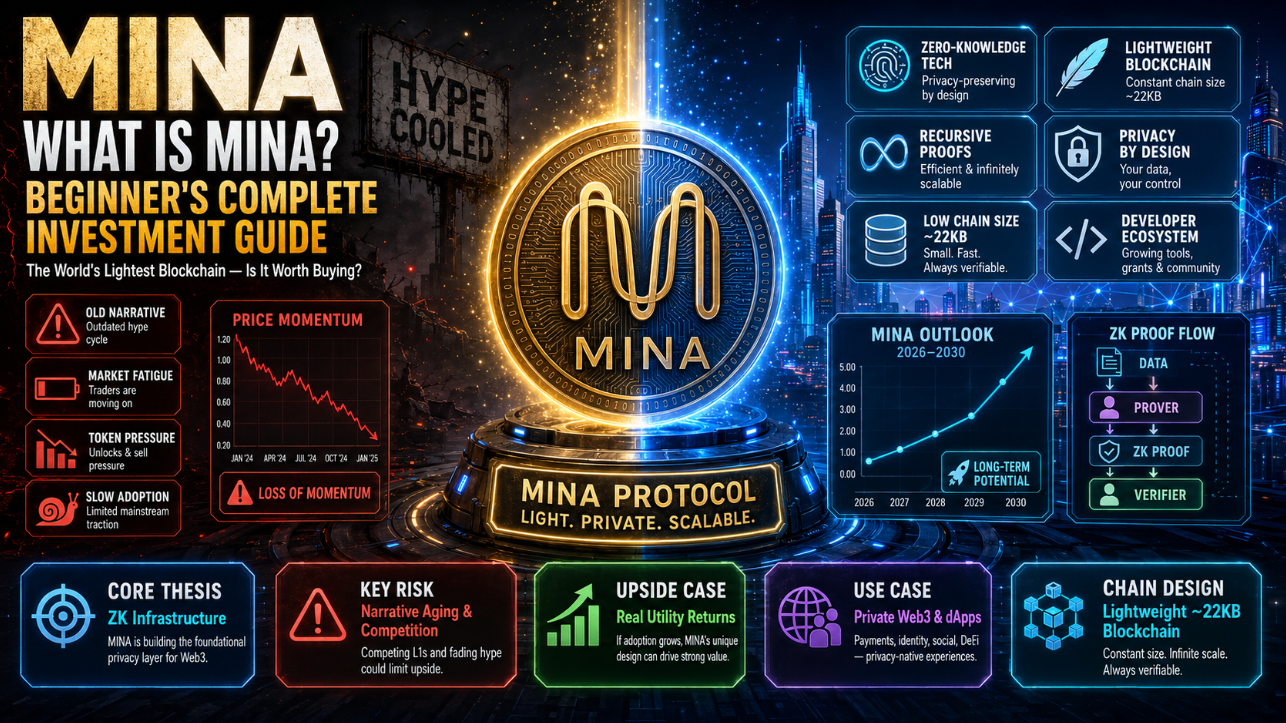
Official Mina documentation describes Mina as a 22KB Layer 1 blockchain that supports zkApps—zero-knowledge smart contracts written in TypeScript. Official resources also highlight that Mina utilizes recursive zero-knowledge proofs to maintain this roughly 22KB lightweight structure.
This phrase sounds deeply technical, but its underlying significance is massive: if a blockchain can preserve an incredibly tiny size, standard smartphones, web browsers, light clients, and even future AI Agents could easily participate in verifying the network, rather than relying entirely on centralized node service providers.
However, investing in MINA requires looking beyond technical highlights. Advanced technology does not automatically guarantee a token's price will rise, and an innovative protocol does not mean it is suitable for every average investor. An investment judgment on MINA must simultaneously weigh its technology, ecosystem, tokenomics, competitive landscape, team execution, price cycles, and your personal risk tolerance.
As of May 2026, CoinMarketCap shows MINA trading around $0.06–$0.07, with a circulating supply of approximately 1.286 billion tokens and a market cap in the $80 million range. The maximum supply does not show a fixed cap. This indicates that MINA is no longer the high-valuation star newcomer token of 2021, but has entered a phase of "low valuation, low market attention, and awaiting fundamental validation."
This guide will help you answer three core questions: What exactly is MINA? Is it worth buying? If you decide to participate, how should you buy it, how much should you buy, and when should you sell?
Chapter 1: The Essence of MINA—What Exactly Is It, and What Problem Does It Solve?
1.1 The Blockchain "Bloat Disease": Why Traditional Blockchains Grow Increasingly Heavy
To understand MINA, one must first grasp a fundamental flaw in traditional blockchains: they get progressively larger.
Since the day Bitcoin and Ethereum went live, they have continuously generated new blocks and transactions. Every single trade, smart contract interaction, and state change becomes a permanent piece of on-chain history. As time goes on and data accumulates, the data volume that a full node must synchronize and store expands drastically.
This triggers several critical issues:
- High Barriers to Entry: It becomes increasingly difficult for average users to run a full node.
- Centralization Risks: Network verification capacity tends to consolidate into the hands of professional nodes, exchanges, institutions, and infrastructure service providers.
- Illusion of Decentralization: While users claim to use a decentralized network, they regularly rely on centralized RPCs or third-party nodes.
- Loss of Trustlessness: The fewer people who can independently verify the chain, the more the core benefit of blockchain—"trustlessness"—is eroded.
This is the exact root problem MINA aims to solve: How can a blockchain continuously run while remaining light enough for everyday devices to participate in verification?
1.2 MINA’s Core Answer: A 22KB Constant Blockchain
MINA's answer is recursive zero-knowledge proofs, specifically Recursive zk-SNARKs.
To explain it in plain English: traditional blockchains are like a ledger that keeps getting thicker. To confirm if the ledger is correct, you have to check a massive trail of data from the very beginning. MINA’s method is closer to compressing that entire ledger into a single mathematical proof. Instead of downloading all historical data, you only need to verify this tiny proof to confirm that the current state of the chain is valid.
The official Mina blog previously explained that Mina uses recursive zk-SNARKs to keep the blockchain compact, remaining at roughly 22KB—about the size of a few tweets.
This is MINA’s core technical selling point. It does not mean historical data vanishes from the network entirely; it means users do not need to download the full history to verify the current network state. Through recursive proofs, a previous proof can be nested inside a new one. The proofs accumulate continuously, but the final cost of verification remains incredibly small.
This is vital for true decentralization. The lower the verification threshold, the more everyday users can actively participate in network validation, preventing a small handful of large-scale nodes from monopolizing that power.
1.3 "The World's Lightest Blockchain" Is Not a Gimmick, But It Is Not a Silver Bullet
While the title "the world's lightest blockchain" is technically accurate, investors should not mistake this for a guarantee of success.
Lightweight structures solve the cost of verification. They make it easier for a wider variety of devices to verify the chain state, which helps decentralization and opens up possibilities for mobile devices, web browsers, embedded hardware, and AI Agents to access the blockchain.
However, for a blockchain to truly succeed, technical elegance must be paired with developers, applications, active users, liquidity, and a sustainable economic model. In other words, MINA’s 22KB feature solves a major infrastructure hurdle, but it still has to answer a commercial question: Who will actually use Mina because of this feature?
Without an abundance of zkApps, real-world privacy computing scenarios, developer migration, and organic user demand, that 22KB metric becomes nothing more than a beautiful technical label that is hard to monetize.
1.4 MINA vs. Ethereum, Solana, Sui: Where Does the Positioning Differ?
The positioning differences between MINA and other mainstream Layer 1 public chains are stark:
- Ethereum: The powerhouse of smart contract ecosystems. Its strengths are security, developer density, asset liquidity, and massive network effects. Its challenges are high mainnet costs and a heavy reliance on Layer 2 networks for scaling.
- Solana: The high-performance chain. Its strengths are rapid transaction speeds, low fees, consumer-facing applications, and a highly active meme ecosystem. Its challenge is a heavier reliance on high-performance infrastructure, meaning the threshold for an average user to perform full verification is relatively steep.
- Sui: The next-generation Move-based public chain. It emphasizes an object-centric data model, parallel execution, and a high-performance user experience tailored for gaming, asset management, and consumer applications.
- MINA: Positions itself as infrastructure for "lightweight verification + native ZK + privacy proofs." It is not trying to compete head-on with Solana on pure speed, nor with Ethereum on ecosystem scale. Instead, it seeks to fill a distinct niche: allowing a blockchain to be utilized in a lighter, more private, and readily verifiable manner.
This is why the investment logic for MINA leans heavily toward the long term. It is not a transactional chain built for short-term explosive volume. However, if zero-knowledge technology, privacy-preserving computation, AI data validation, and light clients become the dominant trends of the future, MINA could see a substantial market repricing.
If you want to compare it to another class of public chain infrastructure assets, you can look at the 2030 AVAX price prediction. The core logic for AVAX centers on multi-chain ecosystems, institutional subnets, RWAs, and high-performance chain infrastructure. MINA’s core thesis relies on lightweight verification, recursive zero-knowledge proofs, and privacy computation. Both exist in the infrastructure track, but AVAX functions as a "heavyweight public chain base designed to carry applications," while MINA serves as a "ZK-native layer built to make blockchains lighter, more private, and easier to verify."
1.5 What Are zkApps? How Do They Differ from Ethereum DApps?
Applications built on MINA are called zkApps (zero-knowledge applications). Official Mina documentation explains that zkApps are zero-knowledge smart contracts powered by zk-SNARKs. They use an off-chain execution and off-chain state model, supporting private computation and efficient on-chain verification.
Traditional Ethereum DApps execute and verify smart contract logic and state changes directly on-chain. This provides high transparency but weak privacy and high execution costs. Conversely, zkApps emphasize off-chain computation and on-chain verification. A user can execute complex or privacy-sensitive computations entirely off-chain, then submit a compact proof to the blockchain. The chain only needs to verify whether that proof is mathematically correct.
This architecture offers several key advantages:
- Enhanced Privacy: Users can prove they meet a certain condition without exposing any of their underlying raw data.
- Lower On-Chain Costs: Heavy or complex computations are offloaded from the main network.
- Superior Verifiability: The blockchain only processes the proof rather than repeating the entire execution logic.
- Targeted Use Cases: Highly optimized for identity, credit scoring, regulatory compliance, AI data authorization, and private voting.
The trade-off is that the development barrier for zkApps is significantly higher than for standard DApps, and its ecosystem is nowhere near as mature as Ethereum's. This represents both MINA’s greatest opportunity and its toughest hurdle.
Chapter 2: MINA’s Technical Architecture—An Easy-to-Understand Breakdown
2.1 The Three Core Characteristics of ZK-SNARKs
ZK-SNARKs serve as the core technical foundation for MINA, offering three defining traits:
- Succinctness: The proofs are tiny, and verification is incredibly fast. For MINA, this is the exact engine that makes lightweight verification possible.
- Non-Interactivity: Once a prover generates a proof, the verifier can check it independently without needing back-and-forth communication. This is perfect for blockchains, where verification must be efficient, deterministic, and easily replicable.
- Zero-Knowledge: You can prove a statement is true without revealing any of the underlying data. For example, you can prove you have a sufficient financial balance, meet an identity requirement, or clear a credit standard without disclosing your private documents.
Combined, these traits allow MINA to verify massive states using tiny proofs, protect user privacy, and maintain high on-chain efficiency.
2.2 Recursive Zero-Knowledge Proofs: How MINA Compresses an Entire Chain
Recursive proofs are the crown jewel of MINA’s technology.
A standard zero-knowledge proof verifies that a single statement is true. A recursive proof goes a step further: it proves that a previous proof is true. By nesting proofs inside one another like a set of Russian dolls, the latest proof inherently validates the correctness of all prior states.
Think of it like an updating ledger where a new cover certificate is generated after every single entry. You don’t need to flip through the entire book; you only need to verify the latest cover certificate to ensure the entire historical record is free of errors. This is precisely how MINA keeps its blockchain at a constant size of roughly 22KB.
This approach is highly aligned with future mobile and light-client applications. If web applications in the future need to integrate smoothly into everyday smartphones, browsers, IoT devices, or AI Agents, lightweight verification will shift from a luxury to a strict necessity.
2.3 Ouroboros Samasika: What Makes MINA’s Consensus Unique?
MINA utilizes a Proof-of-Stake (PoS) consensus mechanism known as Ouroboros Samasika.
Unlike Proof-of-Work (PoW), it does not rely on miners consuming massive computing power to compete for blocks. Compared to standard PoS models, it is specially tailored to complement Mina’s lightweight proof structure, working directly toward the goal of a succinct chain.
For average investors, you don't need to memorize the underlying mathematics. You only need to grasp three core takeaways:
- MINA is not a minable token; it is a staking-based network.
- Token holders can participate in network security by staking directly or delegating their tokens.
- Staking rewards are funded by the issuance of new tokens, which introduces inflation.
Consequently, MINA’s staking mechanism serves as both the network's security foundation and a key piece of its tokenomics. It encourages long-term alignment, but if ecosystem demand lags, the inflation can act as downward pressure on price.
2.4 Technical Advantages of zkApps: Off-Chain Math + On-Chain Proofs
MINA's zkApps model shines in privacy and verification-heavy scenarios:
- A user wants to prove they are a citizen of a specific country without disclosing their actual passport number or date of birth.
- A user wants to prove their credit score clears a certain threshold without revealing their complete financial statements.
- An AI Agent wants to prove a data source is trustworthy without exposing the underlying proprietary query or training content.
- A DAO wants to hold an election without making each member's individual ballot public to the entire internet.
All of these scenarios find an elegant solution using zero-knowledge logic. If MINA’s zkApps can translate these use cases into highly adopted commercial products, the market will re-evaluate its technical value. However, if zkApps remain confined to developer demos and hackathon projects, investors should temper their short-term price expectations.
2.5 Where Are MINA’s Technical Shortcomings?
MINA’s architecture is not without its vulnerabilities:
- High Development Barriers: Building ZK applications is far more complex than writing standard Solidity contracts. Developers must master proof systems, off-chain computation, state design, and privacy logic. Even though Mina supports TypeScript, the conceptual learning curve remains steep.
- A Thin Ecosystem: Compared to networks like Ethereum, Solana, Sui, or Arbitrum, Mina’s DeFi, NFT, gaming, and infrastructure layers are highly immature. Its developer count, active user base, and total value locked (TVL) are noticeably smaller.
- Proof Generation Bottlenecks: The computational cost, speed, and tooling maturity surrounding ZK proof generation heavily impact the end-user experience of zkApps.
- Complex Market Education: The average investor easily understands concepts like "faster speeds" or "lower gas fees," but struggles to grasp the long-term value of "lightweight verification" and "recursive proofs." This directly limits MINA’s short-term valuation elasticity.
In short, MINA possesses robust technical bones, but commercialization and ecosystem onboarding will take considerable time.
Chapter 3: MINA Tokenomics—Where Does the Money Come From, and Where Does It Go?
3.1 The Three Primary Utilities of the MINA Token
The MINA token primarily serves three core functions:
- Transaction Fee Payments: Paying for gas is a baseline requirement. Users must spend MINA to execute transactions or interact with zkApps on the network. However, if on-chain applications are inactive, this demand vector remains weak.
- Staking Participation: This is currently the most prominent utility. Because MINA is a Proof-of-Stake network, holders can stake tokens directly or delegate them to validator nodes to secure the network and earn rewards. For instance, platforms like Kraken detail on their staking pages that users can stake MINA to earn rewards while supporting network security.
- Governance Voting: This provides community alignment. As protocol upgrades, parameter adjustments, and ecosystem grants progress, MINA holders can cast votes. However, governance is rarely a strong driver of buying pressure. History has shown that the ability to vote does not automatically mean the market is willing to buy a token at a premium over the long term.
Ultimately, MINA's true long-term value must be anchored in zkApps activity and organic ecosystem demand, rather than relying solely on staking loops.
3.2 Supply Dynamics and Inflation Mechanics
One of the most vital characteristics for long-term investors to note is that MINA has no fixed maximum supply cap. Articles detailing MINA staking on KuCoin explicitly confirm that MINA lacks a hard supply cap and operates as an inflationary token, with new supply continuously entering circulation via block rewards.
This introduces key considerations for your portfolio:
- If you hold MINA passively without staking it, your purchasing power will be systematically diluted by inflation.
- If you stake your MINA, you will accumulate more tokens, but your returns are denominated in MINA, meaning they are not capital-protected in USD terms.
- If the market price of MINA falls, your staking yields may fail to cover the loss on your initial principal.
Therefore, MINA is not a "buy-and-forget" asset that automatically hedges against inflation. Its long-term investment viability depends on whether ecosystem growth, user onboarding, and staking lockups can outpace the continuous influx of new supply. If it can, inflation is simply a healthy network security cost; if it cannot, inflation acts as persistent downward pressure on price.
3.3 Token Distribution and Institutional Allocations
In its early phases, Mina secured strong backing from a prominent lineup of venture capital firms. In 2022, the Mina ecosystem raised $92 million through a strategic private sale co-led by FTX Ventures and Three Arrows Capital, with participation from Alan Howard, Amber Group, Blockchain.com, Brevan Howard, Circle Ventures, Finality Capital Partners, and Pantera Capital, among others.
Institutional backing is always a double-edged sword:
The Upside: It proves that Mina’s ZK thesis passed rigorous early-stage institutional due diligence, providing the project with ample runway to fund ecosystem development, developer grants, and protocol updates.
The Downside: Early investors generally acquire their tokens at a significantly lower cost basis. Over time, the market must absorb these institutional allocations as tokens unlock and investors potentially look to exit. Furthermore, the presence of entities like FTX Ventures and Three Arrows Capital—both of which suffered high-profile collapses—can make retail investors highly sensitive to the underlying distribution and unlock schedules.
Institutional presence is a validation of early potential, but it is never a risk-free endorsement for secondary market buyers. Long-term success is dictated solely by subsequent adoption, product metrics, and value capture.
3.4 Where Do Staking Yields Actually Come From?
MINA’s staking yields are generated natively via network issuance rewards. They are not equivalent to a bank's interest payments, nor are they fixed income.
This yields a simple two-dimensional matrix: you are accumulating more tokens, but the dollar value of those tokens depends entirely on live market pricing. If the price of MINA trends upward, staking compounds your gains beautifully; if the price trends downward, staking yields merely soften the blow of your principal losses. When evaluating MINA staking, do not simply ask "What is the annualized APY?" Instead, ask: Is this issuance backed by growing network utility, or is it merely diluting the existing ecosystem?
3.5 Building Long-Term Value Without a Burn Mechanism
Many crypto investors favor assets with built-in deflationary burn mechanisms because they systematically reduce supply and create scarcity narratives. Because MINA operates on an inherently inflationary model, its value proposition cannot rely on a "burning supply" story. Instead, long-term value must be built through three alternative channels:
- Surging zkApps Adoption: Driving a massive volume of transactions and consistent gas fee demand.
- High Staking Participation: Encouraging holders to lock up tokens to secure the network, effectively removing circulating supply from the open market.
- Developer and User Inflow: Expanding the utility network value of Mina, thereby increasing structural demand for the underlying asset.
If these metrics trend upward, MINA can build sustainable long-term value despite its inflation. If they stall, the inflationary supply model will inevitably weigh on performance.
Chapter 4: The MINA Ecosystem—Where It Stands and Where It Is Going
4.1 The zkApps Ecosystem: Still in Its Infancy
The zkApps ecosystem on MINA is still in an early phase of development. Prior to the Berkeley Upgrade, Mina's zero-knowledge programmability faced architectural limitations. It was only after this upgrade that Mina truly unlocked its capabilities as a fully programmable ZK network.
Mina's official Berkeley Upgrade resources confirm that the upgrade successfully went live, transitioning Mina into a ZK-native blockchain equipped with robust, programmable zero-knowledge application features.
This marks a massive milestone for the ecosystem. With the upgrade complete, developers can finally build fully functional privacy identities, verifiable on-chain proofs, credit checking layers, zero-knowledge bridges, and AI data authorization tools. However, investors must remain pragmatic: a successful infrastructure upgrade does not mean an ecosystem instantly matures. Once the foundation is laid, it takes developer tools, capital incentives, user onboarding, and time to cultivate a vibrant, revenue-generating application layer.
4.2 Can MINA Challenge Ethereum in DeFi?
In the short to medium term, MINA cannot realistically challenge Ethereum's dominance in the DeFi space.
Ethereum holds an iron grip on DeFi liquidity, historical protocol security, developer density, and user mindshare. MINA’s competitive advantage does not lie in building exact clones of Uniswap, Aave, or Curve; rather, its opportunity lies in utilizing zero-knowledge proofs to execute things that Ethereum cannot easily handle natively. This includes private credit scores, selective data disclosure, off-chain data verification, cross-chain state tracking, compliant identity verification, and secure AI data sourcing.
Trying to fight Ethereum head-on in a pure war for DeFi liquidity is a losing battle for a lightweight chain. MINA can only carve out a dominant market position by leaning heavily into ZK-native, privacy-centric use cases.
4.3 The Privacy Track: Identifying the Real Demand
Data privacy is shifting from a niche preference to a core requirement. Future on-chain applications cannot run indefinitely on entirely public data architectures. Finance, identity management, healthcare, education, credit verification, institutional compliance, and AI data validation all require a delicate balance between verifiability and privacy protection.
MINA’s true opportunity lies in selective disclosure:
- A user can prove they clear a specific credit or identity requirement without showing their full personal history.
- An institution can verify a user's compliance status without harvesting or storing excess private data.
- An AI system can mathematically verify the source and integrity of a dataset without exposing sensitive training parameters.
- A DAO can validate a member's right to vote without revealing their individual ballot details to the public.
These represent genuine, real-world demands. However, whether these use cases can achieve mass adoption within the 2026–2028 window remains an open question.
4.4 Interoperability with Ethereum
MINA’s long-term market cap expansion does not necessarily depend on building a siloed, isolated ecosystem. Instead, its success may stem from deep interoperability with Ethereum, mainstream Layer 2 networks, and application-specific chains.
If MINA can leverage zkBridges or alternative proof infrastructure to allow Ethereum-based DApps to call Mina's lightweight proofs and privacy verification features seamlessly, its addressable market grows exponentially. It does not need to become the central hub for all global capital liquidity; it can win by becoming the definitive zero-knowledge proof and privacy verification layer for the entire Web3 ecosystem. This is a far more realistic and lucrative path than attempting to displace Ethereum directly.
4.5 Core Pillars of the 2026–2028 Roadmap
Following the completion of the Berkeley Upgrade, development focus has shifted toward refining the underlying node infrastructure. In 2026, development entities like o1Labs introduced architectural designs for the Mesa Upgrade, which aims to implement automated hard-fork mechanisms. This is intended to allow Mina nodes to complete network upgrades more independently and smoothly.
This demonstrates that the core teams are actively delivering foundational engineering upgrades. However, as an investor, you should focus on tangible adoption metrics rather than roadmap names. Over the next 2 to 3 years, the defining metrics to track are:
- Is the total number of live, active zkApps steadily increasing?
- Are developers consistently building on the network month-over-month?
- Is there an upward trend in real users executing transactions within these apps?
- Is Mina’s proof layer being actively integrated by external blockchains and applications?
Roadmaps are promises of technology; investment returns are driven solely by execution and real-world adoption.
Chapter 5: Teams and Capital Backing MINA—Who Is Behind It?
5.1 The Interplay Between o1Labs and the Mina Foundation
Mina’s core technical development has long been anchored by o1Labs, while the Mina Foundation is tasked with overseeing ecosystem growth, governance, community initiatives, and protocol grants. This structure mirrors most successful public chain projects, separating core protocol engineering from ecosystem coordination.
When evaluating a team, look past marketing campaigns and judge their long-term engineering delivery. Mina has proven it is a legitimate project; the team successfully delivered a mainnet, pioneered recursive proofs, executed the Berkeley Upgrade, and introduced programmable ZK capabilities to production.
However, technical execution is fundamentally different from commercial success. Engineering a robust protocol does not guarantee a booming ecosystem. The core challenge for Mina's leadership moving forward is transitioning from a phase of "technical delivery" into a phase of "application and user growth."
5.2 Re-evaluating Fundraising History in 2026
Mina’s $92 million historical funding round proves that it successfully captured institutional interest during the early expansion of the ZK track. However, from our vantage point in 2026, the historical weight of early fundraising must be re-evaluated against real-world output.
Strong funding means a project has capital runway, but the market will continuously demand hard answers to modern questions:
- Did those millions of dollars translate into measurable ecosystem growth?
- Did developer grant subsidies result in sticky, long-term applications, or did they vanish once the grants were spent?
- Has the structural ZK advantage been successfully monetized into highly used consumer products?
Furthermore, the structural failure of early co-leaders like FTX Ventures and Three Arrows Capital serves as a stark reminder to all investors: a star-studded institutional roster is never an insurance policy against secondary market losses.
5.3 Decentralized Governance and Community Influence
Mina incorporates community governance as a central component of its long-term decentralization narrative. For example, the Berkeley Upgrade was pushed forward via official Mina Improvement Proposals (MIPs) and community votes. The official blog previously highlighted that the upgrade included MIP1, MIP3, and MIP4, all of which were voted on and passed by the community via on-chain governance.
This proves that the project is not unilaterally steered by a centralized corporate entity. However, retail investors must remain realistic: deep governance participation requires extensive technical knowledge. The vast majority of retail holders do not read complex code proposals or vote consistently. Real governance influence naturally concentrates among core developers, foundation members, major validator node operators, whales, and highly active long-term community contributors. Governance is a fantastic mechanism for transparency and community alignment, but it cannot substitute for product adoption.
5.4 A Framework for Tracking Project Transparency
To audit Mina’s live operational transparency, monitor the following indicators:
- Code Commitments: Are o1Labs and ecosystem developers consistently pushing code updates to public GitHub repositories?
- Communication Channels: Is the official blog regularly updated with clear, factual progress reports rather than pure marketing hype?
- Milestone Execution: Are core updates and engineering milestones delivered according to announced timelines?
- Ecosystem Tracking: Are newly announced zkApps launching into production with real user metrics, and is the developer tooling improving?
While Mina has maintained highly transparent, technical communication regarding milestones like the Berkeley and Mesa upgrades, investors must stay vigilant. If code repositories go silent, ecosystem projects stop updating, or roadmaps face frequent delays, your investment thesis must be re-assessed.
Chapter 6: The Competitive Landscape—Can MINA Win the ZK Wars?
6.1 Mapping the Heavyweights of the ZK Track
The zero-knowledge sector is packed with incredibly well-funded, highly competitive players:
- The Layer 2 Scaling Scaling Contenders: Projects like zkSync, Starknet, Polygon zkEVM, Scroll, and Linea are explicitly built to scale Ethereum via ZK Rollups. Their core advantage is their immediate proximity to Ethereum's massive liquidity pools and developer networks. For the average user, their value proposition is simple: Using ZK to make Ethereum faster and cheaper.
- MINA's Alternative Route: MINA does not position itself as an Ethereum Layer 2; it operates as an entirely independent, ZK-native Layer 1 public chain. Its primary selling point isn't just lowering gas fees for ERC-20 tokens; it is a constant 22KB chain size, native recursive verification, and off-chain zkApps computation.
Consequently, MINA shares both a competitive and a complementary relationship with these platforms. If the market purely demands Ethereum scaling solutions, ZK Layer 2s are positioned to capture that value directly. However, if the market shifts toward independent privacy proofs, ultra-lightweight client verifications, or cross-chain data validations, MINA’s structural differentiation becomes an asset.
6.2 The Dilemma of a ZK-Native Layer 1: Highly Valuable or Stranded?
MINA’s unique positioning as an independent ZK-native Layer 1 introduces two potential paths:
- The High-Value Path: Because the protocol was engineered from the absolute ground up around recursive proofs and lightweight validation, it becomes the ultimate, hyper-efficient layer for zero-knowledge proofs and privacy utilities across the entire Web3 space.
- The Stranded Path: Because the vast majority of global capital liquidity, active users, and developer talent live within the Ethereum and Solana ecosystems, MINA remains technically brilliant but commercially isolated, struggling to attract enough network activity to sustain itself.
This represents the absolute core uncertainty of a MINA investment: the technical differentiation is world-class, but the widespread adoption path is non-linear. If Mina can successfully integrate as a specialized verification or privacy layer for other ecosystems, its positioning is golden. If it limits itself to operating as an isolated, standalone Layer 1 with low application density, it risks being gradually marginalized by the market.
6.3 Will Ethereum’s ZK Roadmap Neutralize MINA?
As Ethereum moves along its multi-year roadmap, it is steadily incorporating zero-knowledge technology into its own base layer and execution environments. If Ethereum and its dominant Layer 2 ecosystems achieve mature, native support for privacy-centric ZK applications, MINA’s independent edge will face a tough test.
However, retrofitting an existing heavy chain is fundamentally different from building a lightweight architecture from scratch. Ethereum can significantly scale its throughput via ZK rollups, but transforming its historical base layer into a constant-size blockchain like Mina is a monumental engineering challenge.
A realistic long-term market split looks like this: Ethereum and high-performance Layer 1s continue to dominate the lion's share of mainstream transactional liquidity, while MINA secures a dedicated market share in specialized lightweight verification, privacy infrastructure, and targeted ZK use cases. MINA does not need to destroy Ethereum to find value; it simply needs to capture the specific use cases that are architecturally impractical on Ethereum.
6.4 The Developer Acquisition Battle
Developers migrate to where the users are, where the capital flows, where the tooling is mature, and where they can realistically monetize their products.
Mina’s core developer advantage is that its zkApps can be written using TypeScript—a ubiquitous language in traditional web development. This is a far lower friction point than forcing developers to learn an entirely new, highly complex ZK-specific language from absolute scratch.
However, building ZK applications is fundamentally an architectural challenge, not just a syntax challenge. Even with TypeScript, developers must completely re-wire their thinking around off-chain execution models, proof verification logic, and privacy state management. To win this war, Mina must deliver immaculate developer tooling, plug-and-play code templates, extensive educational documentation, and robust financial grant structures.
6.5 Where Will MINA Stand in Five Years?
By 2030, MINA’s trajectory will likely converge into one of three distinct outcomes:
Outcome
Core Dynamic
Price Realization
The Bull Case
Cements itself as the definitive ZK-native infrastructure layer for light clients, decentralized IDs, and AI Agent data verification.
Massive repricing driven by organic network utility and institutional integration.
The Base Case
Maintains a passionate technical community and a dedicated niche ecosystem but fails to break into the top-tier of mainstream public chains.
Cyclical price rallies aligned with broader market expansions, but struggles to maintain independent upward momentum.
The Bear Case
Gets structurally outpaced and marginalized by Ethereum's ZK upgrades and faster, well-funded alternative privacy protocols.
Enters a long-term structural decline, remembered as an interesting piece of technology that failed to find market-fit.
Your job as an investor isn't to confidently guess which path will happen today, but to systematically audit live data to see which path the project is actively walking down.
Chapter 7: How to Trade MINA on the HIBT Exchange—A Beginner's Step-by-Step Tutorial
7.1 Confirm Live Trading Pairs on HIBT
Public exchange announcements show that the HIBT support desk previously announced the listing of MINA/USDT Perpetual Contracts, offering 1x to 50x leverage. Additionally, historical bursa support pages have shown the listing of spot trading pairs for MINA/USDT.
However, exchange listings and trading interfaces are dynamic and subject to change over time. Before making any funding decisions, always use the live search function inside the HIBT App or official web portal to verify that the MINA/USDT trading pair is currently active and open for trading.
7.2 Register an Account and Complete Your Security Setup
Before you ever deposit capital into an exchange, your absolute priority is locking down your account security.
- Sign up on HIBT using a secure, dedicated email address or phone number.
- Set an entirely unique, complex password that you do not use anywhere else on the web.
- Immediately enable Two-Factor Authentication (2FA) via Google Authenticator or a hardware security key, and link your verification mobile number and email.
Crucial Security Warning: Never skip 2FA setups out of convenience. If an exchange account is compromised due to poor password hygiene, recovering stolen assets is exceptionally difficult. Avoid common beginner mistakes like recycling passwords across multiple platforms, failing to back up your 2FA security keys, or clicking on unverified links from random "customer support" accounts.
7.3 Clear KYC Identity Verification
If HIBT enforces Know Your Customer (KYC) compliance policies for trading, deposits, withdrawals, or perpetual contract functionalities, you must complete your identity verification first.
This process generally requires uploading a valid government-issued ID (such as a passport or driver's license), completing a live facial selfie verification, and providing basic residence details. Common reasons for KYC rejections include blurry document uploads, name mismatches between your registration and your ID, expired documents, or attempts to access the platform from restricted jurisdictions. If you plan to trade volatile assets like MINA, complete your KYC well in advance so you aren't stuck waiting for account approval during an active market move.
7.4 Fund Your Account with USDT
To acquire MINA on most digital asset platforms, you must first secure USDT (Tether).
- Fiat Gateways: If HIBT supports direct fiat onboarding in your region, you can purchase USDT via bank transfers, credit cards, or integrated third-party payment rails. Fees and processing times vary by channel.
- On-Chain Deposits: If you already hold USDT in an external web3 wallet or an alternative exchange account, you can deposit it directly into HIBT.
When executing an on-chain transfer, the absolute golden rule is network alignment. USDT exists across multiple blockchain networks, including TRC-20, ERC-20, BEP-20, and Solana. The network you select on your withdrawal wallet must match the deposit address network provided by HIBT exactly. Selecting mismatched networks will result in the permanent loss of your funds. Always execute a small test transaction first before moving significant capital.
7.5 Locate the MINA/USDT Order Book
Navigate to the spot or derivatives trading interface on HIBT and type "MINA" into the asset search bar.
- Spot Trading: You are purchasing and taking direct ownership of the underlying physical MINA tokens.
- Perpetual Contracts (Futures): You are trading a financial contract pegged to the price movements of MINA; you do not actually own or hold the underlying spot asset.
Beginners are strongly urged to master spot trading before ever touching derivatives. While HIBT’s historical announcements highlight that MINA perpetual contracts offer up to 50x leverage, leverage amplifies both your profits and your losses equally. For an unseasoned trader, high leverage is an incredibly fast path to total capital liquidation.
7.6 Order Execution: Market Orders vs. Limit Orders
When you are ready to place a trade, you must choose your execution type:
- Market Orders: Your order executes instantly at the best available price currently sitting on the order book. The advantage is speed; the disadvantage is exposure to slippage. During periods of extreme price volatility or thin order book depth, your actual execution price can be significantly worse than the last price you saw on the chart.
- Limit Orders: You specify the exact price at which you are willing to buy. The order will only fill if the market actively hits your specified target. The advantage is absolute cost control; the disadvantage is that if the market moves away from your price, your order will remain unfilled.
For an asset like MINA, which can experience sharp short-term volatility, using Limit Orders is highly recommended. It prevents you from impulsively chasing green candles and forces you to execute at your predetermined risk levels.
7.7 Asset Storage: Exchange Wallets vs. Self-Custody
Once your order fills, you must decide where to keep your assets. If you are executing a short-term trade or maintaining an active stop-loss strategy, keeping your tokens temporarily in your bursa account is highly convenient for fast execution.
However, if your horizon is long-term accumulation, the safest practice is withdrawing your assets to a personal, self-custodial wallet that supports the native Mina network. Self-custody ensures that you hold your own private keys, entirely removing counterparty exchange risk. The trade-off is that you shoulder 100% of the responsibility for securing your seed phrase; if you lose it or expose it to malicious actors, your assets are gone forever.
7.8 Evaluating Staking Options on the Exchange
If HIBT integrates native staking options for MINA, you can evaluate participation based on the stated APY, lockup terms, redemption windows, and systemic platform risks.
Always remember: staking yield is not a risk-free dividend. Because MINA is an inflationary token, your staking rewards are paid out in MINA tokens, not flat USD. If the dollar value of MINA drops significantly during a fixed lockup period, your token rewards will not cover your principal's capital depreciation, and you will be unable to sell to preserve capital. Look past the headline APY and focus heavily on liquidity and price risk.
Chapter 8: The Investment Risks—Five Loss Scenarios to Straighten Out Before Buying
8.1 Technical Deficit Risk
MINA’s entire value proposition is anchored in its specialized zero-knowledge proof architecture. If a competing Layer 1 introduces a vastly superior, cheaper, or more developer-friendly implementation of zero-knowledge technology, and Mina fails to pivot rapidly, its technological moat will dry up. Furthermore, ZK architectures are mathematically intricate; any major zero-day vulnerability discovered in the core proof system would severely damage market trust and depress valuations.
8.2 Ecosystem Stagnation Risk
This represents the most immediate, real-world risk facing the project. If we look back past 2026 and find that the zkApps ecosystem has still failed to deliver a breakout, mainstream "killer app," market patience will inevitably run thin. In technology investing, the most dangerous state for a project is being perpetually stuck in a phase of "just about to explode." If a protocol promises real-world utility year after year, but its active user metrics remain completely flat, capital will leave for more active ecosystems.
8.3 Perpetual Inflation Dilution Risk
Because MINA does not enforce a hard, absolute supply ceiling, it relies on continuous token issuance to secure its consensus mechanism. If the growth of organic network utility fails to absorb this incoming supply, the newly issued tokens will act as a structural drag on price. Staking is a necessary tool to hedge against personal dilution, but it does not stop the overall expansion of the network's aggregate supply. If the macro trend of the asset is downward, earning more inflationary tokens provides little consolation.
8.4 Liquidity and Depth Bottlenecks
Compared to high-cap crypto assets, MINA maintains a smaller market capitalization and lighter daily trading volumes. CoinMarketCap records indicate that its 24-hour trading volume regularly hovers in the single-million dollar range. While this light liquidity has negligible impact on small retail accounts, it introduces substantial execution hurdles for larger capital allocators. Large positions attempting to enter or exit rapidly can trigger significant slippage, making the price highly sensitive to localized news events or whale trades.
8.5 Macro Black Swan Vulnerabilities
This category encompasses systemic shocks: sudden regulatory crackdowns on privacy-preserving protocols, exchange delistings, internal foundation splits, capital runway shortfalls, departures of core engineering leads, severe systemic market crashes, or major security exploits within cross-chain bridges or prominent ecosystem applications. You cannot predict every black swan; you can only insulate your capital by exercising strict position sizing, avoiding leverage, using secure storage, and auditing project fundamentals regularly.
Chapter 9: Is MINA Worth Buying?—A Fundamental Verdict
9.1 The Structural Advantages of MINA
- Deep Technical Differentiation: It refuses to be another generic high-TPS clone or standard Ethereum rollup. Its architecture is built from the bedrock up around a constant 22KB size, recursive math, and native privacy. This gives it a completely distinct identity in a crowded market.
- Legitimate Infrastructure Status: This is not a speculative, short-term project. It possesses a multi-year engineering track record, an active mainnet, a successfully executed major upgrade (Berkeley), and a dedicated foundation and core engineering team continuously pushing code.
- Compressed Valuation Overhang: The token’s valuation has deflated significantly from its historic, highly inflated launch cycle. For investors looking to capture long-term exposure to the ZK track, MINA offers a far more asymmetric entry point today than it did in previous years.
9.2 The Structural Disadvantages of MINA
- An Immature Application Layer: When audited against heavy networks like Ethereum, Solana, or leading Layer 2s, Mina’s user numbers, DeFi liquidity, and developer density are undeniably small.
- Structural Token Inflation: The infinite supply architecture requires continuous, compounding ecosystem demand to absorb new token issuance, creating an uphill battle for price appreciation during periods of low network activity.
- A High Conceptual Narrative Barrier: The broader market easily rallies around simple, immediate concepts like "high speed," "ultra-low fees," "airdrop loops," or "viral memes." Complex concepts like "recursive mathematical verifiability" require deep technical literacy, which heavily slows down retail capital inflow during speculative cycles.
9.3 The Profile of a Ideal MINA Investor
MINA is a strong strategic fit for investors who prioritize deep technical research into zero-knowledge systems and long-term infrastructure trends. It suits individuals who can comfortably watch an asset trade sideways or experience deep drawdowns for months without panicking, and who are willing to regularly audit developer commits, roadmap execution, and zkApps metrics. It is built for patient capital that views a position not as a lottery ticket, but as a long-term venture bet on the future necessity of lightweight blockchain verification.
9.4 Who Should Avoid MINA Entirely
If your core trading goal is immediate liquidity, rapid short-term upside, or momentum trading, MINA is highly unlikely to satisfy your strategy. It is completely unsuited for anyone who cannot tolerate drawdowns exceeding 50%, anyone who fails to model the risks of an inflationary supply structure, or anyone who treats staking APY as a guaranteed, principal-protected savings account.
If your personal style is heavily driven by short-term sentiment waves, trending community hype, and high-beta momentum, you should look toward alternative tracks. For instance, you can read the 2030 SHIB price prediction. The core thesis for SHIB relies entirely on community consensus, viral meme culture, localized market attention, and aggressive ecosystem expansion. MINA’s thesis is strictly dependent on the real-world execution of zero-knowledge code, zkApps adoption metrics, developer retention, and whether inflation can be fundamentally neutralized by real network demand. Both can appreciate during an intense bull market, but their failure points are entirely different: SHIB collapses when attention shifts away; MINA collapses if the technology remains brilliant but nobody builds real applications on top of it.
9.5 Final Allocation Verdict: Buy, Watch, or Pass?
Our comprehensive fundamental judgment concludes that MINA is highly deserving of a spot on your structural ZK tracking list, but it is not suited to serve as a heavy, core anchor in your main portfolio.
If you are a firm believer that zero-knowledge proofs, decentralized privacy computation, light clients, and AI data verifiability will become foundational pillars of the next digital economy, accumulating a disciplined, small position in tranches is a completely valid play. If you are looking to buy purely because the asset looks "cheap" relative to its 2021 all-time highs, pass on it. If you are an unseasoned beginner, focus your energy on learning the underlying protocol dynamics first, and restrict any early allocations to small, non-emotional test capital.
The opportunity is clear: world-class technical differentiation, a deflated valuation, and an inherently important technological sector. The risks are equally clear: an immature ecosystem, persistent supply inflation, fierce competition from Layer 2 networks, and a slow path to commercial monetization.
Chapter 10: Allocation Strategy—How to Manage Sizing, Entries, and Exits
10.1 Position Sizing Principles
Assets with high technical innovation but early-stage ecosystems should never occupy the core foundation of your portfolio. Your structural base is far better reserved for blue-chip assets like BTC and ETH, or mainstream networks where you possess ironclad fundamental certainty.
For the average allocator, MINA should be classified strictly as a high-risk, satellite venture position.
- Conservative Portfolios: Stick to pure tracking or allocate a microscopic sliverage under 1%.
- Balanced Portfolios: Limit your exposure strictly to 1%–3% of your total crypto net worth.
- Aggressive Portfolios: Even if you are exceptionally bullish on the underlying engineering team, capping your total exposure between 5%–10% is highly recommended to preserve capital sanity.
Your total position size must be scaled down to a level where a total project failure or deep prolonged drawdown would have zero structural impact on your broader financial health.
10.2 Structured Accumulation (DCA) Tactics
If you choose to build a long-term position in MINA, utilizing a Dollar-Cost Averaging (DCA) strategy is far superior to trying to time a single entry. However, you must execute this with far more caution than a standard Bitcoin DCA. Bitcoin benefits from an unshakeable global monetary consensus, whereas MINA is a high-risk, technically complex altcoin.
Your accumulation strategy must incorporate strict fundamental safeguards: set a disciplined, small monthly allocation, but establish a hard pause condition. If your monthly audit reveals that live zkApps numbers are flatlining, developer activity on GitHub is collapsing, or core protocol updates are being frequently delayed, immediately freeze your DCA. Never blindly throw good capital after a deteriorating fundamental thesis.
10.3 Executing Position Building in Tranches
Mitigate your entry risk by dividing your planned capital allocation into three distinct, conditional tranches:
[ Tranche 1: The Pilot Position ] ──> Small, immediate entry designed to force active portfolio tracking.
                │
                ▼
[ Tranche 2: The Technical Breakout ] ──> Triggered only when the price breaks out past long-term resistance lines on heavy volume.
                │
                ▼
[ Tranche 3: The Fundamental Validation ] ──> Triggered when on-chain metrics show a rising count of live zkApps and growing network revenue.
This tiered execution prevents you from deploying all your capital at a structural bottom that turns out to be a falling knife.
10.4 Enforcing Stop-Loss and Take-Profit Disciplines
Your risk management boundaries should be triggered by both chart metrics and structural developments:
- Stop-Loss Signals: If the token breaks key long-term macro support on heavy volume with zero buying support, or if fundamental flags go off—such as key engineering leads exiting o1Labs, the protocol roadmap facing an indefinite freeze, or competing ZK rollups completely monopolizing developer mindshare—you must ruthlessly cut your position to preserve capital.
- Take-Profit Signals: If the token experiences a violent, parabolic vertical rally driven entirely by a generalized "AI + ZK" speculative hype wave, scale out of your position in pre-set tranches. If the token price is multiplying while actual on-chain query fees and utility metrics remain unchanged, you are looking at a speculative bubble. Secure your initial principal and let house money run the remainder.
10.5 Your Monthly Fundamental Audit Checklist
Once you hold MINA in your portfolio, commit to auditing three core data points at the end of every single month:
- Engineering Commit Activity: Are o1Labs and the broader developer ecosystem consistently deploying code updates to public repositories?
- Ecosystem Production Metrics: Is the total number of live, functional zkApps expanding, and are they attracting organic transactions?
- Volume and Staking Alignment: Is any upward price movement backed by a healthier rise in spot trading volumes and increasing staking participation, or is it thin, speculative wash trading?
If all three metrics are trending positive, your holding thesis is validated. If the price is rising while these metrics are flat or down, protect yourself against market manipulation. If both price and metrics are in a structural decline, immediately re-evaluate your exposure limits.
Conclusion: A One-Page Summary of the MINA Investment Decision
The structural value proposition of MINA can be distilled into three absolute truths:
- It is a ZK-native Layer 1 blockchain engineered from its very foundation to preserve a constant, hyper-efficient 22KB size via recursive zero-knowledge proofs.
- Its long-term market opportunities are rooted in specialized use cases requiring ultra-lightweight verification, selective data disclosure, private identities, secure cross-chain proofs, and trustless AI data authentication.
- Its defining risks center on an immature application ecosystem, continuous token inflation, aggressive infrastructure competition, and a slow timeline to real-world commercial monetization.
Before you ever commit real capital to MINA, you must secure clean answers to five internal questions:
- Do I genuinely understand how MINA's architecture fundamentally differs from a standard high-TPS blockchain?
- Am I completely at peace with the reality that this is a highly speculative, long-horizon venture asset?
- Can my emotional sanity handle watching this asset trade sideways or experience prolonged market drawdowns?
- Am I actually willing to spend time tracking developer commits and zkApps adoption data month-over-month?
- If the next two years pass and the protocol still fails to secure high-volume, real-world application adoption, do I have the discipline to cut my losses and walk away?
If you possess absolute clarity across these fronts, MINA can serve as a highly calculated, specialized venture component within your broader zero-knowledge portfolio tracking. If you lack these answers, do not let marketing catchphrases like "the world's lightest blockchain" bait you into an impulsive, heavy allocation. Advanced technology is simply the starting line; your actual investment return will be dictated entirely by real-world adoption, structural value capture, and the systematic absorption of inflationary supply.
FAQ: Frequently Asked Questions About MINA
What is MINA?
MINA is a ZK-native Layer 1 blockchain whose defining characteristic is the deployment of recursive zero-knowledge proofs to compress the entire blockchain into a constant, ultra-lightweight size of roughly 22KB. Its ultimate goal is to radically lower the barrier to entry for network validation, enabling everyday hardware like smartphones and web browsers to verify the network state natively.
How does MINA fundamentally differ from Ethereum?
Ethereum operates as a massive, highly secure smart contract ecosystem backed by deep asset liquidity, extensive developer networks, and immense network effects. However, its historical ledger grows increasingly heavy over time. MINA, by contrast, is built from the ground up for lightweight validation and native ZK implementation. It does not exist to replace Ethereum directly; rather, it shines in specialized use cases like private credential checking, ultra-light clients, off-chain computation zkApps, and decentralized cross-chain validation layers.
Does MINA have a hard maximum supply ceiling?
No. CoinMarketCap records indicate that a maximum supply cap is currently unavailable for MINA. Educational resources across prominent trading desks like KuCoin explicitly state that MINA enforces an inflationary token model with no hard supply ceiling, continuously minting new tokens to fund its block verification rewards.
Can I participate in MINA staking?
Yes. MINA operates on a Proof-of-Stake consensus architecture. Token holders can actively secure the network and earn native rewards by staking their tokens directly or delegating their voting weight to active validator nodes. However, all staking rewards are paid natively in MINA tokens rather than fiat USD. If the dollar price of MINA falls heavily, your token rewards can fail to offset your principal losses.
Is MINA a suitable asset for complete crypto beginners?
Beginners can absolutely utilize MINA as an educational case study to learn about zero-knowledge proofs with minor test capital. However, allocating a heavy portion of your main portfolio to MINA is highly discouraged for newcomers. Due to its advanced technical complexity, early-stage ecosystem adoption, and structural token inflation, it is an asset best reserved for experienced investors who possess a deep understanding of the ZK track and can tolerate extended periods of high market volatility.
Can I trade the MINA/USDT pair on the HIBT exchange?
Public integration logs show that HIBT has previously announced the formal listing of MINA/USDT Perpetual Contracts supporting up to 50x leverage, alongside historical spots listings for the asset. However, exchange order books and active pairings are dynamic. Always verify that the pair is actively trading on the live HIBT interface before attempting to execute a trade or initiate an on-chain deposit.
Professional Risk Disclaimer
The analytical content provided within this investment guide is compiled strictly for educational, research, and independent study purposes. It does not under any circumstances constitute formal financial, legal, or investment advice. MINA is a highly volatile, technically complex digital asset prone to intense price swings, deep drawdowns, liquidity bottlenecks, and prolonged structural bear trends.
Never default to assuming an asset will appreciate simply because its underlying technology is highly advanced, and never mistake a low unit price for a token being structurally "cheap." Validating whether an asset deserves a place in your portfolio requires a sober, independent audit of its engineering velocity, real-world application adoptions, tokenomics dilution profiles, macro market cycles, and your own personal risk capital limits.
If you ultimately choose to allocate funds to MINA, exercise strict risk discipline: keep your position sizing conservative, execute entries in tranches, avoid high-leverage derivatives entirely, and maintain an active, long-term audit of the official Mina blog, native network explorers, live developer metrics, production zkApps deployments, and the broader macro movements of the competitive zero-knowledge industry. Mature, successful investing is never built on guessing a perfect market bottom or falling in love with an ideological tech story; it is built on the cold, systematic verification of whether your investment thesis is actually turning into reality.
About the Author
Author: Lucas | Web3 SEO & Crypto Research
Lucas maintains a dedicated, long-term focus on analyzing cryptocurrency markets, global digital exchange ecosystems, Web3 project growth vectors, and advanced Google SEO search engine visibility strategies. His core research specialties encompass digital asset structural price forecasting, bursa user acquisition modeling, multi-chain data analytics, Layer 1/Layer 2 competitive dynamics, zero-knowledge proof ecosystems, artificial intelligence integrations within Web3, decentralized finance (DeFi), Real-World Assets (RWAs), and fundamental risk education for retail investors.
In his research output, Lucas prioritizes the construction of robust, immutable logical frameworks over the distribution of arbitrary price targets. He focuses on deconstructing the long-term enterprise value of crypto assets through a multi-dimensional methodology—meticulously parsing project code development, macro market cycles, live on-chain volume distribution, global regulatory shifts, tokenomic emission designs, and shifting investor sentiment trends. This analytical breakdown of MINA is structured specifically to help readers cultivate independent critical thinking and technical literacy, ensuring they can make calculated financial decisions rather than relying on a single third-party conclusion.