
Concrete already has a sizable onchain financial business, but that does not mean CT Token has become a mature long-term investment.
CT is the governance and configuration token of the Concrete ecosystem. It can be locked to participate in protocol governance and may also be staked to obtain certain protocol-side fee adjustment and other configuration rights. However, CT does not represent equity, debt, dividend rights, or profit-sharing rights in Concrete, nor does it automatically share in protocol revenue. When analyzing CT, one cannot directly convert "how many assets Concrete manages" into "how much CT should be worth."
The core judgment of this article is: Concrete's product fundamentals are worth studying, while CT remains an early-stage token whose value capture capability, supply structure, and market liquidity still need to be verified. What truly determines CT's long-term value is not the label "institutional-grade DeFi," but whether the following chain can hold:
Concrete gains more real customers → protocol usage and revenue grow → more users need to lock or stake CT → new demand can absorb token releases → CT forms sustainable value support.
If any link in the middle is missing, protocol growth and CT price may diverge.
Data note: The market data in this article was verified on October 27, 2026. CT has been listed for only a short time, and different platforms show significant differences in circulating supply, trading volume, and market size statistics. Dynamic figures should be based on the exchange order book, official contract, and latest disclosures at the time of publication.
8 Points to Remember Before Investing in CT
- Concrete is onchain yield and asset management infrastructure, and CT is its governance and configuration token. The two must not be conflated.
- CT completed its TGE on September 30, 2026, with a fixed total supply of 1 billion tokens and no inflationary issuance mechanism.
- CT's official allocation is 35% to the ecosystem, 28% to investors, 22% to the team, and 15% to the foundation.
- The team and investors together hold 50% of supply and are subject to long-term vesting arrangements. The future release schedule is an important valuation variable.
- Merely holding CT does not automatically grant protocol revenue. Official documents emphasize that functionality mainly comes from active locking or staking.
- CT does not represent equity, debt, dividend rights, or profit-sharing rights, nor does it constitute a claim on protocol assets or the foundation treasury.
- Concrete's deposit scale, processing volume, and user numbers can demonstrate product adoption, but they cannot directly prove that CT is undervalued.
- CT's current price history is very short, and supply statistics and trading volume data remain unstable. It is more suitable for small positions and staged verification rather than heavy bets based on single-day price movements.
I. What Is CT Token? First Distinguish Between the Concrete Protocol and the CT Token
Concrete positions itself as onchain financial infrastructure, primarily serving wallets, trading platforms, custodians, asset issuers, and other institutions that want to launch onchain yield products. It is not just a single yield pool but a product system composed of modules including Earn, Vaults, Enterprise, and AssetCX.
CT is a governance and configuration tool launched around this infrastructure. According to the Concrete Foundation, CT is issued by Concrete Network, Ltd., and the foundation coordinates governance and manages the CT treasury. Officially, CT is defined as the "native governance and configuration token" of the Concrete ecosystem, not protocol shares or a revenue certificate.
This distinction determines the analytical approach:
- To study Concrete, look at deposit scale, asset processing volume, product usage, institutional integrations, risk management, and revenue.
- To study CT, further examine locking demand, staking demand, governance participation, fee configuration rights, circulating supply, and market valuation.
A project can perform well and the token may benefit; but if users do not need to buy or lock large amounts of CT, project growth may also fail to transmit fully to the token price.
CT's Official Contract Address
The CT contract address published by the Concrete Foundation is:
0x0A092E544DA31150b439a1aAA1A3a2214a867F46
This address is used on both Ethereum Mainnet and BNB Smart Chain. CT uses the ERC-20 standard and has been extended to other compatible environments through cross-chain infrastructure. Before trading, both the network and the full address must be verified. Do not simply search for "CT," because there are many tokens with the same name on the market.
It is recommended to verify in the following order:
Official website → network → full contract address → trading platform deposit network → trading pair → small test transaction.
If the address displayed by a platform differs from the official address, deposits or trading should be stopped immediately.
II. What Problem Does Concrete Actually Solve? Why Is It Called Onchain Financial Infrastructure?

For ordinary users entering the DeFi yield market, they often need to research protocols, assess smart contracts, allocate positions, rebalance assets, and bear cross-chain, liquidation, and liquidity management risks themselves. Institutions face more complex problems: in addition to yield, they must handle custody, permission controls, accounting, NAV reporting, risk limits, and operational audits.
Concrete's product logic is to encapsulate these processes into deployable infrastructure so that partners do not have to build DeFi systems from scratch.
Earn and Vaults: Encapsulating Strategies into Standardized Shares
Concrete Vaults use the ERC-4626 tokenized vault standard. After users deposit assets, they receive ct[ASSET] tokens representing their vault shares. The vault executes preset strategies, records shares, and updates net asset value, so users do not need to operate each underlying protocol individually.
The value of this structure lies in reducing operational complexity, but it does not mean there is no risk. Returns may still be affected by strategy performance, underlying protocols, oracles, liquidity, cross-chain, and smart contract risks.
Enterprise: Enabling Partners to Launch Their Own Yield Products
Enterprise provides white-label vaults, accounting, monitoring, and operational tools. Partners can retain their own brand and customer relationships while using Concrete's infrastructure to deploy products.
If this model scales, it could bring relatively stable institutional demand. However, investors still need to distinguish between "number of deployments" and "real commercial revenue": launching a vault does not mean it has sustained capital and meaningful fees.
AssetCX: Connecting Qualified Custody with Onchain Yield
AssetCX targets institutions whose assets must remain within qualified custody systems. Its goal is to allow custodial assets to connect to onchain finance through certificates and related infrastructure without requiring institutions to completely abandon their existing custody arrangements.
This is one of Concrete's most differentiated directions, because the bottleneck for institutional onboarding is usually not just yield, but also permissions, custody, reporting, and risk control. If AssetCX can consistently gain institutional clients, Concrete's business moat may strengthen.
But one conclusion must still be emphasized: AssetCX gaining clients does not mean those clients must buy large amounts of CT on the public market. Only when governance, configuration, or fee rights create clear and sizable token demand will product growth truly improve CT's supply and demand.
III. What Scale Has Concrete Reached? How Should the Data Be Interpreted?
As of the verification date of this article, the Concrete Foundation website displayed approximately $1.32 billion in deposits, approximately $24.87 billion in cumulative processing volume, and approximately 54,000 depositors. In its September 2026 official introduction, Concrete also disclosed more than $1.2 billion in deposits, more than $23 billion in cumulative processing volume, and more than 54,000 depositors.
These figures at least show that Concrete is not a concept project that exists only in a whitepaper. It has already formed actual capital usage and product deployment.
However, these figures cannot be misinterpreted:
- Deposits or TVL are not company revenue.
- Cumulative processing volume is not profit.
- The number of depositors is not the number of CT holders.
- Vault yield is not the return of CT holders.
- Assets in protocol vaults do not belong to CT holders.
Officials also specifically note that ecosystem activity data does not represent the assets, revenue, or financial performance of Concrete Network, Ltd. or the Concrete Foundation, and does not change the rights attached to CT.
Therefore, a more reasonable research sequence is: first confirm whether TVL and processing volume continue to grow, then confirm whether growth can generate protocol revenue, and finally confirm whether revenue or usage will increase the CT required for locking, staking, and governance. Without the last step, TVL can only prove that the product is being used, not that CT has equivalent value.
IV. What Are the Uses of CT Token? "Having Utility" and "Having Sustained Buy Pressure" Are Not the Same Thing
1. Locking CT to Participate in Governance
Official documents show that eligible holders can participate in governance by locking CT, influencing strategy approval, collateral classification, fee frameworks, vault policies, and certain module parameters.
The value of this function depends on whether governance power is truly important. If more assets, strategies, and institutions join Concrete in the future, governance decisions may have greater economic impact, and professional participants may be more willing to obtain governance rights.
But a common problem with governance tokens is low participation. Ordinary investors may only trade the price and not vote; institutions may also complete governance through a small number of seats or delegation without needing to continuously buy large amounts of tokens. Therefore, "being able to govern" does not automatically create strong demand.
2. Staking CT to Obtain Protocol-Side Fee Adjustments
After staking CT, users may obtain adjustments to the protocol-side fees applicable when they use specific Concrete modules. This is closer to a usage configuration right than passive dividends.
Whether this use case can generate demand depends on three questions:
- Which products already support fee adjustments?
- Are the fees saved sufficient to cover the opportunity cost of purchasing and locking CT?
- Do high-usage institutions need to buy CT on the market, or can they obtain it through other channels?
Only when "buying and staking CT can materially reduce long-term usage costs" may this mechanism form sustainable demand.
3. Protocol Incentives and Partial Fee Payments
The MiCAR whitepaper mentions that CT can be used as rewards for certain protocol interactions, may also be used to pay certain service fees, and may receive more favorable rates in specific scenarios.
This may increase utility, but it may also increase sell pressure. If users sell immediately after receiving rewards, incentive distribution will expand circulating supply; only when rewards can bring retained users, repeated usage, and new paid activity can a positive cycle form.
4. Staking Points Are Not Cash Yield
Concrete's current Stake CT page shows that users who stake CT can receive Concrete Points, and there is a 14-day withdrawal queue. The economic meaning, redemption arrangements, and applicable rules of the points need to be based on subsequent formal disclosures. Points cannot be directly described as fixed yield or certain token rewards.
Therefore, CT's value capture path can be summarized as:
Increased product usage → governance and fee configuration become more valuable → users actively lock or stake CT → market circulating supply declines or purchase demand rises.
At present, this path has a design foundation, but it still needs to be verified with real data.
V. What CT Is Not: Four Misunderstandings Investors Most Easily Have
CT Is Not Concrete Equity
Buying CT does not mean holding shares in Concrete Network, Concrete Foundation, or Blueprint Finance, nor does it grant ownership of company assets.
CT Is Not a Protocol Revenue Dividend Certificate
Revenue generated by the Concrete ecosystem does not mean revenue will be distributed proportionally to CT holders. The official whitepaper clearly states that CT does not grant rights to income, profit sharing, or claims on protocol assets.
CT Is Not a Vault Share
Concrete vault shares are usually represented by specific ct[ASSET] tokens. CT is a governance and configuration token and cannot be treated as a direct claim on vault assets just because the names are similar.
Merely Holding CT Does Not Automatically Grant Functional Rights
Official disclosures clearly state that CT's functionality comes from active locking or staking, not passive holding. Buying and leaving it in an exchange account does not mean governance participation, fee adjustments, or other protocol functions have been obtained.
VI. CT Tokenomics: How Should a Fixed Supply of 1 Billion Be Viewed?
CT's total supply is fixed at 1 billion tokens, all minted at TGE. Officials state that there is no inflationary issuance mechanism and no public token sale was conducted.
The specific allocation is as follows:
- Ecosystem: 35%, or 350 million tokens, used for community distribution, ecosystem participation, liquidity, and ecosystem growth. Among this, 1% of total supply is used for community airdrops.
- Investors: 28%, or 280 million tokens, used for strategic supporters.
- Team: 22%, or 220 million tokens, used for existing and future contributors.
- Foundation: 15%, or 150 million tokens, used for security, audits, integrations, governance, R&D, and long-term operations.
Why the Combined 50% Held by the Team and Investors Deserves Close Attention
The team and investors together hold 500 million CT. Officials state that these two allocations use long-term vesting arrangements, and the official unlock chart also shows a first-year cliff followed by gradual release.
Long lockups help reduce initial selling pressure after listing, but they do not eliminate supply pressure; they only delay it. Investors need to continuously track:
- The exact date of the first large-scale unlock.
- The amount entering circulating status each quarter or month.
- Whether wallets receiving unlocked tokens transfer coins to trading platforms.
- Whether protocol demand grows in sync before unlocks.
If user and locking demand grow more slowly than new circulating supply, the price may face sustained pressure.
Why the Ecosystem Allocation Is Both an Opportunity and a Risk
The ecosystem share is the largest at 35%. If these tokens are used to attract real users, build liquidity, and drive product integrations, they can help Concrete expand; if incentives mainly attract short-term capital and recipients sell afterward, they will create structural sell pressure.
When evaluating ecosystem incentives, one should not look only at the scale of distribution, but at what each token incentive brings: whether new deposits are retained, whether users reuse the product, whether the protocol generates fees, and whether CT forms locking demand.
VII. Why Do CT Circulating Supply, FDV, and Market Data Differ?
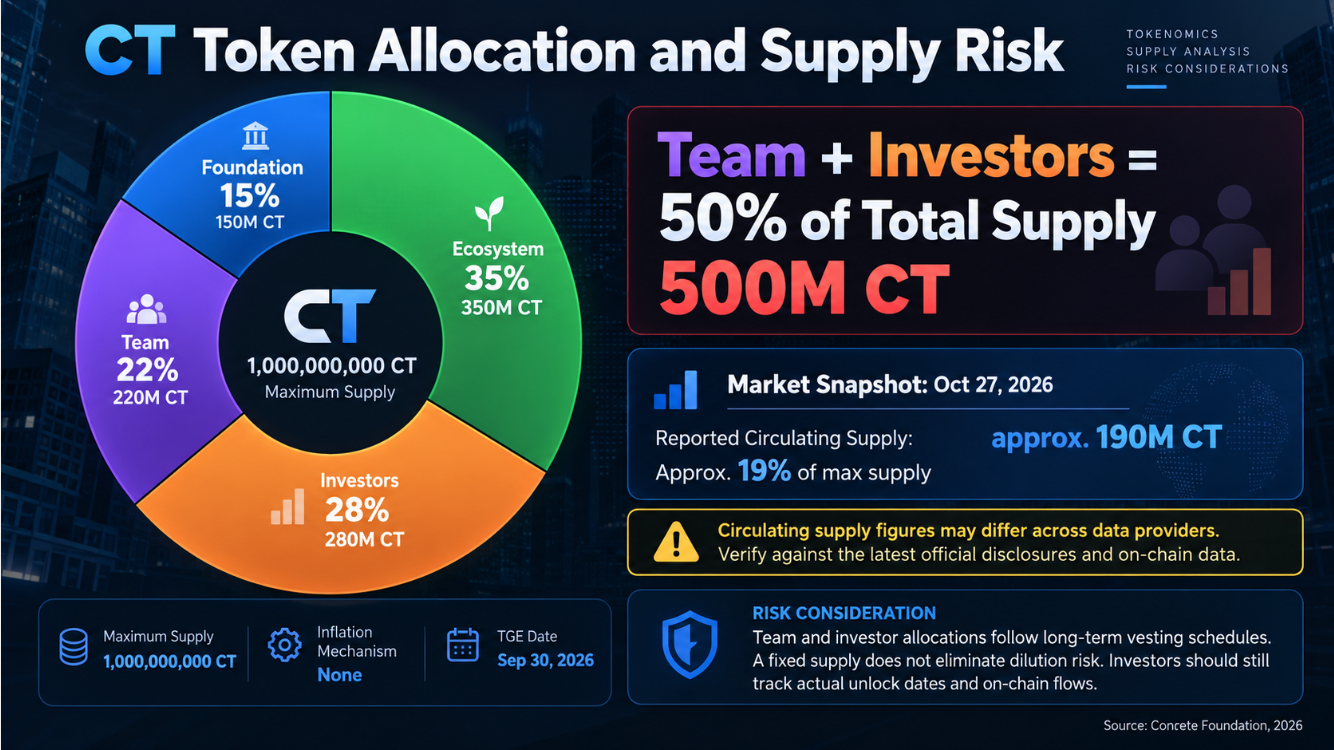
As of October 27, 2026, the CoinMarketCap page shows CT's circulating supply at approximately 190 million tokens, or 19% of maximum supply; based on a price of approximately $0.18, the circulating market cap is approximately $34.7 million, and the fully diluted valuation is approximately $183 million.
The calculation method is:
Circulating market cap=price×circulating supply
FDV=price/1 billion tokens
MC/FDV=190million/1 billion=19%
This means that, under this statistical basis, about 81% of maximum supply has not yet been included in circulating market cap. Even if much of it is still in vesting, treasury, or ecosystem arrangements, investors still need to face the issue of future supply increases.
More alarming is that different platforms are not fully consistent. CoinGecko did not provide a usable circulating market cap during the same period, while some third-party websites gave significantly different supply figures; 24-hour trading volume may also differ by several times or more across aggregators.
Reasons for the differences may include:
- Different statistical update times.
- Whether vesting contracts or foundation wallets are counted as circulating.
- Whether all spot and derivatives markets are included.
- Whether abnormal trades or duplicate data are filtered.
- Whether cross-chain tokens are counted more than once.
Therefore, formal investment decisions cannot rely only on the figure most favorable to one's own conclusion. A more prudent approach is to simultaneously verify official supply arrangements, large onchain addresses, exchange spot depth, and at least two independent data sources.
VIII. Where to Buy CT? Which Platforms Allow Purchasing Concrete Token?
The Concrete Foundation currently lists third-party venues including OKX, Binance Alpha, Coinbase, Gate, Bitget, Kraken, Bitvavo, KuCoin, and MEXC. CoinGecko's market page also includes markets such as Upbit and PancakeSwap.
Here, three types of access points must be distinguished:
- Centralized exchange spot markets: users usually buy and sell through trading pairs such as CT/USD, CT/USDT, or CT/KRW.
- Aggregator or Alpha-type access points: whether they are standard order-book spot, onchain aggregated trading, or wallet functionality must be checked on the product page.
- Decentralized trading pools: users interact directly with smart contracts and need to verify the network, contract address, pool liquidity, and slippage.
"The platform name appears on the official Venues page" does not mean every region or every account can trade. Listing time, trading pairs, deposit and withdrawal networks, KYC requirements, and jurisdictional restrictions are all determined by third-party platforms.
What to Pay Attention to When Viewing CT on HIBT
Readers can open the CT real-time quotes page to verify CT/USDT, and can also view CT price prediction to understand the platform's displayed models or market expectations.
However, quote pages and prediction pages serve different purposes:
- Quote pages should be used to verify real-time prices, trading volume, order book depth, and trading status.
- Prediction pages can only serve as model or expectation references and cannot replace the real-time order book.
If the quote page shows a price of 0, trading volume of 0, or no executable bid/ask order book, one cannot claim that HIBT has opened a tradable CT spot market. At this point, platform announcements and trading pages should be checked to confirm whether it is truly listed, whether there is only a display page, and whether deposit and withdrawal networks are open.
The Correct Process Before Buying CT
- Verify the official contract address from the Concrete Foundation.
- Confirm the network and trading pair supported by the trading platform.
- Check the real-time order book, not just the last traded price.
- Compare the bid-ask spread and ±2% depth.
- Place a small test order to confirm execution and withdrawal processes.
- If onchain holding is required, then verify the withdrawal address and network.
Do not transfer funds directly based on same-named "CT" search results, and do not connect wallets through unfamiliar private messages or unofficial airdrop pages.
IX. Why CT Price Volatility May Be Much Greater Than Changes in Concrete's Business
CT has been listed for only a short time, and price discovery is still ongoing. Even if Concrete's deposit scale does not change dramatically within a day, CT may still experience large fluctuations due to new exchange listings, Korean market trading, airdrop claims, contract speculation, and liquidity changes.
When judging short-term price action, at least the following must be considered simultaneously:
- The ratio of spot trading volume to perpetual contract trading volume.
- ±2% order book depth on major exchanges.
- Whether there are obvious price gaps between different markets.
- Whether foundation, airdrop, investor, and team-related addresses are transferring tokens.
- Whether staking volume is increasing and what actual rights staking provides.
- Whether the rise is accompanied by an increase in circulating supply.
High trading volume alone cannot prove that long-term capital is buying. It may also come from high-frequency turnover, market making, arbitrage, or leveraged positions. What truly determines whether large investors can exit is market depth, not the large 24-hour trading volume displayed on a page.
X. Why Concrete's Growth Does Not Necessarily Make CT Rise
This is the most important counterintuitive conclusion of the entire article.
Suppose Concrete's deposits grow from $1.3 billion to a higher level, but clients can continue to use most products without holding CT, and the savings from fee adjustments are insufficient to stimulate purchases. In that case, product growth may not bring CT demand of the same scale.
Conversely, if a large number of institutions buy and lock CT for the long term to obtain fee advantages, governance rights, or configuration permissions, even if protocol TVL growth is not as fast as the market imagines, token supply and demand may still improve.
Therefore, CT's value capture should not use the simple model of "higher TVL means higher token price," but should be broken into four steps:
- Does Concrete obtain real, sustained product usage?
- Does product usage generate verifiable protocol revenue or fees?
- Must users buy, lock, or stake CT to obtain valuable rights?
- Can new demand cover the supply brought by ecosystem incentives and unlocks?
Only when all four steps hold can Concrete's growth be stably transmitted to CT.
XI. What Is CT's Biggest Investment Opportunity?
Opportunity 1: Institutional Asset Onboarding Continues to Expand
If more exchanges, wallets, custodians, and asset issuers want to offer onchain yield products, Concrete's white-label vaults, risk control, and custody integrations may see stronger demand.
Opportunity 2: Governance Gradually Shifts from Multisig to Token Governance
Current official disclosures indicate that governance is still in the process of gradually transitioning from foundation and multisig management to token governance. If important decisions are truly controlled by participants who lock CT, the practical value of governance rights may increase.
Opportunity 3: Fee Configuration Creates Quantifiable Savings
As protocol scale expands, even small fee adjustments may have obvious value for high-frequency or large users. If the rules for fee rights are public, stable, and cover more products, staking demand for CT may strengthen.
Opportunity 4: Cross-Chain and Product Expansion Increase Usage Scope
CT uses a cross-chain design, and Concrete also plans to expand networks and institutional integrations. Broader product coverage may increase governance and configuration demand, but cross-chain also adds bridge, messaging, and liquidity fragmentation risks.
XII. What Is CT's Biggest Investment Risk?
1. Insufficient Value Capture
Protocol growth may mainly benefit depositors, partner institutions, or the foundation treasury without creating sufficient CT purchase and locking demand.
2. Unlock and Supply Pressure
The team and investors together account for 50%, while the ecosystem and foundation account for another 50%. A fixed total supply does not mean there is no dilution risk; unissued tokens entering the market will still change supply and demand.
3. Governance Is Still in a Gradual Decentralization Phase
The MiCAR whitepaper states that governance is currently still managed by a foundation-led multisig structure and plans to gradually migrate to token governance time locks. Plans do not equal completion; governance authority and timelines need continuous verification.
4. Smart Contract and Strategy Risk
Audits can reduce some risks but cannot guarantee the absence of vulnerabilities. Concrete also depends on underlying DeFi protocols, oracles, custody systems, signing infrastructure, and external networks, and any link may fail.
5. Cross-Chain Risk
CT and Concrete products involve multi-chain deployment. Cross-chain messages, bridged assets, and liquidity on different chains may experience failures, delays, or price deviations.
6. Vault Liquidity and Withdrawal Queue Risk
Vault shares may be subject to withdrawal queues or underlying asset liquidity restrictions. The yield displayed on the protocol website does not mean users can exit at any time without slippage.
7. Market Data Distortion Risk
Different aggregators have different statistics for circulating supply and trading volume. If investors mistake derivatives volume, abnormal trades, or cross-chain duplicate data for real spot demand, they may severely misjudge market strength.
8. Regulatory and Regional Restrictions
CT's MiCAR whitepaper is used to support its trading access, but official marketing materials also state that it has not been reviewed or approved by EU competent authorities. Trading eligibility, tax, and regulatory requirements in various regions may change.
9. Dual Risks of Token Price and Protocol Security
Investing in CT and depositing assets into Concrete vaults are two different risk exposures. The former mainly bears price, supply, and liquidity risk; the latter also bears vault, strategy, and underlying protocol risk. Buying CT does not automatically grant vault yield, and depositing into vaults does not mean one must hold CT.
XIII. Is CT Worth Buying? First Pass Three Verification Thresholds
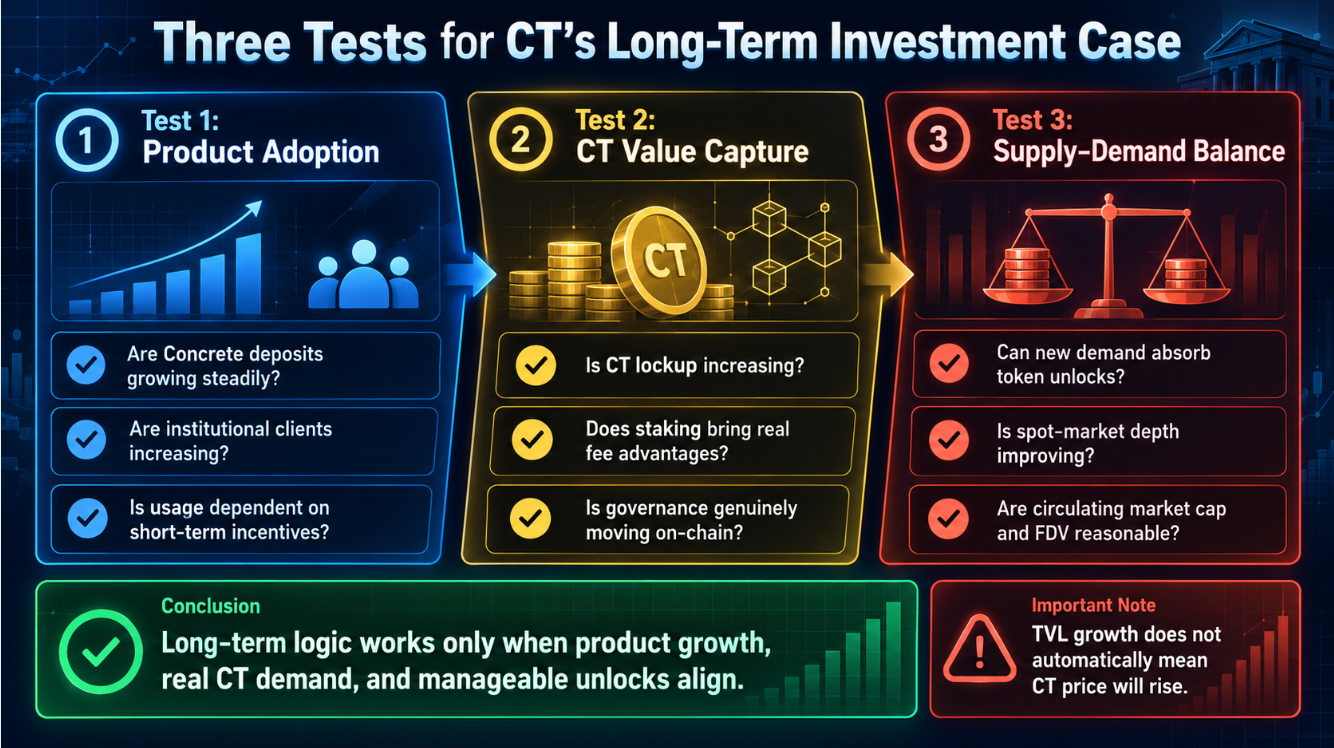
My judgment is: Concrete is worth continuous tracking, but CT is currently more appropriately viewed as an early-stage, highly volatile infrastructure governance token rather than an already-verified long-term blue-chip asset.
Before raising the long-term assessment, I would require it to pass three thresholds.
Threshold 1: Product Growth Must Be Sustainable
Deposits, processing volume, and user numbers need to continue growing, and growth cannot rely only on short-term high-yield subsidies. Institutional integrations should translate into real, retained assets and usage.
Threshold 2: Product Usage Must Translate into CT Demand
There needs to be an increase in staking volume, locked volume, governance participation, and fee configuration usage. If clients use Concrete heavily but have no need to buy or lock CT, token value capture remains weak.
Threshold 3: New Demand Must Cover Supply Release
As team, investor, and ecosystem tokens gradually enter circulation, spot buy pressure and locking demand must expand simultaneously. Otherwise, even a fixed total supply cannot prevent price pressure caused by rising circulating supply.
If all three are improving, CT's long-term logic will strengthen; if only TVL rises while staking, governance, and spot demand do not change, I will not raise the valuation because of it.
XIV. What Should Be Looked at in CT Price Prediction?
Readers can refer to CT price prediction, but no prediction should replace supply and demand analysis. When CT has been listed for less than a month, the historical sample is very short, and the reliability of using candlesticks to extrapolate multi-year target prices is very low.
A more reasonable approach is to build three scenarios.
Optimistic Scenario
Concrete's institutional clients and deposit scale continue to grow; staking and locking CT bring clear fee advantages and governance rights; spot liquidity improves; team, investor, and ecosystem releases are absorbed by new demand.
In this case, the market may assign CT a higher valuation as an infrastructure governance token. But investors should still measure both circulating market cap and FDV, rather than looking only at unit price.
Neutral Scenario
Concrete's products continue to develop, but CT demand remains mainly at the governance narrative level, fee configuration usage is limited; the market can absorb part of new supply but does not form strong locking demand.
In this case, CT may remain highly volatile and range-bound for a long time, with prices driven more by market cycles and listing events.
Pessimistic Scenario
Protocol growth slows, governance decentralization is delayed, staking rights lack appeal, or token releases outpace new demand; at the same time, overall crypto market risk appetite declines.
This would bring FDV contraction, declining liquidity, and long-term sell pressure. Even if Concrete's products are still running, CT may still perform poorly.
XV. Why BTC and ETH Cycles Still Affect CT
CT's fundamentals come from Concrete, but its trading still takes place in the crypto market. BTC and ETH trends affect risk appetite, stablecoin capital, DeFi valuations, and market-making depth.
You can combine BTC price prediction to judge whether the market is in a risk-expansion phase, and also refer to ETH price prediction to observe the overall valuation environment for DeFi and onchain assets.
But it must be clear:
- A BTC rise does not automatically increase Concrete's protocol revenue.
- An ETH rise does not automatically increase CT locking demand.
- Broad market conditions can only improve the market environment and cannot replace project fundamentals.
For low-float, newly listed tokens, broad market drawdowns often amplify price volatility. Position management should first assume that CT's decline may be significantly larger than that of BTC and ETH.
XVI. What Is the Difference Between CT and AXIS? Do Not Put All Infrastructure Tokens into the Same Model
If investors are also paying attention to What Is AXIS, they should first compare sources of value rather than comparing whose gains are larger.
CT's core logic is onchain financial infrastructure, vaults, institutional custody integrations, and governance and fee configuration demand. It should be observed through deposits, processing volume, institutional clients, protocol fees, staking volume, and unlocks.
If AXIS belongs to the Physical AI or related data infrastructure direction, then devices, data, network participants, customer usage, and token value capture in the physical network need to be observed.
Both may be called "infrastructure tokens," but their industry demand, business models, supply pressure, and valuation methods are completely different. Misclassification is often more dangerous than a wrong price judgment.
XVII. What Strategies Should Different Types of Investors Adopt?
Long-Term Investors
Do not establish long-term positions based on short-term price movements after TGE. At minimum, continuously track product usage, staking volume, governance progress, fee mechanisms, and circulating supply changes for two quarters.
Signals that the long-term logic has failed include: protocol data grows but CT locking demand stagnates, governance does not materially transfer for a long time, fee rights lack user adoption, and large unlocks continue to enter trading platforms.
Swing Traders
Focus on listing events, exchange price gaps, spot depth, funding rates, and large address transfers. Do not look only at trading volume; if trading volume is large but ±2% depth is small, exit risk remains high.
Beginner Investors
It is more suitable to wait for data to stabilize. Do not take heavy positions just because of "institutional-grade," "fixed supply of 1 billion," or "TVL exceeding $1 billion." Fixed supply does not mean low circulating supply risk, and institutional products do not mean the token has institutional asset backing.
Staged Verification Strategy
If deciding to participate, the planned capital can be divided into an observation position, a confirmation position, and a trend position. Increase risk exposure only when product data, CT usage, and supply-demand structure continue to improve; if key assumptions are disproven, stop adding positions.
Position size should be determined by the maximum acceptable loss, not by target price.
XVIII. Ten CT Indicators I Will Track Long-Term
- Concrete's real-time deposit scale and its composition.
- Cumulative processing volume and new processing volume, not just historical totals.
- Number of active vaults, institutional clients, and partner integrations.
- Protocol revenue and its sources.
- The ratio of CT staking volume and locked volume to circulating supply.
- Number of governance proposals, participation rate, and whether power is truly migrating onchain.
- Products covered by fee adjustment functionality and actual usage scale.
- Unlocks and onchain flows of team, investor, ecosystem, and foundation tokens.
- Depth, spreads, and independent trading volume in major spot markets.
- The degree of matching between circulating market cap, FDV, and actual protocol usage.
These ten indicators can be compressed into one judgment formula:
Product adoption × real CT demand × supply discipline × market liquidity ÷ current valuation.
If there is only product adoption without CT demand, the token may fail to capture value; if there is CT demand but the valuation has already priced in years of growth, it may likewise not be a good price.
XIX. Frequently Asked Questions About CT Token
What Is CT Token?
CT is the governance and configuration token of the Concrete ecosystem, used for locking to participate in governance and for staking to obtain certain protocol-side fee configuration rights.
What Is the Concrete Project?
Concrete is onchain yield and asset management infrastructure, with products including public or permissioned vaults, white-label enterprise infrastructure, and custodial asset onboarding solutions.
What Is CT's Total Supply?
The fixed total supply is 1 billion tokens. Officials state that there is no inflationary issuance mechanism, and all supply was minted at TGE.
What Is CT's Token Allocation?
Ecosystem 35%, investors 28%, team 22%, foundation 15%. Team and investor shares have long-term vesting arrangements.
Does CT Have Dividends or Protocol Revenue Sharing?
No. Officials clearly state that CT does not grant equity, debt, dividends, profit sharing, or claims on protocol assets.
Can Merely Holding CT Participate in Governance?
Not necessarily. Official mechanisms require locking CT to participate in governance; specific eligibility, duration, and parameters should be based on the governance contract and latest rules.
On Which Platforms Can CT Be Purchased?
The Concrete Foundation lists third-party venues including OKX, Binance Alpha, Coinbase, Gate, Bitget, Kraken, Bitvavo, KuCoin, and MEXC. Actual availability, trading pairs, and regional restrictions are determined by each platform.
Can CT Be Bought on HIBT?
This should be based on HIBT's real-time trading page and official listing announcements. The existence of only a quote or prediction page is insufficient to prove that the spot market has opened. If there is no price, trading volume, or order book, it should not be treated as "listed and tradable."
Why Is CT Price So Volatile?
Main reasons include short listing time, price discovery, new exchange listings, limited circulating supply, airdrop and unlock expectations, contract trading, and changes in market depth.
What Is CT's Biggest Risk?
The biggest structural risk is that Concrete's product growth does not translate into sufficient CT demand, while future token releases increase market supply.
Will Concrete's TVL Growth Make CT Rise?
Not necessarily. TVL may improve token value capture only when it brings revenue and further increases CT locking, staking, or payment demand.
Is CT Suitable for Long-Term Holding?
Current evidence is still insufficient to view CT as a mature long-term blue chip. Long-term investors should wait for more verification of value capture, governance implementation, and supply release.
How Should CT Price Prediction Be Viewed?
Scenario analysis should use product adoption, CT demand, circulating supply, unlocks, liquidity, and FDV. It is not appropriate to give precise multi-year target prices based on short-term candlesticks.
XX. Final Conclusion: Concrete Is Worth Studying, but CT Still Needs to Prove Value Capture
Concrete has already demonstrated real product scale: it has onchain vaults, white-label infrastructure, institutional custody integrations, and deposits above the billion-dollar level. Compared with projects that have only concepts and roadmaps, these data form a more reliable research foundation.
But CT's investment conclusion cannot be directly derived from these achievements.
CT is a governance and configuration tool, not Concrete equity, nor a protocol revenue dividend certificate. The official design gives locking and staking functional significance, but the market still needs to prove whether these rights can form sufficiently strong and durable token demand. At the same time, investors must also face the release schedule within the fixed supply of 1 billion tokens: the team and investors together account for 50%, and the use of ecosystem and foundation funds will also affect future circulation.
Therefore, my judgment on CT is:
Concrete is onchain financial infrastructure worth tracking, while CT is a high-risk, early-stage governance and configuration asset whose value still needs to be verified.
I will not conclude that CT is cheap just because TVL is high, nor will I ignore unlocks just because supply is fixed. I will wait for three pieces of evidence: sustained growth in product usage, usage that can translate into CT locking or staking demand, and new demand sufficient to absorb future releases.
If these three pieces of evidence gradually appear, CT's long-term investment logic will become more convincing; if only protocol scale grows while token demand stagnates, governance is delayed, and circulating supply continues to rise, then even the strongest "institutional onchain finance" narrative will not be enough to support long-term bullishness.
Main Sources
- Concrete Foundation: CT homepage, official contract, and trading venues
- Concrete Foundation: CT TGE and Tokenomics
- Concrete Foundation: CT MiCAR White Paper
- Concrete: Products and institutional-grade onchain financial infrastructure
- Concrete Docs: Glossary and vault standards
- CoinGecko: CT market and trading depth
- CoinMarketCap: CT price, circulating supply, and market data
Risk disclosure: This article is for information and research purposes only and does not constitute investment advice, a promise of returns, or a purchase recommendation. Crypto asset prices are highly volatile, and you may lose all of your principal. Please make decisions based on the laws of your region, your personal risk tolerance, and independent verification.