
I. Introduction: Why Is an API3 Price Prediction Harder to Write Than Most?
API3 is a project that is difficult to explain clearly in a single sentence.
Like Chainlink, it operates within the "oracle" sector, but it does not simply copy Chainlink's model. Chainlink functions more like a third-party oracle network, aggregating data from multiple sources before providing it to smart contracts. In contrast, API3 emphasizes first-party oracles, which allow the data providers themselves to run nodes directly, bringing data onto the blockchain.
This might sound like a minor technical variation, but it heavily impacts investment theses:
- If API3's first-party oracle model gains market validation, it has an opportunity to secure a highly differentiated position across DeFi, RWAs (Real World Assets), cross-chain applications, AI Agents, and multi-chain data services.
- If the market continues to believe that Chainlink's sheer scale, network effects, and comprehensive product suite are irreplaceable, API3 may find itself relegated to a long-term niche alternative.
This is precisely why price predictions for API3 are so polarized. Bullish investors point to its low market cap and argue that once the OEV (Oracle Extractable Value) network matures, API3 could witness a multi-fold or even ten-fold valuation recovery. Bearish perspectives argue that entrenched competitors like Chainlink, Pyth, and RedStone are simply too dominant, making it incredibly difficult for API3 to capture mainstream market share.
As of May 2026, CoinMarketCap shows the price of API3 floating around $0.34, with a circulating supply of approximately 86.42 million tokens and a market cap hovering around the $30 million level, ranking outside the top 500 digital assets. This highlights that API3 remains a small-to-mid-cap infrastructure token rather than a mainstream market asset.
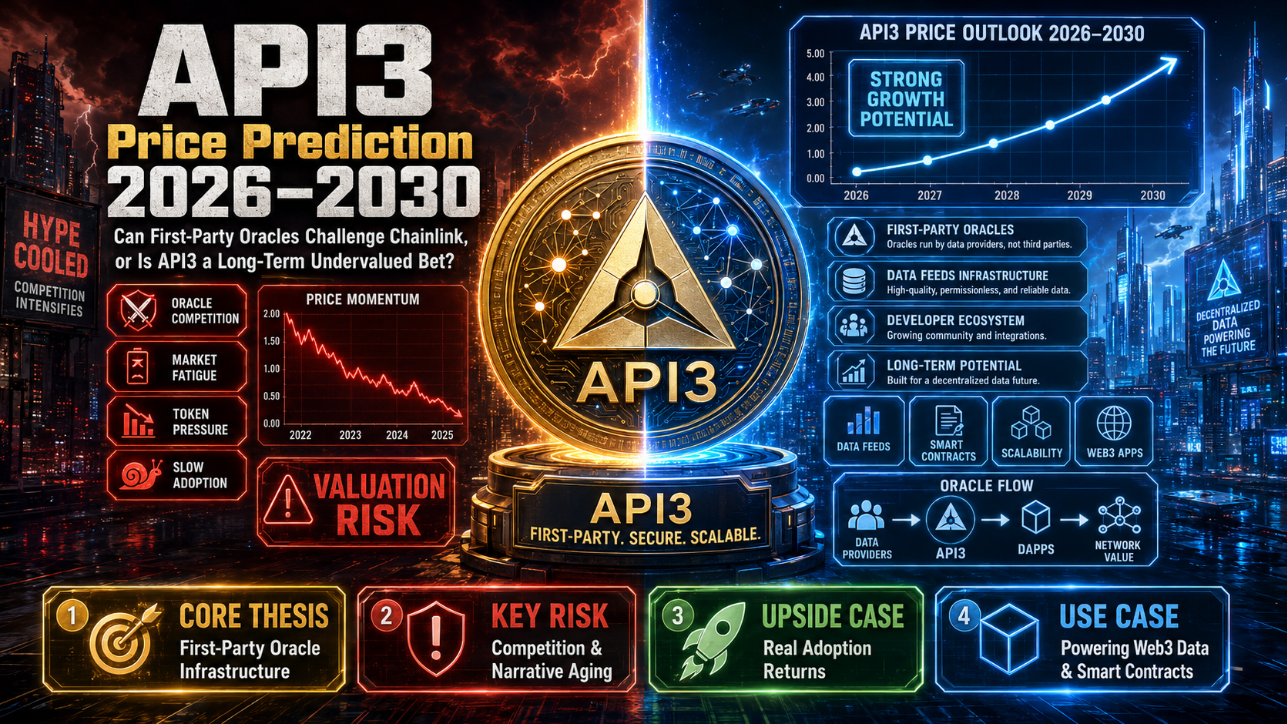
This article avoids pulling a arbitrary figure out of thin air for "how much it will hit in 2030." Instead, it breaks down the fundamentals, the oracle landscape, OEV revenue streams, competitive dynamics, tokenomics, and market cycles to project several realistic price trajectories for API3 from 2026 to 2030.
II. What Exactly Is API3? Three Core Concepts Newcomers Must Understand
Concept 1: First-Party Oracles vs. Third-Party Oracles
To understand API3, you must first understand the function of an oracle.
Blockchains are inherently isolated and cannot natively fetch real-world, off-chain data—such as ETH/USD prices, stock markets, weather data, sports scores, foreign exchange rates, or commodity pricing. If a DeFi protocol wants to facilitate lending, liquidations, derivatives, or insurance, it requires trusted external data inputs. This bridging service is performed by an oracle.
Chainlink's classic design relies on a third-party oracle network, where independent nodes fetch data from providers, aggregate it, and deliver it to smart contracts.
API3 flips this premise: Why not eliminate the middleman and let data providers push data straight onto the blockchain themselves? This is a first-party oracle. Official API3 documentation highlights that its dAPIs and oracle stack grant dApps access to highly decentralized, direct data sources. Furthermore, API3’s brand messaging has pivoted toward the slogan "Oracles that pay you," emphasizing that the network does not just deliver data, but actively recaptures revenue for protocols via its OEV mechanism.
- The advantage: Lower middleman layers, enhanced data accountability, and a more direct relationship between data creators and on-chain applications.
- The disadvantage: Chainlink commands massive network effects. Developer habits, integration counts, flawless safety records, and vast product matrices favor the incumbent. No matter how innovative API3's model is, it requires substantial mainstream integration to prove itself.
Concept 2: What Are dAPIs?
A dAPI can be understood as a Decentralized API.
Traditional APIs are data interfaces provided by centralized corporations or platforms (e.g., exchange price APIs, weather APIs, or stock market feeds) that traditional applications call upon to read data.
A dAPI places these API services inside an on-chain, verifiable environment, allowing smart contracts to interact with them natively. API3’s core goal is to enable data providers to seamlessly push their API data onto blockchains so DeFi and other applications can consume it directly.
For DeFi protocols, the value proposition of a dAPI is clear: lending protocols need price data, derivatives protocols require index feeds, RWA platforms need real-world asset values, and prediction markets require external event resolutions. If dAPIs achieve widespread adoption among on-chain applications, API3 will secure a robust, long-term fundamental floor.
Concept 3: What Is OEV and Why Does It Matter?
OEV stands for Oracle Extractable Value.
In DeFi, real-time price updates inherently trigger liquidations, arbitrage opportunities, and trade executions. Historically, this value was extracted by searchers, MEV (Maximal Extractable Value) bots, or external block builders, leaving the protocol and its users empty-handed.
API3's OEV network is designed to reclaim this leak: it allows dApps using API3 data feeds to claw back a portion of the OEV generated during oracle updates. According to API3's official documentation, when a dApp integrates an OEV Rewards-enabled contract, API3 generates a report at the end of each month and routes 80% of the extracted OEV revenue back to the dApp in the form of the network's native Gas token, while reserving the remaining portion as a protocol fee.
This is where API3's value capture becomes incredibly compelling:
- Traditional Oracles: You pay the network to buy data.
- API3 Model: You use the data, and you potentially earn back OEV revenue.
If this model scales effectively, API3 shifts from a simple data utility into an infrastructure piece that actively optimizes a DeFi protocol's revenue model.
Quick Glance at API3 Tokenomics
The API3 token is primarily utilized for DAO governance, staking, and ensuring protocol security. DAO documentation shows that the API3 Pool contract allows holders to stake tokens to earn voting power, accumulate inflationary or protocol rewards, or delegate their voting rights to other participants.
This confirms that API3 is not a cosmetic governance token; it is structurally tied to protocol alignment and security. However, investors must remember that staking yields alone do not guarantee price appreciation. Long-term appreciation depends entirely on dAPI adoption rates, expanding OEV revenues, collected protocol fees, and expanding market share.
III. Six Core Variables Determining API3's Price
Variable 1: The Macro Health of the Oracle Sector
Oracles are the bedrock infrastructure of DeFi. As long as decentralized finance, tokenized RWAs, on-chain derivatives, lending protocols, decentralized stablecoins, and prediction markets grow, aggregate oracle demand will inevitably scale alongside them.
However, sector expansion does not automatically guarantee windfalls for API3. Chainlink remains the unchallenged titan of this space. DefiLlama’s revenue tracking outlines that Chainlink continues to generate substantial fee revenue across multiple chains from services covering data requests, automation keepers, VRF (Verifiable Random Function), CCIP (Cross-Chain Interoperability Protocol), and staking modules.
API3's window of opportunity lies in structural differentiation, specifically through OEV reclamation and first-party efficiency. If the market prioritizes historical security track records and established scale above all else, Chainlink wins. If protocols begin prioritizing OEV optimization, structural transparency, and rapid multi-chain deployments, API3 can be aggressively repriced.
Variable 2: The API3 vs. Chainlink Market Share Battle
API3 does not need to fully dethrone Chainlink to be a highly lucrative investment. It simply needs to capture a respectable market share within specific sub-niches to trigger a major valuation rerating.
For example, small-to-mid-sized DeFi protocols are acutely sensitive to cost structures and OEV leaks, making them prime candidates for API3 integration. Similarly, emerging layer-1 and layer-2 networks require rapid, cost-effective data deployments. However, Chainlink's moat is deep. It commands the vast majority of blue-chip integrations and institutional branding. To break through, API3 must demonstrate consistent migration numbers rather than just relying on theoretical architectural advantages.
Variable 3: The True Income-Generating Capacity of the OEV Network
OEV is the ultimate fundamental variable for API3's growth.
DefiLlama's data on API3 protocol revenue indicates that the network generated roughly $378,000 in Gross Protocol Revenue in Q1 2026, and sits around $241,000 for Q2 to date. Crucially, the bulk of this income is recorded under Asset Yields, while Token Holder Net Income currently displays as 0.
This data is vital for investors. It proves that while API3 is successfully generating fundamental revenue, the scale remains modest, and it has not yet converted into direct net income distributed straight to token holders. Consequently, from 2026 to 2030, the primary focus should not be the existence of OEV, but rather:
- Is OEV revenue scaling sequentially quarter-over-quarter?
- How many major dApps are actively activating OEV rewards?
- How are the protocol-retained fees being utilized or distributed?
- Will the market eventually revalue API3 based on a strict price-to-earnings (P/E) or protocol fee model?
Until these mechanics become fully realized, OEV remains an excellent thesis. Once they manifest in the numbers, the valuation logic for API3 changes permanently.
Variable 4: The Velocity of Multi-Chain Expansion
API3’s ultimate valuation depends heavily on multi-chain horizontal expansion rather than just capturing market share on the Ethereum mainnet.
The official API3 platform highlights that the network supports over 100+ data feeds across supported chains, displaying active implementations across various DeFi protocols utilizing its data infrastructure and OEV Rewards. Case studies published on CoinGecko reiterate that API3 provides transparent, on-chain pricing feeds across more than 40 EVM-compatible chains, blending its first-party oracle node design with native OEV infrastructure.
With capital spreading across networks like Base, Arbitrum, Optimism, Scroll, Mantle, Core, Sonic, Monad, and Berachain, establishing an early-mover footprint on emerging chains allows API3 to secure market share before competitor integrations lock up the market.
Variable 5: Staking Participation and Circulating Float
API3's native staking mechanics directly influence liquid market supply. As detailed in API3 DAO documentation, token holders can commit their capital into the DAO pool to secure governance rights and inflationary staking rewards.
High staking participation restricts the active circulating float, creating high upward price elasticity during demand spikes. However, if staking rewards are sustained primarily via token inflation rather than being backed by organic protocol revenues and OEV fee capture, it can create long-term dilutive structural pressure. Staking metrics must always be assessed in tandem with protocol cash flows.
Variable 6: Macro Crypto Market Cycles
As a small-to-mid-cap infrastructure asset, API3 exhibits high beta characteristics and is deeply sensitive to macro crypto liquidity cycles.
When BTC and ETH lead a market charge, capital consolidates into blue-chip assets before rotating downward into DeFi, RWAs, oracles, interoperability layers, AI, and meme coins. API3 is rarely a first-mover in a macro expansion cycle, but during an altcoin rotation phase, its low market cap allows for massive upside volatility. Conversely, during liquidity contractions or bear markets, small-cap infrastructure tokens experience severe drawdowns.
IV. Review of API3's Current Status (2025–2026): Assessing the Foundation
The current status of API3 can be categorized as follows: depressed market valuation, highly differentiated narrative, infant-stage protocol revenue, and intense competitive headwinds.
With a token price around $0.34 and a market cap near $30 million, API3 is a micro-cap asset when compared directly against Chainlink's multi-billion-dollar valuation. Product-wise, the project has successfully evolved its core narrative from basic "first-party data delivery" into a comprehensive "OEV Rewards" infrastructure network, boasting integrations with platforms like Yei Finance, Compound Finance, Morpho, and Moonwell.
While DefiLlama records measurable protocol revenues, the absolute numbers remain in their early stages. API3 is currently in a critical phase where its theoretical architectural advantages must convert into aggressive protocol acquisition and verifiable cash-flow growth.
V. 2026 API3 Price Prediction: Can OEV Commercialization Act as a Price Catalyst?
The year 2026 serves as a massive validation period for API3's commercial rollout. If OEV network fees scale and a growing number of mid-tier protocols integrate API3 data feeds to claw back lost arbitrage value, the market will likely begin rerating the token as a yield-optimizing infrastructure layer rather than a generic oracle clone.
- Bearish Scenario: If macro liquidity tightens, aggregate DeFi TVL contracts, and OEV revenue growth stalls, API3 will likely consolidate within a compressed $0.20–$0.50 range, reflecting valuation headwinds common to small-cap infrastructure assets during market corrections.
- Neutral Scenario: If the market chops sideways but API3 maintains a steady clip of protocol integrations and modest OEV growth, the token could recover toward the $0.60–$1.20 zone, representing an orderly, fundamental-driven recovery.
- Bullish Scenario: If BTC and ETH sustain an expansionary macro environment, DeFi TVL rebounds, and API3 logs breakout OEV numbers alongside blue-chip dApp integrations, the token could rally to $1.50–$3.00, powered by market validation of its commercial monetization model.
Strategic Note for 2026: Newcomers should favor a "milestone verification + tiered accumulation" approach. Buying strictly on a narrative means accepting long periods of sideways or downward price action. Waiting for confirmed adoption milestones minimizes downside risk at the cost of entry premium.
VI. 2027 API3 Price Prediction: Achieving Local Breakouts Against Chainlink
By 2027, the central thesis for API3 hinges on whether the market broadly accepts first-party architectures as a superior alternative for cost and revenue optimization. If dAPI counts, OEV fee revenues, and multi-chain deployments print strong sequential growth, API3 can comfortably cement its status as the most fundamentally unique alternative oracle option in the second-tier bracket.
- Pessimistic Scenario: If integration growth decelerates while Chainlink successfully expands its dominance across CCIP, Data Streams, and Automation modules, API3 could find its market share squeezed by alternative players like Pyth or RedStone, sliding back to $0.25–$0.70.
- Neutral Scenario: API3 maintains an orderly presence, trading between $0.80–$1.80. It retains a sticky, dedicated user base of specialized DeFi applications but fails to build a powerful, industry-wide consensus narrative, remaining an effective alternative rather than a dominant market disruptor.
- Optimistic Scenario: Driven by OEV networks becoming an indispensable revenue reclamation tool for mainstream DeFi applications, API3 could claim a price range of $2.50–$5.00, especially if it establishes itself as the default oracle infrastructure on multiple high-throughput emerging chains.
The structural risk in 2027 is a counter-offensive by incumbents. If Chainlink deploys a highly competitive native OEV-capture variant or competing oracles outpace API3 on business development and developer onboarding, API3's differentiation moat could narrow significantly.
VII. 2028 API3 Price Prediction: The Halving Cycle and the AI + DeFi Convergence
The year 2028 aligns with the next Bitcoin halving cycle, paired with a more mature intersection of AI Agents and blockchain technology. API3 stands a chance to capitalize on a dual structural narrative: a macro DeFi resurgence and real-time data ingestion requirements for autonomous AI infrastructure.
As autonomous AI Agents scale their footprint across on-chain execution, automated risk modeling, liquidity management, and high-frequency arbitrage, their dependency on direct, low-latency, tamper-proof data interfaces will scale exponentially. Oracles will shift from simply supplying price feeds for human-driven dApps into acting as the primary data ingestion gateways for AI-driven financial layers.
- Pessimistic Scenario: If the halving fails to generate strong structural liquidity expansion and the AI-agent integration narrative remains largely speculative, API3 will likely fluctuate within a modest $0.40–$1.00 range.
- Neutral Scenario: Backed by generalized market recovery and steady expansion of its core OEV products, API3 could comfortably reach $1.20–$3.00, though stopping short of becoming a primary market-leading asset.
- Optimistic Scenario: Powered by a full-scale infrastructure bull run where oracles are revalued as foundational data layers, API3 could surge toward $4.00–$8.00, assuming its OEV Cash flow mechanics are fully optimized and integrated globally.
VIII. 2029–2030 API3 Price Prediction: The Long-Term Fundamental End-Game
By 2029–2030, the absolute ceiling for API3 will be determined by whether it has secured its position as a standardized, permanent infrastructure layer for multi-chain financial applications. If the aggregate market size for DeFi, tokenized real-world assets, and automated on-chain agents expands into an enterprise-grade sector, the underlying addressable market for oracle data services will expand by orders of magnitude.
- Extreme Pessimistic Scenario ($0.20–$0.60): Chainlink and a handful of hyper-capitalized alternatives completely monopolize mainstream data delivery. API3 integrations grind to a halt, OEV fee generation drops to negligible levels, and the market drops the asset from its long-term thesis.
- Neutral Scenario ($1.50–$4.00): API3 secures a highly stable, cash-flow-positive, and permanent market share across several specific high-throughput networks and specialized protocols, operating as a solid mid-cap asset without threatening the structural dominance of the primary market leader.
- Optimistic Scenario ($5.00–$12.00): Driven by widespread, industry-wide implementation of dAPIs and the OEV network generating substantial, recurring capital inflows, API3 commands a prominent premium market share during a macro expansionary cycle.
- Extreme Optimistic Scenario ($15.00+): Achieving a valuation of this magnitude requires flawless fundamental execution: a massive macro expansion of global DeFi, universal implementation of API3 as the industry standard for OEV management, and a market fully willing to value the API3 token based on aggressive infrastructure price-to-revenue multipliers.
IX. Structural Risks of Investing in API3: Pitfalls to Moniter
Technical and Oracle Manipulation Risk
Oracles represent the ultimate attack vector for DeFi applications. If an oracle feed is successfully manipulated via flash loans, liquidity pool distortions, or architectural vulnerabilities, the underlying lending, stablecoin, and derivatives applications can face catastrophic capital liquidations. While API3’s first-party framework mitigates certain third-party node-collusion risks, it remains vulnerable to source data inaccuracies, contract-level exploits, or undiscovered edge cases in its OEV reclamation logic.
Aggressive Competitive Headwinds
Chainlink remains an absolute powerhouse with deep institutional relationships. If Chainlink rolls out native, highly efficient OEV-reclamation updates across its existing client network, API3’s core marketing edge could be blunted. Simultaneously, high-speed alternatives like Pyth and cost-efficient architectures like RedStone are aggressively fighting for the exact same market segment.
Liquidity and Float Dynamics
API3 trades with a modest market cap and comparatively thin daily volume (often hovering around the $9 million range according to CoinMarketCap). While this float dynamic is perfectly acceptable for retail participants, large institutional allocations or sudden exits can trigger severe slippage and aggressive intraday price volatility.
Value Capture Imbalances
This is the most critical risk for token holders: an expanding protocol revenue stream does not automatically translate to direct token value accumulation. As evidenced by current DefiLlama tracking, despite printing verifiable gross protocol revenues, the net income flowing directly back to token holders is currently recorded as zero. Investors must carefully monitor governance votes and protocol updates to ensure that rising OEV revenues structurally translate into token-level value capture.
X. Practical Allocation Strategies Based on Investor Profile
- Conservative Investors: API3 is best kept on a strict monitoring list or allocated via tiny, risk-controlled tranches. Do not over-allocate based on low market cap metrics; the asset carries high structural execution risks.
- Aggressive Investors: API3 can be utilized as a high-beta, high-elasticity play within the decentralized data sector, provided strict capital stop-losses and tiered take-profit targets are maintained.
- Milestone-Driven Investors: Postpone structural accumulation until three specific fundamental indicators register clear alignment: sequential growth in OEV-reclaimed fees, verifiable integration migration from legacy platforms, and a steady uptick in non-inflationary staking yields.
When executing trades, prioritize limit orders over market execution to protect against thin order-book slippage. To compare the underlying structural logic of API3 against alternative crypto sectors, you can analyze its positioning alongside:
- The 2030 AVAX Price Prediction to evaluate core public layer-1 infrastructure valuation metrics.
- The TWT Price Prediction to understand end-user application gateway mechanics.
- The 2030 SHIB Price Prediction to benchmark speculative community-driven momentum cycles.
Unlike these assets, API3 sits firmly in a highly specialized niche: a small-cap, cash-flow-dependent B2B infrastructure asset.
XI. Conclusion: The Core Ingestion Thesis
Allocating capital to API3 is ultimately a direct bet on three structural developments:
- Global smart contract applications will continue to scale their absolute demand for secure, real-time external data feeds.
- First-party validation architectures and OEV economic reclamation models offer a demonstrably superior financial return model for DeFi dApps compared to legacy alternatives.
- The API3 token mechanics will successfully adapt to route expanding protocol cash flows back to long-term token stakers.
Final Verdict:
- 2026: Focus entirely on the sequential financial monetization and traction of the OEV network.
- 2027: Track whether the project achieves meaningful market breakthroughs against incumbent networks.
- 2028: Look for structural revaluations powered by a macro halving cycle and the operational data demands of AI Agents.
- 2029–2030: The long-term price ceiling will be dictated by API3’s status as a standardized, built-in financial layer for global DeFi.
FAQ: Frequently Asked Questions Regarding API3 Price Prediction 2026–2030
What is API3?
API3 is a decentralized oracle network that delivers off-chain data directly to smart contracts via first-party nodes run by data providers themselves. It features a unique OEV (Oracle Extractable Value) network designed to capture and return lost arbitrage value back to decentralized applications.
How does API3 differ from Chainlink?
Chainlink relies primarily on third-party intermediary nodes to collect, aggregate, and deliver data onto a blockchain. API3 bypasses third-party networks entirely by enabling the data sources to push information directly on-chain, utilizing an OEV network architecture to optimize the cost-to-revenue models of integrated dApps.
Can API3 reach $10 by 2030?
Yes, but this trajectory requires the fulfillment of optimistic fundamental milestones: sustained, sequential scaling of OEV fee generation, widespread migration of blue-chip DeFi applications to dAPIs, and an expansionary structural bull market that assigns high valuation multiples to web3 data infrastructure.
What is the primary risk associated with API3?
The core risks center on fierce market competition from entrenched incumbents and ensuring that expanding gross protocol revenues translate cleanly into non-inflationary value capture for native token stakers.
Kindly Reminder
The contents of this article are intended strictly for educational and research purposes and do not constitute financial or investment advice. API3 is a small-cap, high-beta infrastructure asset that carries significant execution, technological, and competitive risks. Never over-allocate capital based strictly on low-market-cap metrics, and consistently monitor fundamental data updates across DefiLlama, official API3 repositories, and broader oracle sector integrations before committing capital.