
Introduction: Why Does IMX Deserve an Independent Predictive Analysis?
IMX is a token that is easily misunderstood.
When many people see IMX, they simply classify it as a generic Layer 2 token, or bind it together with the previous NFT craze, viewing it merely as a "legacy asset from the 2021 NFT bull market." This understanding is not entirely wrong, but it is far from accurate.
The core positioning of Immutable behind IMX is not a general-purpose Layer 2, but an infrastructure purpose-built for Web3 gaming and NFT assets. Officially, the Immutable Chain is described as a Layer 2 blockchain tailored specifically for gaming, providing players with gas-free transactions, Unity and Unreal SDKs, and ecosystem support targeted at on-chain games.
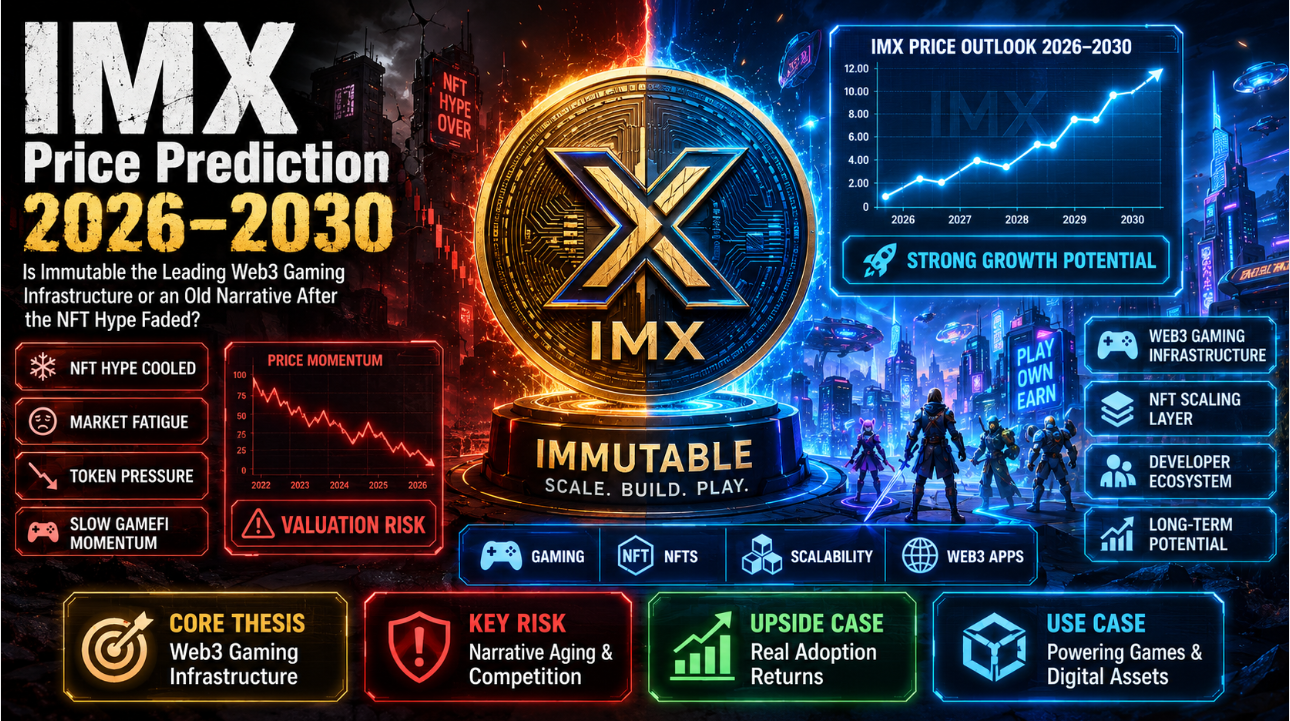
This means that the pricing logic of IMX cannot be evaluated solely by Ethereum scaling or NFT image trading volumes. It is genuinely betting on three directions:
- The Evolution of NFTs: Whether NFTs will transition from profile-picture (PFP) speculation toward gaming assets, digital collectibles, and on-chain ownership.
- The Quality of Web3 Gaming: Whether Web3 games will upgrade from simplistic "Play-to-Earn" structures to genuinely high-quality, fun games.
- Infrastructure Dominance: Whether Immutable can establish itself as the core infrastructure for Web3 gaming asset issuance, trading, and user growth.
As of May 2026, CoinMarketCap shows the price of IMX hovering around $0.16, with a circulating supply that has reached 2 billion tokens out of a maximum supply of 2 billion tokens, putting its market capitalization at approximately the $320 million level. This indicates that IMX has completed a significant portion of its circulating distribution. The primary question going forward is no longer just "unlock selling pressure," but rather "whether ecosystem growth can re-support its valuation."
This article will systematically analyze the long-term value of IMX from the perspectives of project fundamentals, historical price action, NFT and GameFi cycles, Immutable zkEVM, the competitive landscape, price deductions for 2026–2030, and investment strategies. This article does not exist to tell you that IMX will definitely hit a specific price point; instead, it is designed to help you determine whether IMX is a Web3 gaming infrastructure asset worth tracking for the long term, or simply a high-volatility altcoin left over from the last NFT bull market.
Chapter 1: What Is IMX — Understanding What You Are Investing In
1.1 The Core Positioning of Immutable: A Layer 2 Built Specifically for NFTs and GameFi
Immutable first became widely recognized by the market because it solved several legacy issues plaguing Ethereum NFT transactions: high gas fees, slow confirmations, poor user experience, and friction in trading gaming assets.
During the 2021 NFT bull market, these roadblocks were blindingly obvious. Users buying or selling an NFT frequently had to pay dozens or even hundreds of dollars in gas fees. While users were willing to tolerate this for high-priced PFP collections, this cost structure was completely unfeasible for high-frequency, low-priced assets like gaming items, cards, skins, and equipment.
Immutable’s positioning is to provide a more suitable underlying environment for these exact NFT and gaming assets. Rather than building a generic,the chain, it builds infrastructure directly around the experience of game developers and players: low fees, instant confirmation, asset trading rails, developer SDKs, market liquidity, and game publishing support.
Third-party educational materials also describe Immutable X as an Ethereum-based Layer 2 scaling protocol aimed at removing gas fees, boosting scalability, and integrating NFT liquidity through a global shared order book.
Therefore, the fundamental premise of IMX is not whether it has a "Layer 2 narrative," but rather "whether Immutable can become the default infrastructure for Web3 gaming assets."
- If Web3 gaming truly develops in the future, gaming assets will generate a massive demand for minting, trading, transferring, and composability, all of which could heavily benefit Immutable.
- If Web3 gaming fails to break out of its niche for an extended period, IMX will be treated by the market as a legacy NFT narrative asset over the long term.
1.2 The Three Primary Token Utilities: Fees, Staking, and Governance
IMX is an ERC-20 utility and governance token native to the Immutable ecosystem. Standard documentation from TokenInsight notes that IMX is utilized to pay transaction fees, incentivize users and developers, and allow token holders to earn rewards through staking while participating in governance.
Early reporting from platforms like The Defiant regarding the Immutable X token launch also highlighted that IMX is utilized for fees, staking, and governance, with a specific portion of transaction fees on Immutable X required to be settled in IMX tokens.
From a value-capture perspective, these three utilities hold varying degrees of importance:
- Governance Voting: This is a foundational feature, but it creates limited organic buying demand for average investors. Many governance tokens face this exact hurdle: the ability to vote does not inherently mean users are willing to hold the token long-term.
- Staking: This can effectively lock up circulating supply and boost holder engagement. If staking yields are derived from real protocol revenue rather than pure token emissions, the value proposition is significantly stronger.
- Transaction Fees and Ecosystem Usage: This is the most vital component. Only if game transactions, NFT asset trades, marketplace activity, and developer deployments on Immutable continue to scale can IMX form a solid foundation of real demand.
Ultimately, IMX shouldn't be judged simply by whether it "has use cases," but by the real transaction volumes and user scale operating behind those use cases. Token designs can create value-capture entry points, but those points are only meaningful if the ecosystem is active.
1.3 Tokenomics: Does the 20-Billion Total Supply Still Face Selling Pressure?
The maximum supply of IMX is capped at 2 billion tokens. Live data from CoinMarketCap indicates that the circulating supply has reached 2 billion tokens, meaning that from our 2026 vantage point, IMX has essentially entered a state of full dilution, with a negligible gap between its market cap and its Fully Diluted Valuation (FDV).
This offers a distinct advantage to modern investors: the structural pressure of "new token unlocks diluting the market" has dropped significantly compared to its early operational stages. Market analyses on CoinMarketCap note that because virtually the entire supply of IMX is already circulating, the threat of incoming token dilution is minimized.
However, full dilution does not mean a total absence of risk. Price action will always remain exposed to market sentiment, ecosystem performance, actual transaction metrics, staking ratios, team and foundation treasury allocations, and market-making depth.
The primary question hanging over IMX right now is not "how much supply is left to unlock," but "whether these 2 billion IMX tokens can be structurally repriced by future ecosystem demand." If the Immutable ecosystem experiences active growth, full dilution becomes an asset because the market does not have to fear massive unreleased token allocations. If ecosystem growth falls short, full dilution cannot save the price.
1.4 The Strategic Significance of Immutable zkEVM
Immutable zkEVM represents a highly critical variable in the pricing logic of IMX.
In its early phases, Immutable X leaned more heavily toward operating as an NFT trading and minting infrastructure. The introduction of the zkEVM signifies Immutable's ambition to allow a wider pool of game developers to utilize familiar EVM tools, Solidity smart contracts, and Ethereum ecosystem development practices within a specialized, gaming-optimized environment.
When Polygon introduced the Immutable zkEVM testnet in 2023, documentation highlighted that it supports developers migrating existing smart contracts and Solidity code, offering a low-risk development environment tailored specifically for game studios. When QuickSwap announced the launch of the Immutable zkEVM mainnet in 2024, it similarly described it as a Layer 2 EVM ZK-rollup powered by Polygon and purpose-built for Web3 gaming.
The significance of this for IMX is profound: it shifts from being merely an NFT marketplace tool to an on-chain execution environment capable of hosting entire gaming economies.
- If the zkEVM can successfully attract a wider variety of games, driving transaction volume and asset liquidity, the valuation framework for IMX becomes significantly stronger.
- If the zkEVM remains a pure technical upgrade without onboarding real players and volume, the market will not support it long-term.
- Technical upgrades are simply the starting line; game deployments and user retention are the finish line.
1.5 Identifying the Core Competitors
IMX operates in a highly aggressive competitive landscape.
- Ronin: Possesses historical user data from Axie Infinity and extensive experience running a dedicated gaming-specific chain.
- Polygon: Historically maintains deep corporate resources regarding mainstream brand collaborations and gaming studios.
- General-Purpose Layer 2s & Alternative L1s: Ecosystems like Arbitrum, Base, Solana, Avalanche, and Beam are all actively fighting to capture game developers.
Beyond web3-native options, traditional gaming corporations may choose to build their own proprietary app-chains, utilize private enterprise infrastructure, or opt out of issuing public tokens entirely.
Immutable’s core strength lies in its singular focus. It is not a broad, multi-purpose DeFi chain; it has spent years building explicitly around gaming and NFT infrastructure. Official announcements from Immutable in 2024 noted that the number of gaming projects secured in 2024 exceeded the total sum of the company's historical track record. Key milestones included the early-access launch of the Immutable zkEVM mainnet in January, the rollout of the $100 million Inevitable Games Fund in April, and Guild of Guardians breaking past 1 million downloads in May.
These data points demonstrate that Immutable is actively expanding its footprint. However, for IMX to maintain its crown in the gaming NFT sector, it must continuously prove two things: developers are willing to deploy, and players are willing to stay. The former relies on tooling, capital funds, partnerships, and publishing capabilities; the latter relies on genuinely fun games rather than basic financial rewards.
Chapter 2: Historical Price Review — What Trends Can We Learn from Past Performance?
The historical price action of IMX can be summarized in a single sentence: immensely powerful narrative pricing during its launch phase, severe drawdowns during the bear market, and a recovery track that depends entirely on whether NFTs and blockchain gaming can execute a genuine reboot.
IMX captured highly inflated valuations during the peak of the initial NFT and GameFi hype. Pricing data accessible via platforms like MetaMask notes that Immutable X hit an all-time high of $9.52, while its historic low hovers around $0.13. While various tracking platforms record slightly different precise numbers for historical peaks, the macro takeaway is clear: IMX experienced an immense structural drawdown from its historical highs.
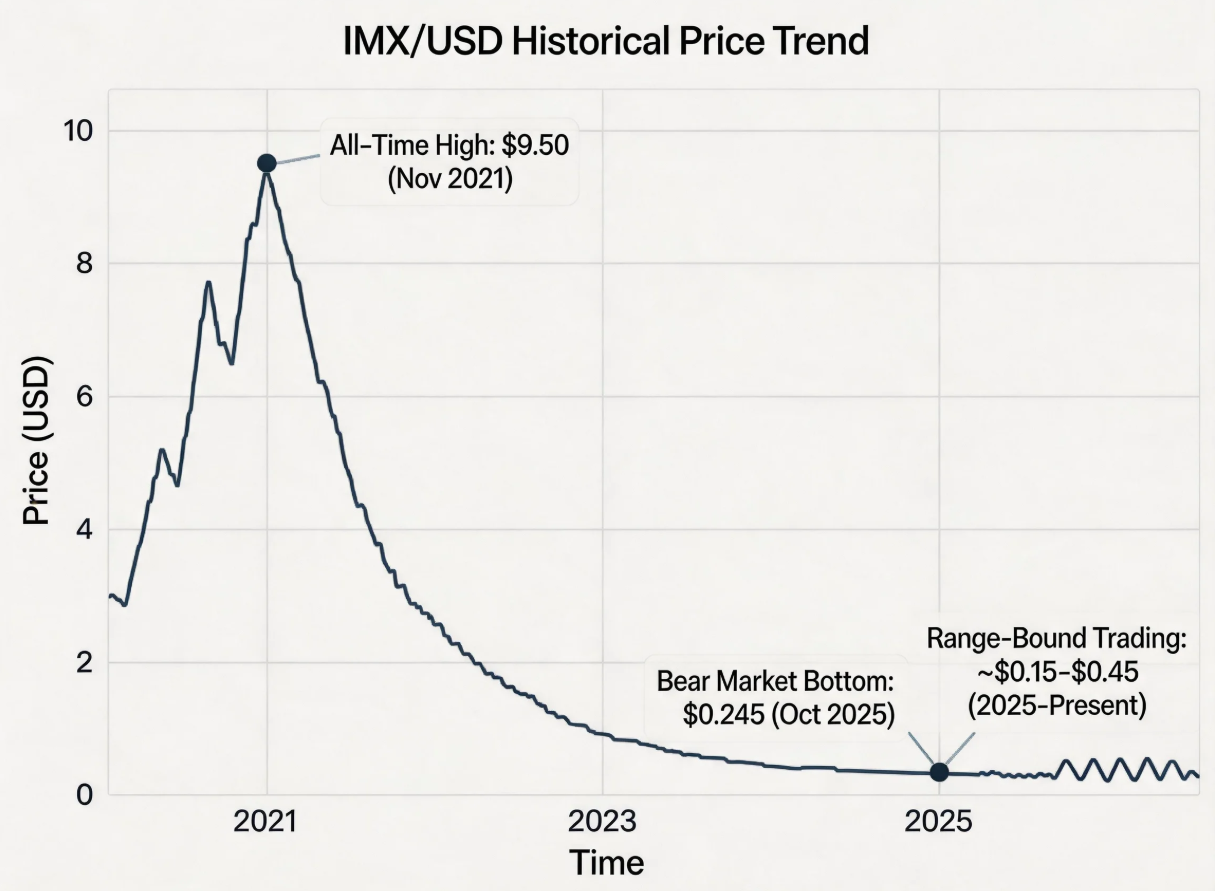
This macro trend reveals two clear market characteristics:
- Extreme Elasticity in Bull Markets: As long as the market actively believes that tokenizing gaming assets is on the verge of an explosive breakout, infrastructure assets like IMX can command immense valuation premiums.
- Ruthless Corrections Post-Hype: Once the core narrative cools down, the repricing is brutal. A drop in NFT volumes, user churn in blockchain games, a macro bear market, token unlock distributions, and a contraction in global risk appetite can cause assets like IMX to experience drawdowns far exceeding BTC and ETH.
IMX does not move in perfect lockstep with ETH. While it shares a baseline correlation with ETH because it exists within the broader Ethereum Layer 2 ecosystem, its pricing is far more acutely driven by the specific market sentiment of the NFT sector and the cyclicality of the GameFi track.
- When NFT transaction volumes surge, game project funding is active, and gaming asset narratives are strong, IMX can heavily outperform the broader market.
- When the NFT market enters a deep freeze and GameFi is written off as an unsustainable model, IMX can underperform ETH and major blue-chip assets.
Historically, the core events driving the price of IMX have centered on major project milestones within the Immutable ecosystem—such as updates regarding Gods Unchained, the GameStop NFT partnership, narratives surrounding Illuvium, the introduction of the Immutable zkEVM, and high-profile institutional alignment. In 2025, Ubisoft and Immutable announced Might & Magic: Fates. This style of collaboration with legacy traditional gaming intellectual property (IP) represents a key indicator for the market evaluating the real adoptions of the Immutable ecosystem.
Analyzing past cycles indicates that the structural bottoms for IMX typically materialize when the NFT market is completely illiquid, gaming projects are entirely ignored in public discourse, the price breaks below the cost basis of the vast majority of investors, and trading volumes dry up. Conversely, tops materialize when NFT and GameFi narratives reach a point of euphoric hype, short-term prices move vertical, and the market collectively ignores hard underlying user retention metrics.
This provides a vital insight for future modeling: the price of IMX will not rise sustainably over the long term based solely on the abstract premise that "Web3 gaming has a big future." It must continuously validate its positioning with real games, active players, and tangible on-chain transaction volumes.
Chapter 3: Core Variables Impacting the Price of IMX
3.1 Whether the NFT Market Recovers Is the Primary Variable for IMX
IMX maintains a high correlation with the aggregate NFT market, but it cannot be simply equated with profile-picture collectibles.
The initial NFT bull market was fundamentally driven by PFP speculation, status-seeking collectibles, and rapid trading loops. If the NFT market undergoes a sustainable long-term recovery, it is unlikely to take the exact same shape. Instead, it will lean heavily into functional directions: in-game assets, verifiable digital collectibles, brand memberships, cross-application items, ticketing, decentralized identities, and AI-generated content assets.
For IMX, the absolute core focus is gaming asset tokenization. If game skins, cards, gear, virtual land, characters, and battle passes shift onto the blockchain over the coming years, and users demonstrate a genuine willingness to trade them, Immutable’s core infrastructure value will be aggressively repriced.
However, the modern NFT market landscape remains mixed. Artificial intelligence data updates hosted on platforms like CoinMarketCap note that around May 25, 2026, aggregate weekly NFT sales across the broader crypto market dropped by approximately 25%. Concurrently, on-chain NFT sales volume on the Immutable network recorded a 15% decline, even as total unique buyer counts showed an upward trend. (CoinMarketCap)
This indicates that the NFT sector has not fully transitioned back into a raging, macro bull state. For IMX to experience a structural upward expansion, it requires more than just an increasing count of raw buyers; it demands a simultaneous improvement in high-quality transaction volumes, organic gaming asset velocity, and clear user retention.
3.2 Whether Web3 Games Evolution from "Play-to-Earn" to "Real Games"
The fatal flaw of early GameFi projects was that many were not actually games; they were financial yield protocols wrapped in rudimentary gaming aesthetics. Players entered these ecosystems not because the gameplay was compelling, but because they could extract short-term financial rewards. Once token emissions outpaced demand, yields dropped, and incoming user growth slowed, the entire internal economy collapsed. Axie Infinity served as a stark case study for the entire web3 space: relying purely on a "Play-to-Earn" model cannot sustain a healthy, multi-year gaming ecosystem.
Immutable’s long-term opportunity relies on its explicit bet on "Genuine Gameplay + On-Chain Asset Ownership," rather than simplistic token-mining loops. The official Immutable ecosystem hosts flagship titles like Gods Unchained, Guild of Guardians, and Illuvium, while continuously onboarding legacy traditional gaming entities and independent Web3 studios.
Yet, the ultimate arbiter of IMX’s value is not how many games sign partnership announcements, but whether those games can command real user retention.
- Game Count represents supply.
- Active Players represent demand.
- On-Chain Transaction Volume represents actual token value capture.
If titles hosted on Immutable can cross the chasm from "niche Web3-native circles" to mainstream gamers, IMX’s valuation framework will shift completely. If the games continue to primarily target mercenary airdrop hunters and short-term speculators, IMX will struggle to break out of its legacy infrastructure box.
3.3 Mainstream Enterprise Partnerships Are a Bonus, But Cannot Substitute for Hard User Data
Immutable has secured impressive partnership wins. The 2025 collaboration between Ubisoft and Immutable to deliver Might & Magic: Fates is a prime example, building a strategic card game around a classic IP with a deep pre-existing global fanbase. Historically, Immutable has also captured significant market attention through integrations with GameStop NFT and major Web3 studios like Illuvium.
These high-profile alignments deliver immense brand validation and localized market hype. However, investors must model two distinct risks when evaluating enterprise partnerships:
- A partnership announcement does not guarantee commercial success.
- A legacy IP does not automatically translate into long-term user retention.
The traditional gaming industry is filled with high-profile IP games that fail commercially. Web3 gaming introduces an even tougher hurdle, as it must simultaneously solve web3 onboarding friction (wallets, seed phrases, gas), manage sustainable economic systems, and overcome mainstream gamer skepticism. Therefore, when evaluating institutional partnerships, disciplined investors must continuously look at execution metrics: Is the game live? What is the Daily Active User (DAU) count? What do the 30-day retention rates look like? What is the actual NFT trading volume? Are the players genuine consumers, or merely mercenary users farming rewards?
3.4 The Impact of Staking Mechanics on Circulating Supply and Holder Confidence
The IMX staking architecture exerts a two-fold influence on price dynamics:
- Supply Reduction: It systematically removes tokens from the active circulating market, reducing immediate liquid spot selling pressure while bolstering long-term holder alignment.
- Yield Quality: If staking rewards are primarily funded via artificial token emissions rather than real protocol fee generation, the long-term economic effectiveness is diminished.
The ideal flywheel model for IMX operates as follows: ecosystem transaction activity increases $\rightarrow$ protocol fee generation scales $\rightarrow$ a dedicated portion of fees is structurally routed back to active stakers $\rightarrow$ token holders choose to lock up supply long-term $\rightarrow$ liquid market circulating supply drops $\rightarrow$ token price receives structural fundamental support. If underlying ecosystem transactions remain stagnant, staking rewards fail to function as a sustainable, long-term value anchor. Thus, while the staking ratio is a highly useful secondary health indicator, it should never serve as an isolated reason to buy. The underlying revenue engine backing the yield is what truly matters.
3.5 ETH and Macro Liquidity Cycles Dictate the Broad Trend
As an Ethereum ecosystem asset and a high-beta altcoin, IMX cannot disconnect from the broader macro environments dictated by BTC, ETH, and global liquidity conditions.
- Rising ETH prices typically act as a strong tailwind for Layer 2 networks, NFT activity, and on-chain decentralized applications.
- Bullish BTC price action drives overall crypto market risk appetite and inflows.
- Loose global fiat liquidity (interest rate cuts, quantitative easing) disproportionately benefits high-volatility, speculative risk assets.
If macro liquidity contracts, BTC trends downward, and ETH weakens, IMX is highly unlikely to sustain an independent macro uptrend. However, whether IMX can actively outperform ETH depends on whether the NFT and Web3 gaming sectors capture narrative dominance. If the market chooses to funnel capital into alternative mainlines—such as Real World Assets (RWAs), Artificial Intelligence (AI), Decentralized Physical Infrastructure Networks (DePIN), or Bitcoin L2 layers—IMX may experience a underperformance cycle. It requires the market to actively rotate capital back into on-chain consumer metrics, gaming infrastructure, and digital asset ownership to outpace major blue-chips.
3.6 Regulatory Risks: Will NFTs and Gaming Assets Be Labeled Securities?
The regulatory scrutiny facing the NFT and Web3 gaming sectors primarily stems from three pressure points:
- Financial Commitments: Whether in-game assets or pre-sales incorporate implicit or explicit promises of future financial yield or capital appreciation.
- Token Incentives: Whether internal in-game reward tokens or ecosystem governance distributions map tightly to traditional investment contract frameworks (e.g., the Howey Test).
- Consumer Protections: Whether internal game NFT marketplaces, loot boxes, random luck draws, or secondary market speculation cross into regulated gambling frameworks, or expose minors to unregulated financial speculation.
If Web3 games continue to lead their marketing with financial returns and earning potentials, regulatory pressure will naturally intensify. If the sector pivots toward highlighting digital self-custody, interoperable player-owned assets, open game economies, and user-driven trading, the regulatory risk profile becomes significantly more manageable. Immutable must continuously steer its ecosystem within clear, compliant operational boundaries, as aggressive regulatory enforcement would severely restrict the valuation ceiling of IMX.
Chapter 4: 2026 IMX Price Prediction — Can NFTs and Gaming Achieve a Genuine Recovery?
The year 2026 stands as a critical validation phase for IMX. From a cyclical perspective, 2026 sits within the extended post-halving phase of the crypto market. If liquidity continues to flow down the risk curve from BTC and ETH into alternative layers, the NFT and Web3 gaming sectors have a clear window to capture capital rotation. However, a major psychological barrier exists: the previous GameFi and NFT bubbles inflicted severe capital damage on retail participants, meaning the market will not easily buy into unverified promises a second time.
2026 Price Scenarios for IMX
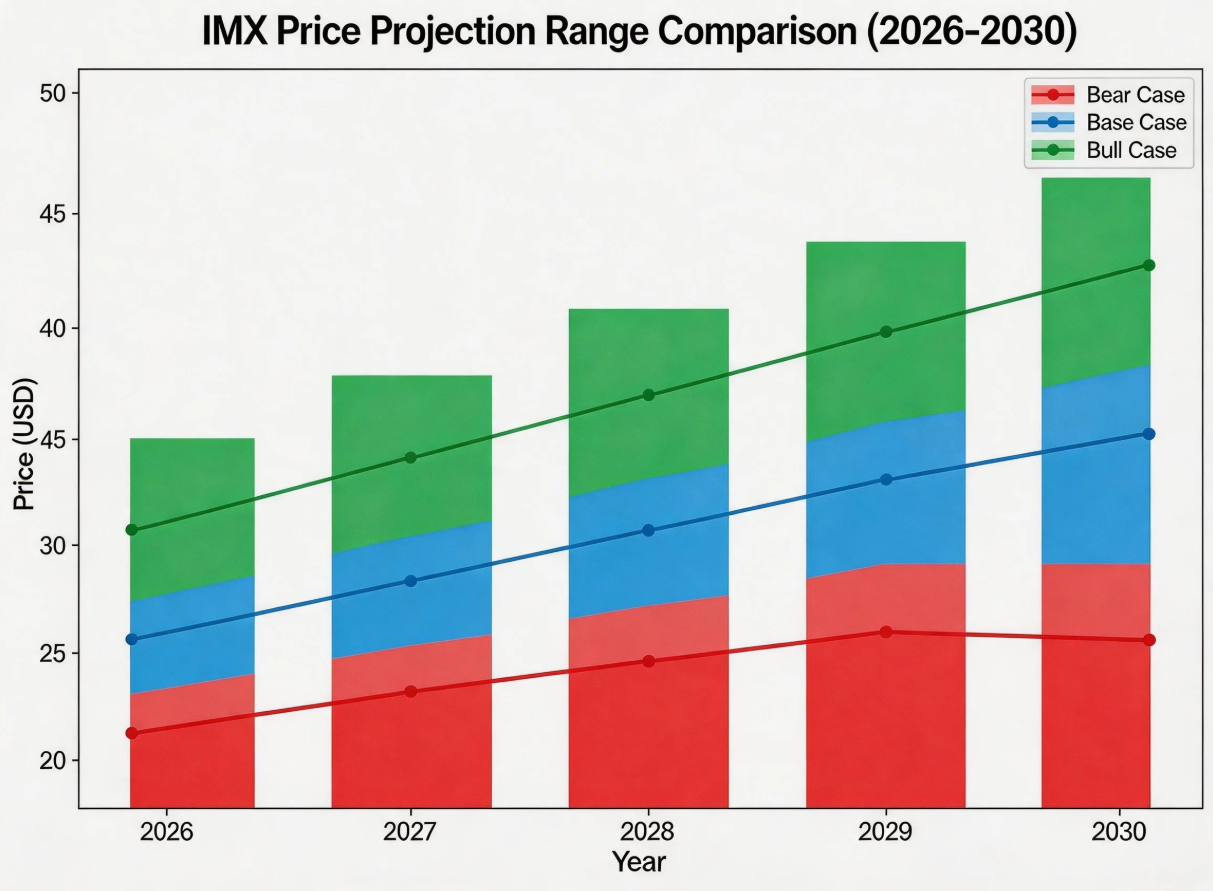
- The Bearish Scenario ($0.10 – $0.25): Under this framework, the price continues to consolidate heavily within a low-range accumulation box. The broader NFT market remains deeply illiquid, Immutable's flagship game pipeline experiences launching delays, and hard active player metrics show no structural improvement. IMX continues to be classified by the market as an out-of-favor, legacy narrative asset, experiencing short-term speculative bounces that rapidly fade due to a lack of fundamental trend backing.
- The Neutral Scenario ($0.30 – $0.80): This serves as our baseline expectation. The Immutable zkEVM ecosystem achieves gradual stability, onboarding a steady stream of active titles. Unique NFT buyer metrics and transaction volumes display a clean, upward recovery curve, and capital begins to actively track Web3 gaming infrastructure as a legitimate value segment. While it stops short of a raging, manic bull run, it allows IMX to recover cleanly from deep, structurally undervalued levels.
- The Bullish Scenario ($1.20 – $2.50): This scenario requires a synchronized resurgence of both the NFT and Web3 gaming sectors. The Immutable ecosystem must deliver one or two breakout flagship games that capture genuine mainstream player traction. Continuous marketing catalysts from high-profile setups—such as Ubisoft, Illuvium, and Guild of Guardians—must drive persistent media interest, paired with an overall high-risk-appetite expansion across ETH and the broader altcoin market. Under these conditions, the structural full dilution of IMX becomes a massive tailwind, allowing its price to exhibit extreme upward elasticity.
The critical catalysts to monitor throughout 2026 include: the exact rate of game deployments and active user metrics on the Immutable zkEVM, the post-launch retention numbers of flagship titles, a structural rebound in aggregate Immutable NFT sales volumes, a distinct rise in game asset transactional velocity, optimizations to the internal IMX fee-routing and staking loops, and whether the market formally re-lists gaming as a core bull market line.
Our core directional assessment concludes that while 2026 offers IMX an asymmetric window for structural valuation recovery, entering a true macro expansion track strictly requires the emergence of hard player retention data and real transaction metrics, rather than a speculative bounce built on legacy NFT rhetoric.
Chapter 5: 2027 IMX Price Prediction — Can GameFi Capitalize on High-Quality Titles?
By 2027, the primary question testing the valuation of IMX will no longer be technical delivery, but the underlying quality of the games themselves. If Web3 gaming remains stubbornly stuck in the legacy paradigm of "token issuance, aggressive airdrop farming, speculative NFT pre-sales, and short-term mercenary yield mining," the market will completely deny it high valuation multiples. The structural failures of the first GameFi wave have made capital highly disciplined. For IMX to maintain an upward trajectory through 2027, it must prove that the games built on Immutable can retain real players who consume content for entertainment, rather than users merely automating accounts to farm rewards.
2027 Price Scenarios for IMX
- The Bearish Scenario ($0.12 – $0.35): This scenario materializes if any 2026 recovery is driven purely by localized market emotion rather than real player acquisition. Once the short-term hype cools down and macro liquidity rotates elsewhere, IMX will give up its gains and slide back into a depressed, low-range market structure due to a lack of organic ecosystem revenue.
- The Neutral Scenario ($0.40 – $1.00): Immutable continues to securely onboard games and process standard transactional volume, but the ecosystem lacks a true, global crossover hit. The market broadly recognizes the protocol's position as a reliable web3 gaming infrastructure provider and prices it cleanly as a steady utility asset, while withholding highly aggressive speculative multiples.
- The Bullish Scenario ($1.50 – $3.00): The Immutable ecosystem successfully fosters one or more high-retention Web3 titles that command substantial DAU metrics. NFT asset velocity trends up consistently, user acquisition costs drop due to positive word-of-mouth among traditional gamers, and the market explicitly positions IMX as the leading infrastructure asset of the Web3 gaming sector.
When evaluating whether to maintain structural exposure to IMX during 2027, execution signals must take absolute precedence over asset charts. Constantly audit four critical on-chain metrics:
- Are the DAU and Monthly Active User (MAU) numbers of the flagship games experiencing a consistent MoM upward trend?
- Is the transactional velocity of internal game NFTs maintaining a stable baseline, or is it dropping off post-launch?
- Is there a steady pipeline of external independent studios electing to deploy within the Immutable ecosystem?
- Is any upward price movement of the IMX token backed by a clear expansion in gas consumption and protocol fee generation?
If the market price undergoes a sharp upward pump while underlying gaming user metrics remain completely stagnant, you are looking at a purely speculative move and should aggressively consider scaling out to take profits in tranches. If the token price consolidates sideways while active player data improves fundamentally, the asset is building clean, fundamental strength and can be patiently held. If game pipelines suffer extensive delays, player churn intensifies, and NFT transaction metrics contract severely, your initial investment thesis has been broken, and you must re-evaluate your exposure limits.
Chapter 6: 2028 IMX Price Prediction — Navigating the Next Halving Cycle
The year 2028 will likely position itself as the accumulation and execution window surrounding the next Bitcoin halving cycle. Historically, during pre- and post-halving phases, market capital aggressively scans the risk curve for high-elasticity assets, and infrastructure protocols with clean, powerful narratives—like gaming and digital property rights—traditionally capture early rotational interest.
However, treating a 2028 pre-halving allocation in IMX as an automatic, risk-free winning trade is a major tactical error. The primary challenge is that the NFT sector has already historical traveled through an immense speculative bubble. If market capital rotates back into digital asset property rights in 2028, it is highly unlikely to buy into old, unrefined concepts. Capital may demonstrate a strong structural preference for entirely next-generation primitives—such as AI-driven dynamic gaming assets, completely on-chain consumer frameworks, decentralized social network property layers, RWA-linked NFTs, native Bitcoin ecosystem collectibles, or completely unmapped sectors.
2028 Price Scenarios for IMX
- The Bearish Scenario ($0.10 – $0.30): Immutable fails to incubate a breakout title capable of sustaining long-term organic volume, and the broader market completely passes over the NFT/GameFi track as a primary narrative line. Capital flows into alternative high-beta sectors, leaving IMX in a low-volume, illiquid consolidation state.
- The Neutral Scenario ($0.40 – $1.20): The Immutable ecosystem maintains a baseline rate of development, processing standard transactions without an explosive breakout. The token price moves structurally within a defined range, primarily tracking the broader altcoin market beta and macro ETH liquidity cycles.
- The Bullish Scenario ($1.50 – $3.50): If the market begins aggressively front-running the next macro bull expansion, and digital property infrastructure regains structural narrative favor, Immutable stands to benefit immensely. Because it has spent years accumulating a massive catalog of live games and verified active users, the market can aggressively reprice IMX ahead of the cycle to capture dominant vertical exposure.
By 2028, the risk profile of IMX will have structurally shifted. Token unlock distributions will completely cease to function as a primary threat because the circulating supply will sit at or near 100% of its maximum cap. The sole, defining risk factor will be whether organic ecosystem demand has scaled sufficiently to justify its market presence. In other words, the market will no longer discount IMX based on fears of "incoming token unlocks diluting the float"; it will price IMX strictly based on a transparent equation: Does this infrastructure possess a real, sustainable volume of gaming utility demand?
Chapter 7: 2029 IMX Price Prediction — Can IMX Outperform Major Blue-Chips in a New Bull Market?
If the market transitions into a full, macro bull run during 2029, the performance profile of IMX will be dictated entirely by its ranking within the global crypto narrative hierarchy.
- If the primary market lines are dominated by AI + Crypto convergence, institutional RWAs, native Bitcoin Layer 2 networks, high-performance Solana consumer primitives, or DePIN networks, IMX will likely track as a standard beta asset, rising with the tide of the altcoin market but failing to secure independent outperformance.
- IMX will capture true alpha outperformance only if the market collectively embraces the thesis that on-chain gaming asset structures and verified digital ownership represent the definitive consumer-facing gateway for next-generation Web3 mass adoption.
2029 Price Scenarios for IMX
- The Bearish Scenario ($0.50 – $1.20): A macro market expansion occurs, but Web3 gaming fails to capture the spotlight as a primary bull market engine. Capital flows primarily into alternative sectors, leaving IMX to experience a modest, passive rise driven entirely by general market liquidity rather than organic ecosystem demand.
- The Neutral Scenario ($1.50 – $3.50): Immutable successfully cements its status as a vital, highly reliable infrastructure component of the global Web3 gaming space. Game deployments and transaction volumes experience clean, sustainable growth curves, though it stops short of establishing a completely dominant, monopoly-like global gaming hub.
- The Bullish Scenario ($4.00 – $7.00): This requires a manic bull phase where the Immutable ecosystem births a massive, global breakout title. On-chain gaming asset velocities enter an intense, compounding up-cycle, the market aggressively positions IMX as the undisputed king of the gaming chain sector, and valuations move back into highly premium multiples.
The competitive war between IMX and alternative gaming ecosystems—such as Ronin and Beam—will reach a defining climax by 2029. Ronin will lean heavily on its deep historical data and native community gaming roots; Beam will utilize its focused venture funds and aggressive community alignment; Immutable will pitch its robust zkEVM architecture, enterprise publishing relationships, and frictionless onboarding toolkits.
The ultimate victor will not be determined by marketing budgets or promotional campaigns, but by a single metric: Which infrastructure can structurally host and retain the highest volume of real daily active players and digital asset transaction fees?
To verify whether IMX is entering a powerful, structural macro trend during this phase, monitor a clear set of quantitative indicators:
- On-chain NFT sales volume on the Immutable network displays consecutive months of structural upward expansion.
- Total unique buyer metrics and raw transaction values rise in a clean, synchronized trend.
- Flagship titles within the ecosystem consistently sustain active player counts above major mainstream distribution thresholds.
- The rate of incoming game migrations to the Immutable zkEVM accelerates cleanly.
- Spot trading volume for the IMX token expands drastically alongside a rising staking ratio, signaling deep structural accumulation.
- Mainstream market analysts and venture allocators formally list the gaming asset track as a top-tier core bull market narrative.
Chapter 8: 2030 IMX Price Prediction — Is a Five-Year Long-Term Allocation Worth It?
By 2030, the ultimate valuation ceiling for IMX will be decided by a single macro outcome: whether Web3 gaming has successfully integrated as a standard component of the global mainstream interactive entertainment market.
- If, by 2030, on-chain gaming asset architectures remain confined to a highly specialized, insular niche of crypto-native enthusiasts, Immutable’s aggregate valuation space will face a rigid structural ceiling.
- If, by 2030, tokenizing in-game assets, skins, items, and collectibles has emerged as a default operational model for global studios—where players expect to seamlessly own, trade, and port their digital property across disparate application environments—then the underlying utility value of a dominant infrastructure layer like Immutable will scale exponentially.
2030 Price Scenarios for IMX
- The Bearish Scenario ($0.30 – $0.80): The project maintains a basic operational baseline, but the Web3 gaming sector fails to achieve cross-over mainstream adoption. The market refuses to grant foundation assets premium multiples, and the token price consolidates within a depressed, low-volume range.
- The Neutral Scenario ($2.00 – $5.00): Immutable secures its position as a primary infrastructure standard for Web3 digital assets. The ecosystem tracks a steady growth trajectory, processing stable volume across multiple mature game titles and liquid NFT marketplaces, though it stops short of completely disrupting legacy web2 gaming distribution giants.
- The Bullish Scenario ($6.00 – $10.00+): This represents an exceptionally strict, best-case execution outcome. Web3 gaming enters a phase of true mass market adoption, with Immutable serving as a core underlying engine. Transaction metrics for digital property rights experience massive scale, the native staking and fee-routing loops cleanly capture the economic velocity of the ecosystem, and the entire digital asset landscape operates within an intense macro bull cycle.
Comparing IMX directly to legacy traditional web2 distribution giants like Steam or Epic Games is highly useful for mapping out long-term conceptual scale, but you must avoid mechanically applying their precise valuation models to a crypto asset. Immutable is not a centralized game publishing storefront; it acts as an open infrastructure layer for digital property issuance, programmatic trading, and decentralized economic settlement.
Its enterprise value is not derived from simple raw game download counts; it is structurally dictated by whether on-chain asset minting, marketplace velocity, settlement fees, and ecosystem yields can form a direct, value-capturing feedback loop with the underlying IMX token.
The single toughest psychological challenge of holding an infrastructure asset like IMX over a multi-year horizon to 2030 is managing severe drawdowns. Even if your overarching long-term thesis regarding Web3 digital property rights proves correct, you must expect to sit through extreme mid-cycle corrections ranging from 60% to 80%. A vast number of market participants accurately predict a long-term directional trend, yet fail to realize returns because they are emotionally washed out by localized market volatility.
Consequently, executing a multi-year allocation in IMX requires strict clarity regarding position sizing and automated risk boundaries. Do not allow your long-term optimism for 2030 to blind you to intermediate market execution risks.
Chapter 9: Investment Strategy — Sizing, Entries, and Managing Risk
9.1 For Crypto Beginners: Do Not Overallocate Based on Market Scale
While the global interactive entertainment and gaming market commands an immense addressable scale, beginners must remember that IMX remains a high-beta, high-risk altcoin asset.
The most common tactical error newcomers make is executing a flawed logical leap: equating the statement "the global gaming market is massive" directly with "the price of IMX is guaranteed to rise." The global gaming market is indeed massive, but how much market share Web3 architectures can capture, how much of that subset Immutable can command, and how cleanly the IMX token can capture that underlying value represent three completely separate operational questions.
If you are a beginner, your optimal approach is to restrict any early allocation to a small, non-emotional tracking size, entering in disciplined tranches. Never execute a heavy, concentrated allocation, and completely avoid chasing prices during vertical short-term pumps.
9.2 For Intermediate Investors: Utilize NFT Sentiment and On-Chain Metrics for Swing Trading
IMX is highly responsive to swing trading frameworks built around tracking specialized sector sentiment.
- The Long Entry: When data points indicate a clear recovery in aggregate NFT trading volumes, media interest in gaming pipelines is rising, on-chain transaction fees on the Immutable network are expanding, and the IMX token chart prints a breakout past long-term consolidation boundaries on heavy volume, entering a swing position is highly viable.
- The Exit/Short: When the NFT market enters an extended cooling cycle, major gaming studios announce pipeline delays, or the token price experiences an intense short-term pump that is completely unbacked by any improvement in underlying on-chain transaction metrics, you must aggressively guard against a localized top.
Mastering swing trading loops on IMX requires looking beyond pure chart candelsticks; you must systematically overlay live data tracking of the NFT and GameFi macro cycles to avoid getting trapped on technical trend fakes.
9.3 For Long-Term Holders: Execute a Rigorous Quarterly Fundamental Audit
If your operational goal is to accumulate and hold IMX over a multi-year horizon, you must abandon a passive "buy-and-forget" mindset. Commit to executing a strict fundamental health check at the end of every single quarter, auditing six specific benchmarks:
[ Quarterly Fundamental Audit Checklist ]
  ├── 1. Project Inflow: Is the raw count of new game deployments actively expanding?
  ├── 2. User Engagement: Are active player metrics and DAU data displaying stable upward curves?
  ├── 3. Economic Velocity: Are NFT sales values and unique buyer counts scaling cleanly?
  ├── 4. Token Mechanics: Is the staking participation ratio expanding alongside real protocol fee accumulation?
  ├── 5. Competitive Moat: Is Ronin, Beam, Solana, or an alternative ecosystem outstripping Immutable's adoption curve?
  ├── 6. Engineering Velocity: Is the core team consistently hitting their disclosed technical and ecosystem milestones?
If these quantitative benchmarks display structural improvement quarter-over-quarter, maintaining your investment exposure is fundamentally validated. If the market price is rising while these operational benchmarks are flatlining or deteriorating, protect your capital by scaling down your position. Treating generic long-term optimism as an excuse to ignore deteriorating fundamental data is an exceptionally dangerous path to capital impairment.
9.4 The Three Most Critical Cognitive Traps to Avoid in an IMX Investment
- Trap 1: Equating Generalized NFT Recoveries Automatically with an IMX Pump: A structural resurgence in the NFT sector can easily localize within alternative networks—such as Solana, Base, Bitcoin Ordinals, or unmapped layers—without generating a single transaction fee for the Immutable network.
- Trap 2: Treating Partnership Press Releases as Verified User Growth: Corporate announcements and strategic alliances represent early-stage intent. Only live production deployments, active player retention metrics, commercial revenue, and on-chain transaction values impact token value capture.
- Trap 3: Equating "Web3 Gaming Has a Massive Future" Directly with "Immutable is Guaranteed to Win": A market sector can expand dramatically while an early pioneer protocol fails to maintain its market share against faster, more efficient, or better-funded emergent competitors.
If you want to evaluate an alternative class of infrastructure assets with a completely different value-capture mechanism, you can review the 2030 AVAX price prediction. Avalanche's core architecture targets broad public public public chain ecosystems, compliant institutional subnets, enterprise RWAs, and generalized high-performance infrastructure. Conversely, IMX focuses its entire operational energy on gaming NFTs and the rapid settlement of digital consumer assets. Both reside within the broad infrastructure narrative, but their underlying economic capture pathways are entirely distinct.
If you prefer tracking pure community-centric, attention-driven crypto assets, consider analyzing the 2030 SHIB price prediction. Shiba Inu’s trajectory depends explicitly on cultural meme consensus, retail attention waves, localized media hype, and speculative community extensions. IMX operates on an entirely different plane, requiring the cold validation of production game deployments, organic NFT trading volumes, and developer retention metrics. Both can experience intense vertical rallies during a broad market expansion, but their underlying structural failure points are worlds apart: SHIB collapses the moment public attention shifts to a newer meme asset; IMX collapses if its technical infrastructure remains immaculate but game studios fail to build actual fun applications on top of it.
Conclusion: What Is the Five-Year Macro Thesis for IMX?
The long-term investment thesis for IMX is fundamentally a calculated bet on three structural developments occurring simultaneously:
- NFTs will successfully transition out of the early phase of speculative profile pictures into a mature era of in-game economies, digital collectibles, and verifiable consumer property rights.
- Web3 gaming architectures will cleanly shake off the legacy flaws of simplistic "Play-to-Earn" mining loops, delivering high-quality, high-retention interactive entertainment products that attract genuine consumers.
- Immutable will successfully defend and scale its positioning as the primary, default infrastructure layer for this gaming asset vertical, enabling the underlying IMX token to directly absorb the economic velocity of ecosystem growth.
If these three pillars execute successfully over the coming years, IMX commands an asymmetric opportunity for structural valuation expansion heading into 2030. If the aggregate NFT and Web3 gaming sectors remain locked in a multi-year structural depression, IMX will continue to consolidate within low-range, illiquid bands. If Immutable continues to stack corporate partnerships but fails to translate them into live active players, the token price will struggle to sustain macro uptrends. If Web3 gaming experiences an explosive global breakout, but the primary developer talent and user liquidity funnel into alternative networks like Ronin, Solana, or Base, the absolute upside capture for IMX will be highly constrained.
Therefore, IMX should never be approached as an asset to buy blindly and store without tracking; it is a highly specialized infrastructure protocol that demands rigorous, consistent tracking. While its historical certainty profile is lower than core blue-chips like BTC and ETH, and its speculative upside velocity may be outpaced by viral short-term memes or bleeding-edge AI primitives, it possesses an undeniably clean, well-entrenched operational positioning within the Web3 gaming infrastructure landscape.
Final Multi-Year Structural Map
- 2026: Focuses heavily on a low-range structural valuation repair and the stabilization of the initial zkEVM framework.
- 2027: The critical validation phase testing whether Web3 games can successfully break free from the legacy "Play-to-Earn trap" and attract real consumers.
- 2028: Serves as a vital post-halving structural observation window to accumulate positions ahead of the next narrative wave.
- 2029: If digital property rights and gaming infrastructure emerge as a primary engine of the bull market, IMX captures extreme alpha outperformance against generic altcoins.
- 2030: The absolute valuation ceiling of the asset is determined by whether Immutable has successfully converted its game asset marketplaces and player metrics into a sustainable, long-term token value capture engine.
Before deploying real-world risk capital into IMX, ensure you have formulated clear, unshakeable answers to five internal baseline questions:
- Do I genuinely believe that Web3 gaming architectures can acquire and sustain millions of real daily active players over a multi-year horizon?
- Do I have firm confidence that Immutable can maintain its technological and structural edge inside an intensely aggressive gaming chain war?
- Is my financial portfolio structured safely enough to comfortably sit through intermediate IMX market drawdowns exceeding 60% without forcing a panic liquidation?
- Am I actively committed to spending time tracing hard quantitative data like NFT transaction values, zkEVM fee generation, and player metrics month-over-month?
- If the next 2 to 3 years unfold and the ecosystem fails to deliver a genuine crossover breakout game, do I possess the emotional discipline to admit my thesis was wrong and exit the position?
If you lack data-backed, confident answers to these core inquiries, exercise restraint and refrain from executing a heavy, emotional allocation.
FAQ: Frequently Asked Questions Regarding the IMX Price Horizon (2026–2030)
What is the IMX token?
IMX functions as the native ERC-20 utility and governance token powering the Immutable ecosystem. Immutable operates as a dominant Layer 2 infrastructure protocol custom-engineered for NFTs and Web3 gaming applications, purpose-built to completely strip away gas fee barriers, optimize player onboarding experiences, and secure digital asset ownership on-chain.
How does IMX fundamentally differ from a generic Layer 2 scaling token?
A generic Layer 2 network focuses its engineering and economic resources on scaling general-purpose smart contracts, multi-chain DeFi liquidity pools, and broad decentralized applications. Immutable, by contrast, focuses its entire operational structure explicitly on interactive entertainment and digital property rights. Its value proposition is not anchored in competing for generic raw throughput (TPS); it is built on optimized gaming asset issuance, liquid shared order books, frictionless player login toolkits, and highly targeted developer support frameworks.
What does the implementation of the Immutable zkEVM mean for the IMX token?
The launch of the Immutable zkEVM allows external game studios to utilize familiar Ethereum-native tools, EVM execution standards, and Solidity smart contracts within a gaming-optimized Layer 2 environment. This expands Immutable's positioning from an isolated NFT minting and marketplace framework into a fully functional, programmable chain execution environment capable of hosting entire multi-asset gaming economies, directly scaling the utility profile of the underlying IMX token.
Can the price of IMX realistically hit $10 by 2030?
A target of $10 is mathematically viable, but it is strictly confined to an exceptionally optimistic execution outcome. For IMX to challenge the $10 threshold, Web3 gaming must achieve a phase of massive global market adoption, Immutable must defend its status as a primary layer for digital property issuance, transaction velocities must scale exponentially to generate substantial fee revenue, the internal value-capture mechanisms must function flawlessly, and the broader digital asset market must exist within a highly intense macro bull cycle. Conservative allocators should never treat an optimistic target like $10 as a baseline expectation when managing risk capital.
What is the single greatest risk factor threatening IMX?
The primary risk factor is the threat of long-term ecosystem stagnation within the Web3 gaming sector. If Immutable successfully deploys technical upgrades and completes corporate onboarding partnerships, yet the games themselves fail to attract real, long-term active players and continuous transaction fee generation, the market will systematically devalue IMX as an unproductive asset. Secondary risks include prolonged freezes in the NFT market, aggressive developer acquisition by well-funded competing protocols, stringent regulatory crackdowns on digital gaming items, and cyclical macro liquidity contractions.
Is IMX suitable to serve as a long-term "buy-and-hold" asset?
IMX is highly deserving of consistent, disciplined observation on your long-term tracking list, but it is unsuited for unresearched, concentrated long-term positions. It is optimized for investors who hold an active fundamental thesis regarding the future necessity of digital property rights in interactive entertainment, who manage risk safely using small-to-medium satellite positions, and who commit to executing data-driven fundamental checkups tracking live player metrics and protocol fee velocity.
Professional Risk Advisory
The multi-year analytical projections and fundamental deconstructions contained within this strategic guide are compiled strictly for academic, research, and independent educational study. Under no circumstances should any portion of this text be interpreted as a formal offer, solicitation, or professional financial endorsement to execute digital asset transactions. Cryptocurrency markets are subject to extreme volatility, acute liquidity constraints, fast shifts in public narrative attention, and complex regulatory environments. High-beta altcoins like IMX, which are explicitly tied to early-stage technology sectors like Web3 gaming and NFTs, can experience profound structural drawdowns, extended periods of low volume stagnation, or permanent capital impairment if the underlying sector fails to mature.
Never execute an allocation based on a project's historical peak price action under the assumption that it is guaranteed to return to those levels, and never mistake a compressed unit spot price for an asset being fundamentally undervalued. True valuation audits require a disciplined analysis matching engineering execution speeds, production adoptions, live protocol fee capture loops, and macro liquidity trends against your own personal risk-tolerance thresholds.
If you ultimately choose to assume market exposure in IMX, govern your capital with strict operational discipline: scale your position sizing conservatively, enter markets in pre-set tranches, completely avoid high-leverage derivatives, and maintain a rigorous quarterly audit analyzing official foundation announcements, Immutable zkEVM gas consumption data, unique NFT buyer metrics, live DAU numbers of core game titles, token staking velocities, and the macro structural evolution of the competitive Web3 interactive entertainment industry. Mature investment success is never built on speculative guessing or emotional attachment to a technical label; it is built on the cold, systematic verification of whether your core investment thesis continues to be supported by hard reality.