
Introduction: Why Does TWT Deserve an Independent Predictive Analysis?
In the crypto market, TWT occupies a rather unique niche. Unlike meme coins, it doesn't rely entirely on community sentiment; unlike standard DeFi governance tokens, it doesn't serve a single protocol; and unlike public chain tokens, it isn't a direct bet on on-chain Total Value Locked (TVL). Behind TWT is Trust Wallet, a self-custodial Web3 wallet boasting one of the largest global user bases in the industry.
The official Trust Wallet website shows that its wallet product covers buying, selling, swapping, NFTs, DApps, and earning features, while emphasizing that users maintain absolute control over their private keys. The official TWT wallet page also notes that Trust Wallet has already served over 210 million users.
This sets TWT apart from the vast majority of ordinary altcoins. Its value isn't derived from an isolated DeFi pool or a short-term trend, but from the gateway-level sector that is the Web3 wallet.
If the future sees an increasing migration of users from centralized exchanges to on-chain wallets, DApps, DeFi, NFTs, blockchain games, on-chain payments, and self-custodial asset management, wallets will inevitably become one of the most critical entry points for traffic in the crypto world. A long-term bet on TWT is, fundamentally, a bet on whether Trust Wallet can continue to dominate this gateway.
However, a major problem remains obvious: just because Trust Wallet has a massive user base doesn't mean TWT will automatically appreciate. Product success does not inherently guarantee that its native token will effectively capture value. Before investing in TWT, one must clearly separate two distinct questions:
- Is Trust Wallet a great wallet product?
- Is TWT a token worth holding for the long term?
This article will build a comprehensive framework for evaluation across several dimensions, including Trust Wallet's fundamentals, TWT's tokenomics, historical price action, the Web3 wallet landscape, its relationship with the Binance ecosystem, regulatory risks, and price scenario modeling for 2026–2030. This piece is not designed to hand out an absolute target price; instead, it is built to help you determine whether TWT is a legitimate wallet-sector asset worth tracking for the long haul, or simply an ecosystem token best used for cyclical swing trades.
Chapter 1: What Is TWT — Understanding What You Are Investing In
1.1 The Functional Positioning of Trust Wallet Token: What Real Need Does It Solve?
TWT, short for Trust Wallet Token, is a utility and governance token native to the Trust Wallet ecosystem. Trust Wallet itself is a self-custodial wallet that allows users to store crypto assets, connect to DApps, swap tokens, manage NFTs, participate in staking, and access broader Web3 services.
The valuation foundation of TWT is not based on "on-chain gas fees," but rather on the Trust Wallet user ecosystem. It operates primarily as a user incentive and community engagement token for the wallet platform. Educational documentation from CoinMarketCap Academy notes that TWT's allocation routes cover user acquisition, developer incentives, community rewards, and reserve pools. Similarly, introductions from Bitget point out that TWT holders can participate in governance initiatives and potentially access specific perks within the platform.
In plain terms, TWT's core logic is not that "every single on-chain transaction burns TWT," but rather that "as the Trust Wallet ecosystem scales, TWT becomes increasingly viable as a tool for user perks, incentives, governance, and platform growth."
This dual reality represents both its greatest strength and its core vulnerability:
- The Advantage: Trust Wallet possesses a massive user foundation, making its gateway value exceptionally obvious.
- The Drawback: The hard, programmatic demand for TWT is significantly weaker than that of network-native assets like BNB, ETH, or SOL. A user can fully utilize Trust Wallet without ever needing to purchase a single TWT token.
Therefore, evaluating TWT's long-term value doesn't hinge on whether Trust Wallet can attract users, but on whether those users have a compelling, structural reason to hold TWT.
1.2 TWT Tokenomics: Does the Supply Structure Support Long-Term Prices?
The maximum supply of TWT is capped at nearly 1 billion tokens. Current market data from CoinMarketCap shows that TWT’s total supply and maximum supply stand at approximately 999.86 million tokens, with a circulating supply of roughly 429.86 million tokens, placing its market cap around the $200 million mark. Historical tracking profiles from TokenInsight similarly confirm a maximum supply cap of 1 billion tokens.
From a supply architecture perspective, TWT holds at least one clear advantage: it is not an infinitely inflationary token. Having a clearly defined maximum supply makes it significantly easier to value than ecosystem tokens that suffer from perpetual emissions without an upper limit.
1.2 TWT Tokenomics: Does the Supply Structure Support Long-Term Prices? (Continued)
From a supply architecture perspective, TWT holds at least one clear advantage: it is not an infinitely inflationary token. Having a clearly defined maximum supply makes it significantly easier to value than ecosystem tokens that suffer from perpetual emissions without an upper limit.
However, a fixed supply cap does not guarantee price appreciation. True value sustainability hinges on three critical questions:
- First, when and how will the remaining uncirculated tokens be released into the market?
- Second, is there a sufficiently powerful, long-term demand engine to absorb the circulating float?
- Third, will Trust Wallet continuously expand hard use cases for the TWT token?
If TWT can eventually be integrated into broader wallet perks—such as unlocking premium features, securing discounts on in-wallet swaps, gaining priority access to ecosystem airdrops or launchpad events, defining user tiering systems, or powering ecosystem-wide rewards—its demand curve will strengthen dramatically. If TWT remains relegated to serving as a purely symbolic governance asset, its price action will continue to drift on market sentiment rather than being anchored by genuine utility.
1.3 Binance's Acquisition of Trust Wallet: A Value Catalyst or a Dependency Risk?
In 2018, Binance announced the successful completion of its acquisition of Trust Wallet, stating that the move was aimed at providing enhanced on-chain services to its user base. Binance's 2018 annual review also highlighted that following the acquisition, Trust Wallet rapidly expanded from a simple ERC-20 wallet to supporting over 10 distinct blockchain networks.
This corporate alignment has historically acted as a major catalyst for TWT. As one of the world's premier cryptocurrency exchanges, Binance brings unparalleled brand equity, user distribution networks, deep resources, liquidity, and cross-ecosystem synergies to the table. Backed by Binance, Trust Wallet easily secured massive exposure and heightened consumer trust.
Howerver, this setup introduces a distinct structural dependency risk:
- If the Binance ecosystem remains dominant and continues to expand, Trust Wallet reaps massive secondary benefits.
- If Binance faces regulatory friction, geopolitical restrictions, brand controversies, or ecosystem contractions, Trust Wallet and TWT could experience indirect headwinds.
For TWT to exhibit true long-term fundamental health, it cannot survive solely under the protection of the Binance halo; it must prove that Trust Wallet can maintain market dominance in the Web3 wallet sector on its own merits. In short, Binance is an incredible bonus, but it cannot be the wallet's sole moat.
1.4 Identifying the Competitive Landscape
The competition surrounding TWT is not a simple "token vs. token" battle, but a war between Web3 entry gateways. Trust Wallet faces fierce competition from heavyweights such as MetaMask, OKX Wallet, Binance Web3 Wallet, Coinbase Wallet, Phantom, Rabby, Backpack, and Bitget Wallet. Each competitor brings a unique edge to the arena:
- MetaMask: Holds an unshakeable mindshare among Ethereum and EVM-native power users.
- OKX Wallet: Excels at exchange ecosystem integration, cross-chain aggregation, inscription markets, and polished multi-chain user experiences.
- Phantom: Completely dominates the mindshare and user flow of the Solana ecosystem.
- Rabby: Highly favored by advanced DeFi power users due to its detailed security alerts and transaction simulations.
- Trust Wallet: Derives its edge from mobile-first optimization, clean self-custodial architecture, broad multi-chain support, its relationship with Binance, and a massive global user footprint.
TWT's capacity for long-term appreciation is strictly tied to Trust Wallet maintaining its gateway dominance. If its user acquisition slows, the product interface falls behind, or its DApp aggregation rails falter, TWT's valuation multiples will contract. Conversely, if Trust Wallet can successfully expand its multi-chain entry points, integrate Web3 consumer tech, boost in-wallet transaction volumes, and roll out a robust user-tiering rewards ecosystem, TWT's long-term investment logic becomes incredibly robust.
To compare this with a different class of infrastructure assets, consider the valuation frameworks of public chains. The core logic for an asset like AVAX rests on public chain ecosystem expansion, institutional subnets, RWAs, and multi-chain network architecture. TWT's core logic, by contrast, relies entirely on Web3 wallet gateway capture and tokenized user perks. Both are classified as "infrastructure-related assets," yet their value capture models are completely distinct: AVAX is fundamentally dependent on the economic prosperity of its on-chain applications, while TWT relies on wallet user scale and targeted token utility design. You can review the AVAX price prediction at to further analyze how infrastructure token valuation paths diverge.
Chapter 2: Historical Price Review — What Cycles Teach Us
The historical price action of TWT is highly educational. It does not mirror pure, value-less hype plays, nor does it possess the absolute consensus floor of market leaders like BTC or ETH. Instead, it behaves precisely like an "ecosystem gateway token": it exhibits high elasticity in bull markets, undergoes significant drawdowns in bear phases, but can print decoupled, market-outperforming rallies when triggered by independent fundamental catalysts.
TWT's all-time high materialized around the tail end of 2022. Historical data from TokenInsight notes that TWT reached a lifetime high of approximately $2.74, proving that the market is entirely willing to accord a premium valuation to the Web3 wallet gateway when conditions align.
Its most famous round of growth was tied directly to the "self-custodial wallet narrative" following the collapse of FTX. After the FTX crisis in late 2022, the market became highly sensitive to centralized exchange risks, prompting many users to re-evaluate the core principle of "not your keys, not your coins." As demand for self-custodial options surged, Trust Wallet, operating as a key wallet solution backed by the Binance ecosystem, was aggressively repriced by the market, leading to a remarkably strong price performance for TWT.
This specific cycle demonstrates that TWT is not completely chained to the daily price action of BTC. It possesses its own unique, independent fundamental triggers:
- A systemic trust crisis surrounding centralized platforms directly triggers capital rotation into top-tier self-custodial wallet tokens.
- Accelerations in macro Web3 onboarding directly boost the baseline value of the entry gateway.
- Significant feature rollouts, broader cross-chain integrations, or aggressive utility expansions by Trust Wallet directly reprice TWT.
However, history also proves that TWT is not permanently immune to market corrections. While it can scale rapidly during bullish cycles, it suffers deep contractions when macro liquidity drains. With current CoinMarketCap data pricing TWT around the $0.50 range, the token remains at a significant discount from its historical peak.
Analyzing past price cycles indicates that a structural bottom for TWT typically forms when three factors overlap: general crypto market stagnation, a temporary lack of new narratives in the wallet sector, and a decline in TWT’s daily trading volume and social engagement metrics. Conversely, market tops are flagged by another triad of signals: extreme euphoria surrounding self-custody narratives, vertical short-term price spikes, and token valuations that have completely decoupled from Trust Wallet's actual product delivery metrics.
Therefore, allocating capital into TWT requires looking past pure candlestick charts or raw, cumulative download statistics. You must accurately evaluate whether the current market environment is actively repricing the strategic value of the Web3 entrance gateway.
Chapter 3: Core Variables Impacting the Price of TWT
3.1 Web3 Wallet User Growth Is the Definitive Long-Term Variable
TWT's terminal value is tied to the expansion of the on-chain user base.
- If the vast majority of crypto participants choose to keep their capital inside centralized exchange apps over the long term, leaving on-chain wallets as a niche tool for advanced DeFi power users, TWT's valuation ceiling will remain heavily restricted.
- If the industry successfully transitions to a state where everyday users utilize wallets for routine transfers, instant swaps, NFT interactions, web3 gaming, social dapps, RWA management, and programmatic decentralized identity verification, the wallet becomes the ultimate super-app of Web3.
While Trust Wallet boasts a massive user base exceeding 210 million cumulative users according to its official TWT wallet page, disciplined allocators must look beyond all-time cumulative registration data. The true metrics of value generation are Daily Active Users (DAU), Monthly Active Users (MAU), in-wallet swap volumes, DApp interaction frequencies, and user retention curves.
- Cumulative users represent brand equity.
- Active users represent genuine protocol value.
3.2 Token Utility Strength Defines the Structural Price Floor
The single most persistent drag on TWT’s price action is that it is not structurally required to use the Trust Wallet application. A user can download the mobile app, manage multiple cryptographic keys, swap assets via integrated aggregators, and browse endless DApps without ever needing to buy or hold TWT.
Consequently, the long-term appreciation of TWT depends entirely on the aggressive expansion of its utility design. Key features to watch include:
- Do TWT holdings unlock steep discounts on internal swap fees or cross-chain bridges?
- Does holding TWT grant guaranteed access to partner project airdrops, launchpad allocations, or localized reward campaigns?
- Can TWT be utilized within a gamified tiering system that enhances staking yields or unlocks advanced security suites?
- Is there a programmatic connection being built between wallet platform growth and token value capture?
Documentation from Trust Wallet's updated TWT litepaper outlines an intention to anchor the tokenomics around a sustainable ecosystem engagement flywheel, staking frameworks, and localized rewards, actively pushing its utility deeper into user engagement loops. Investors must continually analyze whether these updates translate into structural, long-term buying pressure, or if they function merely as ephemeral marketing incentives.
3.3 The Binance and BNB Chain Alignment Is a Double-Edged Sword
TWT shares a deep, structural relationship with the Binance and BNB Chain ecosystems. An expansion in BNB Chain activity directly drives user onboarding and utility loops toward Trust Wallet. Similarly, the structural strength of the global Binance brand infuses Trust Wallet with immense institutional-grade credibility.
However, this architecture introduces a concentrated surface of risk. If international regulators increase enforcement pressure against Binance, or if specific regional restrictions impact Binance-affiliated applications, the market will systematically apply a discount multiple to TWT's valuation out of caution. The optimal path for TWT is to absorb the network benefits of the Binance ecosystem while aggressively building independent, multi-chain, and multi-regional resilience.
3.4 Macro Crypto Cycles Dictate Valuation Elasticity
As an altcoin asset, TWT remains tied to the liquidity waves dictated by the Bitcoin halving cycles.
- During macro Bitcoin expansions, market risk appetite scales up, and capital sequentially rotates down the risk curve from BTC and ETH into platform tokens, public chain ecosystems, DeFi protocols, and wallet sector assets. TWT benefits heavily from valuation expansion in this liquidity environment.
- During Bitcoin corrections, capital rapidly retreats into stablecoins and blue-chips, causing altcoins like TWT to undergo severe drawdowns regardless of their underlying product fundamentals.
Every major price swing for TWT must be contextualized within the status of global fiat liquidity, exchange trust cycles, and actual on-chain user growth metrics.
3.5 Navigating Regulatory Realities for Self-Custodial Wallets
Self-custodial wallets represent the core, non-negotiable infrastructure of decentralized networks, making them a natural focus area for global regulatory bodies. Regulatory attention typically zeroes in on:
- Whether wallet routing interfaces adequately prevent the movement of illicit capital or interactions with sanctioned addresses.
- Whether integrated in-wallet swap aggregators trigger localized securities or brokerage registration mandates.
- How privacy-preserving tools or cross-chain protocols accessible inside application dashboards align with evolving compliance frameworks.
For a premier global application like Trust Wallet, managing this landscape requires dedicating significant engineering and compliance resources to advanced localized risk alerts, security scanning integrations, and proactive user safety education. The wallet's official product features highlight advanced security scanning protocols and encrypted cloud backup features, proving that safety and compliance are core product focus areas.
- If Trust Wallet can continuously elevate its security and compliance features without compromising the foundational ethos of self-custody, it will capture the trust of mainstream consumers and institutional capital.
- If regulatory enforcement pressures across major jurisdictions become overly restrictive, the user growth curve for wallet applications could flatten, suppressing TWT's valuation multiples.
Chapter 4: 2026 TWT Price Prediction — Valuation Expansion or Consolidation?
The year 2026 stands as an important repricing window for TWT. From a cyclical perspective, 2026 occupies the structural extension phase following the 2024 Bitcoin halving cycle. If BTC and high-cap blue-chips sustain a healthy structural environment, altcoins will access distinct windows of capital rotation. TWT’s core advantage during this phase is its multi-pronged narrative: it operates simultaneously as a Web3 entry gateway, a self-custodial asset management play, and a top-tier asset within the Binance ecosystem.
- The Bearish Scenario ($0.30 – $0.60): This scenario materializes if the macro market peaks prematurely or enters an extended correction phase. If the wallet sector lacks fresh narrative catalysts, and Trust Wallet delays the execution of high-demand utility integrations for the TWT token, price action will continue to drift within a depressed, structurally undervalued accumulation box. This outcome wouldn't point to product failure, but rather to a market environment unwilling to pay a premium multiple for wallet gateway assets.
- The Neutral Scenario ($0.80 – $1.50): This represents our baseline expectation. Backed by a steady, moderate recovery across the broader crypto market, Trust Wallet's active user metrics expand cleanly. In-wallet swap velocities, DApp logins, staking volumes, and multi-chain expansion continue to scale, paired with a gradual roll-out of the tokenomics updates outlined in the litepaper. TWT recovers from its deep cyclical discount back toward a more fundamentally justified valuation range.
- The Bullish Scenario ($2.00 – $3.00): This outcome requires a powerful combination of catalysts: sustained structural strength from BTC, robust capital rotation into altcoins, a resurgence of the self-custody narrative triggered by macro exchange cycle shifts, and the launch of a highly aggressive token utility framework by Trust Wallet that structurally drives token lockups and buying demand. Under these conditions, TWT has a clear path to challenge its previous historical high.
The primary catalysts to monitor throughout 2026 include: hard active user trends within the Trust Wallet application, the sequential execution of the TWT litepaper utility updates, the volume expansion of internal revenue-generating features (like swap fees), inflow metrics from the broader BNB Chain and Binance ecosystems, and whether a trust crisis surrounding centralized platforms resurfaces.
Chapter 5: 2027 TWT Price Prediction — Testing Resilience in Market Downturns
If the broader market transitions into a structural cooling phase or an outright macro downtrend during 2027, TWT will face a rigorous test of its fundamental resilience. Infrastructure-level gateway assets like wallets hold a distinct structural edge during market downturns: user retention does not drop to zero. Even when speculative trading volumes contract, users still require secure applications to manage their long-term holdings, execute essential transfers, interact with core DApps, and maintain staking positions. This ensures that established products like Trust Wallet retain an organic baseline of utility that pure hype projects lack.
However, the price of the token itself may not have the same resilience to price drops:
- The Bearish Scenario ($0.25 – $0.70): In a deep macro bear market, altcoin liquidity drains rapidly. If TWT's internal utility fails to generate independent structural buying demand, the token's price action will retreat into a deep discount range as capital aggressively flees into BTC, ETH, and stablecoins for capital preservation.
- The Neutral Scenario ($0.70 – $1.50): Trust Wallet preserves its dominant market share and active user base despite a quieter macro market. TWT behaves strictly as a steady ecosystem utility asset; the price consolidates within a predictable range, and the market discounts aggressive growth multiples across the board.
- The Bullish Scenario ($1.80 – $3.50): This scenario requires the wallet sector to capture a distinct counter-cyclical narrative, or for Trust Wallet to implement a highly successful token-lockup reward structure that completely mitigates broader market selling pressure, allowing TWT to log a clean breakout against its macro pairs.
The core question for holding TWT in 2027 is not "is it a good project," but whether its market price has already fully priced in all future growth expectations. If TWT experiences an intense upward extension during the preceding bull cycle, implementing a disciplined, multi-tranche profit-taking strategy throughout 2027 is highly prudent. If the token prints a moderate, orderly consolidation while Trust Wallet's core fundamental user metrics continue to improve, a small tracking position can be comfortably maintained for the long haul.
Chapter 6: 2028 TWT Price Prediction — The Pre-Halving Accumulation Window
The year 2028 will map close to the next Bitcoin halving cycle, a macro window that long-term fundamental allocators historically utilize to accumulate high-quality altcoins at deep structural discounts. If the crypto market is grinding through the tail end of a prolonged bear market, TWT offers an interesting accumulation profile. Because secure wallet access is a permanent, non-negotiable requirement of the crypto industry, an established leader like Trust Wallet is highly unlikely to disappear from public relevance unlike speculative, narrative-dependent protocols.
- The Bearish Scenario ($0.20 – $0.50): This downside case materializes if competitive pressures from integrated exchange wallets heavily erode Trust Wallet's market share, while TWT's internal application utility remains stagnant, forcing the market to price it strictly as a legacy governance token.
- The Neutral Scenario ($0.60 – $1.20): The macro market builds a structural floor ahead of the incoming halving cycle, though broad risk-on liquidity remains restrained. TWT establishes a clean horizontal accumulation floor, well-supported by Trust Wallet's baseline operational scale, creating a steady entry window for patient allocators.
- The Bullish Scenario ($1.50 – $2.50): Front-running the incoming halving cycle triggers early capital positioning within premier infrastructure plays. Backed by the successful deployment of advanced staking rewards and user value-capture loops, TWT experiences an early structural re-rating ahead of the broader market.
The "pre-halving accumulation" thesis aligns well with TWT, but managing timing risks is essential. Investors should scale in via tranches rather than executing heavy, isolated positions, because if macro environments remain constrained throughout 2028, altcoins can experience prolonged horizontal accumulation phases. The optimal accumulation window inside a pre-halving year rarely aligns with the absolute bottom tick of the price chart; instead, it presents itself as an extended phase of low-volatility sideways consolidation, where market sentiment is completely cold, yet the underlying product continues to log steady user and development growth.
Chapter 7: 2029 TWT Price Prediction — Can TWT Outperform Major Blue-Chips in a New Bull Market?
If the digital asset ecosystem enters a fresh, powerful macro bull expansion during 2029, TWT's capacity for market outperformance will depend entirely on whether the wallet sector can secure a top-tier position within the narrative hierarchy.
- If the primary engines of the next bull cycle are driven by niche verticals—such as autonomous AI agents, enterprise RWA layer integrations, or hyper-specific high-throughput L1 consumer apps—TWT may not print the highest alpha returns on the board. However, irrespective of which sector triggers a bull run, every single user requires a secure wallet entry point to interact with those applications. Infrastructure plays naturally capture secondary network value, though their upward velocity can be more measured than the specific hyper-hyped narrative leaders of that cycle.
- The Bearish Scenario ($0.80 – $1.50): The macro bull market scales up, but capital loops primarily through new alternative L1 chains and hyper-speculative tokens. The wallet sector fails to secure center stage, leaving TWT to experience a passive, liquidity-driven rise that lags behind the top-performing altcoins.
- The Neutral Scenario ($1.50 – $3.00): A healthy, fundamentally driven bull run where the market actively rewards established, revenue-generating gateway infrastructure. Trust Wallet’s core metric footprint scales cleanly, TWT utility loops are mature, and the token moves along a sustainable upward repricing track without entering a state of extreme, unsustainable bubble euphoria.
- The Bullish Scenario ($4.00 – $6.00): The Web3 wallet sector captures massive structural alpha as on-chain consumer apps cross into true mass market adoption. Trust Wallet completely dominates the multi-chain mobile landscape, its integrated swap and asset management revenue engines perform flawlessly, and a highly optimized TWT token design directly captures a structural percentage of that global economic velocity.
To verify whether TWT is establishing a genuine, sustainable macro uptrend during this phase, allocators must scan for clear fundamental confirmation signals: the price successfully clears major multi-year resistance levels on expanding daily spot trading volume, daily trading metrics surge significantly, Trust Wallet rolls out a significant, tier-one architecture upgrade that directly links token holdings to programmatic application perks, the aggregate wallet sector charts display a synchronized, industry-wide upward trend, and on-chain data confirms a steady expansion in active token-holding wallet addresses alongside robust metrics across the BNB Chain ecosystem.
Chapter 8: 2030 TWT Price Prediction — The Five-Year Long-Term Outlook
Looking out to 2030, the terminal value of TWT depends on a single macro development: whether self-custodial Web3 wallets emerge as the primary interface through which everyday consumers access the decentralized internet.
- If the industry matures to a state where hundreds of millions of global citizens utilize self-custodial wallets daily to manage personal assets, interact with decentralized social apps, verify decentralized identities (DID), and settle frictionless cross-chain payments, a market leader like Trust Wallet commands immense strategic enterprise value.
- Conversely, if native centralized exchange apps maintain an unshakeable monopoly over user onboarding, or if the wallet landscape becomes hyper-fragmented across native browser-integrated extensions (such as MetaMask, Phantom, or Coinbase Wallet), Trust Wallet's addressable value expansion will face rigid boundaries.
Multi-Year Structural Scenario Projections
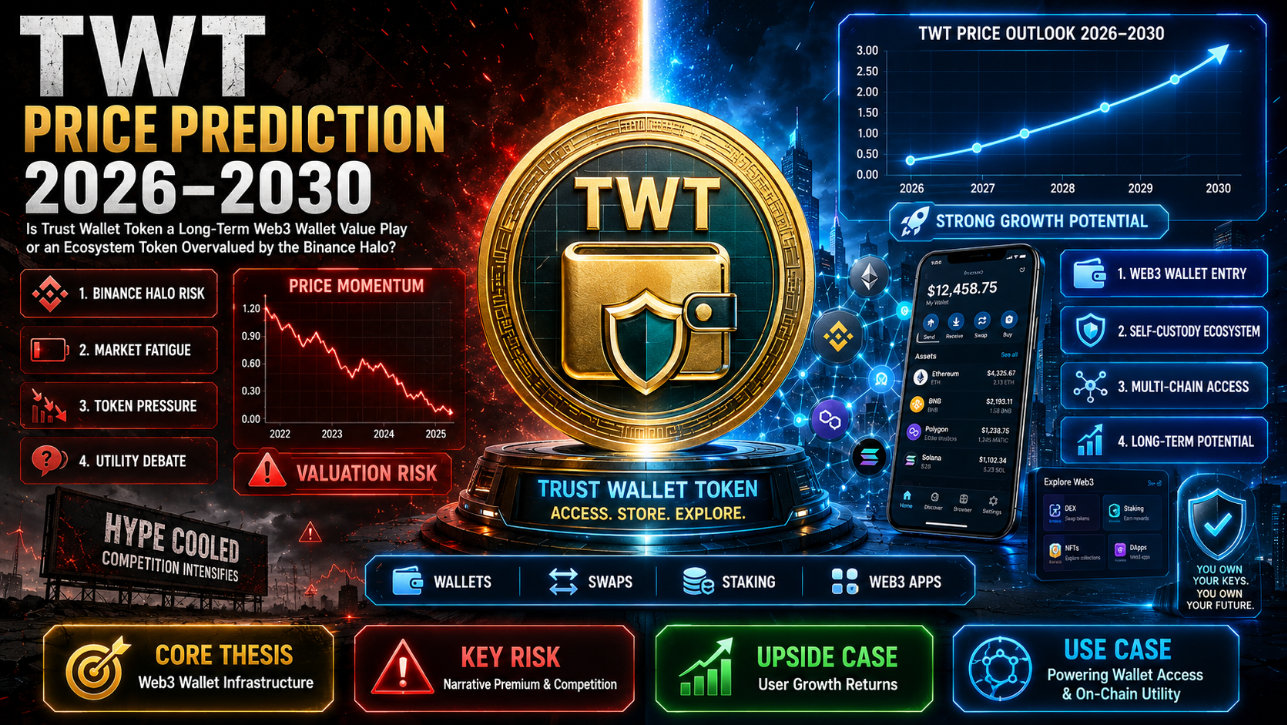
- Under the Bearish Outcome, TWT prices are projected to hold within a range of $0.30 to $0.60 in 2026, move between $0.25 and $0.70 in 2027, contract to a band of $0.20 to $0.50 in 2028, and transition to a channel of $0.80 to $1.50 in 2029, concluding the decade with a long-term range of $0.50 to $1.20 by 2030. This line maps out a scenario where Trust Wallet preserves its market footprint but fails to engineer robust token value capture.
- Under the Neutral Baseline, TWT prices are modeled to recover to a band of $0.80 to $1.50 in 2026, sustain a consolidation channel of $0.70 to $1.50 throughout 2027, establish an accumulation floor between $0.60 and $1.20 in 2028, scale to a range of $1.50 to $3.00 during the 2029 market expansion, and settle into a mature fundamental range of $2.00 to $4.00 by 2030. This path mirrors steady platform metrics and clear utility execution devoid of extreme market-wide bubble premiums.
- Under the Bullish Framework, TWT price action is estimated to challenge a high band of $2.00 to $3.00 in 2026, show high cyclical resilience between $1.80 and $3.50 in 2027, launch an early pre-halving rally to a range of $1.50 to $2.50 in 2028, surge aggressively to a bracket of $4.00 to $6.00 in 2029, and reach a terminal valuation scale of $5.00 to $8.00+ by 2030. This projection depends on the wallet sector securing massive narrative adoption, paired with intensive internal value-routing architectures.
The definitive hurdle of executing a multi-year long-term hold on an asset like TWT is successfully managing intermediate volatility drawdowns. Even under highly optimistic terminal target assumptions, an altcoin portfolio can easily endure mid-cycle corrections ranging from 50% to 80%. Long-term investing requires more than abstract optimism; it demands implementing clear, pre-planned parameters governing position sizing, dynamic profit-taking targets, and automated capital preservation boundaries well ahead of time.
Chapter 9: Investment Strategy — Managing Capital, Positioning, and Entry Points
9.1 For Crypto Beginners: TWT Is an Infrastructure Play, Not a Get-Rich-Quick Token
If you are a newcomer to the digital asset space, the most sustainable strategy for evaluating TWT is to utilize a conservative, multi-tranche approach with non-emotional tracking capital. Do not look at Trust Wallet's massive download statistics or its relationship with Binance and assume that the token is guaranteed to log instant exponential gains.
TWT possesses a significantly more visible fundamental product baseline than purely speculative low-cap altcoins, but its upward elasticity during euphoric market phases may be lower than trending, high-narrative tokens. It operates as a mid-to-long-term infrastructure tracking asset rather than a tool for short-term speculation. While utilizing a Dollar-Cost-Averaging (DCA) strategy can be highly effective, beginners must maintain a clear risk distinction: executing a DCA strategy on an ecosystem altcoin like TWT carries an entirely different risk profile than doing so on a decentralized market leader like BTC. Altcoins require strict position limits to protect aggregate portfolio capital.
9.2 For Intermediate Investors: Execution Loops Built on Sector Sentiment
For market participants with established trading experience, TWT offers a highly responsive profile for executing medium-term swing trades aligned with macro structural cycles:
- The Long Accumulation: Focus heavily on identifying horizontal accumulation floors during market-wide corrections, tracking Trust Wallet's continuous application iterations, and monitoring key underlying user activity metrics.
- The Trend Trade: Execute long entries when daily charts print clear structural breakouts above multi-month consolidation boundaries on expanding spot volume, backed by broader momentum across the wallet sector.
- The Distribution Window: Systematically scale out of positions into tranches when market sentiment surrounding self-custody reaches a state of intense public euphoria, or when short-term price spikes move vertical while decoupling entirely from Trust Wallet's immediate fundamental milestones.
TWT's core advantage is its measurable operational footprint, which shields disciplined swing traders from the unverified hype typical of completely speculative tokens.
9.3 For Long-Term Allocators: The Rules of Risk Management
If your investment horizon targets a multi-year allocation leading to 2030, you must implement a strict, data-driven fundamental audit loop at the close of every quarter. Continually re-verify four core operational assumptions: is Trust Wallet's active monthly user base growing or maintaining its market dominance relative to its direct competitors? Are the team's programmatic tokenomics upgrades actively driving structural token demand and user lockups? Has the underlying corporate relationship with the Binance ecosystem shifted in a way that introduces sudden, unhedged operational or regulatory risks? Has a major competitor successfully deployed a superior product feature or incentive model that is triggering visible user migration away from Trust Wallet?
Long-term investing does not imply holding an asset indefinitely through structural decay. It means giving a clear fundamental thesis the necessary time to play out in reality, while maintaining the discipline to adjust your exposure limits the moment your core underlying assumptions are invalidated.
9.4 Asset Allocation Guidance: TWT Belongs in a Satellite Sleeve
While TWT offers a robust fundamental profile within the wallet sector, it should not function as the bedrock or primary anchor of a well-balanced digital asset portfolio. Core portfolio allocations are best reserved for structural market leaders like BTC and ETH, or highly dominant public chain layers that capture broad network velocity. TWT is optimally deployed within a specialized "satellite sleeve" designed to capture targeted exposure to the growth of the Web3 entry gateway. Conservatively minded participants should limit exposure to a nominal fractional boundary, whereas balanced allocators can position it cleanly within a broader asset-management and utility basket. Aggressive market participants must tightly limit position sizes to risk limits capable of weathering an unhedged 70% mid-cycle drawdown without forcing emergency liquidations.
If your trading methodology prioritizes extreme narrative volatility, intense community attention cycles, and pure meme culture dynamics, you can review the 2030 SHIB price prediction at. Shiba Inu’s valuation framework is entirely dependent on decentralized community consensus, viral social tracking, and speculative momentum expansions. TWT, by contrast, operates within a structured utility paradigm, dependent on Trust Wallet's active user acquisition metrics, gateway status, and programmatic token design. Both can experience explosive expansions during an intense market run, but their core risk surfaces are fundamentally opposite: SHIB faces immediate devaluation the moment public attention deserts its meme narrative; TWT faces risk if Trust Wallet scales its product perfectly, yet fails to translate that commercial success into direct value capture for the token.
Summary: The Five-Year Fundamental Thesis for TWT
The multi-year investment thesis for TWT relies on the successful execution of three sequential milestones: first, Web3 wallet architectures must successfully solidify their position as the undisputed, dominant entry gateway for global digital asset participants; second, Trust Wallet must successfully maintain its market leadership and outpace its direct competitors within this mobile self-custodial infrastructure landscape; third, the TWT token design must programmatically absorb a tangible percentage of the platform's user scaling and transactional volume.
If any single component of this equation fails to materialize, TWT's macro upside will face rigid structural limits. If the wallet track expands but Trust Wallet loses its market share to aggressive competitor applications, TWT's upside shrinks. If Trust Wallet commands hundreds of millions of active users but the token remains completely disconnected from the application's internal economic loops, the price will continue to drift on pure speculation. If the token utility is optimized perfectly but the wider industry enters a prolonged macro bear market, the asset will slide into a deep discount range. TWT is not an asset to buy blindly and ignore, but it represents an incredibly high-value infrastructure play that deserves close, consistent tracking.
The Macro Multi-Year Roadmap
- 2026: Focuses heavily on structural valuation recovery from deeply discounted levels, backed by the initial rollout of updated token utility models.
- 2027: Serves as a vital stress-test phase analyzing the token's structural resilience and independent utility demand during a cooling macro market.
- 2028: Opens a high-value pre-halving accumulation window to build exposure within established infrastructure leaders while market sentiment is completely cold.
- 2029: Offers a clean macro expansion track where TWT can capture powerful alpha gains if the wallet sector re-emerges as a primary bull market main line.
- 2030: The terminal valuation ceiling is set by whether Trust Wallet has successfully converted its gateway dominance into hard, programmatic demand for the TWT token.
Before allocating hard-earned capital into TWT, ensure you have formulated clear, data-backed answers to five baseline internal questions: Do I genuinely believe that self-custodial Web3 wallet user growth will continue to expand globally over a multi-year timeline? Do I have firm confidence that Trust Wallet can successfully defend its market share against well-funded centralized exchange wallet ecosystems? Do I fully understand that TWT’s value-capture engine is structurally less direct than that of network-native Gas tokens? Is my capital management strategy resilient enough to sit through localized asset corrections exceeding 50% without panic selling? Am I prepared to objectively admit my core underlying assumptions were incorrect and adjust my portfolio boundaries if TWT underperforms fundamental product growth over an extended period? If you lack clear, data-grounded answers to these inquiries, exercise patience and avoid rushing into a heavy, emotion-driven allocation.
FAQ: Frequently Asked Questions Regarding TWT (2026–2030)
What class of asset is TWT?
TWT operates as a utility and governance token native to the Trust Wallet ecosystem. Its value loops are anchored around platform user growth, ecosystem incentives, community governance initiatives, and planned internal user perks. It does not function as a native public chain Gas token, nor is it a speculative meme asset; it is classified as a wallet-sector ecosystem token.
What is the exact relationship between Trust Wallet and Binance?
Binance announced the successful acquisition of Trust Wallet in 2018, providing the wallet application with access to extensive ecosystem resources, deep corporate synergy, and powerful brand validation. For the TWT token, this alignment functions as an incredible long-term growth catalyst, while introducing a distinct structural dependency risk that allocators must continually monitor.
What are the supply metrics of TWT?
Verified market data from CoinMarketCap shows that TWT’s total supply and maximum supply are capped at approximately 999.86 million tokens, with a circulating float of roughly 429.86 million tokens. Analytical tracking profiles from TokenInsight similarly confirm a hard maximum supply cap of 1 billion tokens.
Can TWT realistically challenge the $5 mark by 2030?
A target of $5 is mathematically viable within our long-term modeling, but it should never serve as an investor's default baseline expectation. For TWT to clear the $5 threshold, Trust Wallet must comfortably preserve its global market dominance, the wider Web3 wallet sector must enter a phase of mass-market consumer adoption, the TWT token must implement deep, structural utility demand mechanisms within the app, and the macro crypto market must operate within an intense bull cycle. Lacking these conditions, the asset is more likely to trade within a moderate, fundamentally grounded range.
Is TWT optimized for a passive, long-term "buy-and-forget" hold?
TWT is a prime candidate for consistent tracking on a professional allocator's watch list, but it is unsuited for passive, concentrated multi-year positions that are left unmonitored. It is optimized for investors who hold an active, data-driven thesis regarding the strategic value of the Web3 entry gateway, who manage risk safely by utilizing conservative satellite position sizing, and who commit to executing regular fundamental audits tracking live active user trends and token utility milestones.
What constitutes the single greatest risk surface for TWT?
The most critical risk facing TWT is "product success paired with inadequate token value capture." Trust Wallet can successfully scale its user registration metrics globally, yet if the TWT token remains structurally disconnected from the platform's core revenue engines, the token's price action will fail to mirror the app's commercial success. Additional risk factors include intense market share erosion from integrated exchange wallets, regulatory headwinds targeting self-custodial software interfaces, and macro liquidity drawdowns.
Professional Risk Advisory
The multi-year price scenario modeling, fundamental deconstructions, and sector analyses contained within this document are compiled strictly for academic, research, and independent educational study. Under no circumstances should any portion of this text be interpreted as a formal offer, structural solicitation, or professional financial endorsement to execute digital asset transactions. Cryptocurrency markets are subject to extreme structural volatility, acute liquidity constraints, fast shifts in public attention, and complex, fast-evolving global regulatory environments. Altcoin assets like TWT, which are tied to early-stage software interfaces like Web3 wallets, can experience profound drawdowns, extended periods of low-volume stagnation, or permanent capital impairment if the underlying sector fails to mature.
Never execute an allocation based on a project's historical peak price action under the assumption that it is guaranteed to return to those levels, and never mistake a compressed spot price for an asset being fundamentally undervalued. True valuation audits require a disciplined analysis matching engineering execution speeds, production adoptions, live protocol fee capture loops, and macro liquidity trends against your own personal risk-tolerance thresholds.
If you ultimately choose to assume market exposure in TWT, govern your capital with strict operational discipline: scale your position sizing conservatively, enter markets in pre-set tranches, completely avoid high-leverage derivatives, and maintain a rigorous quarterly audit analyzing official foundation announcements, wallet active user trends, internal swap metrics, token staking velocities, and the macro structural evolution of the competitive Web3 entry gateway landscape. Mature investment success is never built on speculative guessing or emotional attachment to a technical label; it is built on the cold, systematic verification of whether your core investment thesis continues to be supported by hard reality.
About the Author
Lucas | Web3 SEO & Crypto Research
Lucas maintains a dedicated focus on the structural analysis of cryptocurrency markets, digital exchange ecosystems, Web3 user acquisition frameworks, and advanced Google SEO search architecture. His core research vectors encompass multi-year asset price forecasting, exchange growth modeling, cross-chain data analysis, Layer 1/Layer 2 competitive dynamics, zero-knowledge proofs, AI integration within decentralized systems, Web3 wallet infrastructure, Real-World Assets (RWAs), and fundamental risk education for retail investors.
In his research, Lucas prioritizes building robust, immutable logical frameworks over handing out arbitrary price targets. He focuses on stripping down an asset's long-term enterprise value through a comprehensive, multi-dimensional methodology—painstakingly auditing active repository development, macro market cycles, on-chain volume distribution profiles, evolving global compliance frameworks, tokenomics emission designs, and shifting investor sentiment trends. This comprehensive analysis of TWT's price trajectory for 2026–2030 is engineered explicitly to help readers develop independent critical evaluation skills, rather than relying on an isolated target price to drive complex capital allocation decisions.